Korail Class 331000: Powering the Gyeongui-Jungang Line
The Korail Class 331000 is a vital component of South Korea's commuter rail network, specifically serving the Gyeongui-Jungang Line. These Electric Multiple Units (EMUs)—trains where the motors are distributed among the cars rather than being located in a single locomotive—were introduced to manage the growing passenger demands and line extensions of the Gyeongui Line, eventually evolving into the integrated Gyeongui-Jungang Line.
Manufactured by Hyundai Rotem, these trains have been in active service since 2009. They were designed to provide reliable, efficient transport as the rail network expanded from the original Gyeongui Line toward key hubs like Gongdeok and Yongsan stations.
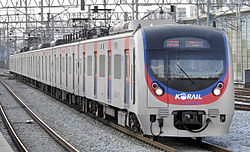
Key Facts
- Operator: Korail
- Line Served: Gyeongui-Jungang Line
- Manufacturer: Hyundai Rotem
- Service Period: 2009–present
- Maximum Speed: 110 km/h (68 mph)
- Primary Depot: Munsan
Technical Specifications and Performance
The Class 331000 is built for high-capacity urban commuting. The trains utilize a Toshiba COVO52-A0 IGBT-VVVF propulsion system. This technology uses Insulated Gate Bipolar Transistors (IGBT) to control the power supplied to the motors, allowing for smoother acceleration and better energy efficiency. The system employs IGBT 1C4M motors to achieve a power output of 4,400 kW (5,900 hp).
In terms of movement, the trains feature an acceleration rate of 3.0 km/(h⋅s) and a service deceleration of 3.5 km/(h⋅s), which can increase to 4.5 km/(h⋅s) during emergency braking. The electrical system operates on 25 kV 60 Hz AC, with power collected via a pantograph.
Physical Dimensions and Construction
The car bodies are constructed from steel, with specific batches featuring different exterior finishes. The standard dimensions for the units are:
- Car Length: 19,500 mm
- Width: 3,120 mm
- Height: 3,750 mm
- Track Gauge: 1,435 mm (Standard Gauge)

Train Formations and Car Types
The Class 331000 is organized into two distinct configurations depending on the specific service requirements of the line:
- Eight-car formation: Used by trains 331-01~331-13 and 331-23~331-27. The layout follows a TC-M-M'-T-T-M-M'-TC pattern.
- Four-car formation: Used by trains 331-14~331-22, primarily operating on the Seoul Station branch. The layout follows a TC-M'-M'-TC pattern.
To understand the technical makeup, it is helpful to identify the specific roles of each car type:
- TC car: Contains secondary power devices, air compressors, batteries, and the driver's cabin.
- M' car: Equipped with the pantograph, main transformer, controller, and motor.
- M car: Contains the motor and controller.
- T car: A trailer car (unpowered).

Evolution of the Batches
The development of the Class 331000 occurred in two primary stages to meet the expanding infrastructure of the Gyeongui-Jungang Line.
The First Batch (2009)
Introduced for the opening of the original Gyeongui Line, the first batch (trains 331-01 to 331-13) features smoother aluminum bodies. While they share a front-end design with the Class 321000, they are distinguished by LCD monitors installed on the sides of each car, positioned above the doors.
The Second Batch (2012–2014)
The second batch was produced to support the eastward extensions toward Yongsan station. These trains (331-14 to 331-27) utilize a standard ribbed stainless steel body. A notable interior difference is that the LCD displays are mounted on the top of each car rather than the sides. This batch includes the four-car sets used for branch line services and the eight-car sets that were either built as eight cars or extended from shorter configurations in 2014.
Interior and Safety Features
Passenger comfort and safety are prioritized through several design choices. The interior is finished in a white, fire-retardant material. For accessibility, the end cars are equipped with dedicated spaces for wheelchairs. Information is provided to passengers via TGIS (Train Information Guidance System) color displays, stop notifiers, and dead section notifiers.
Sustainability is integrated into the electrical design through regenerative braking. This system captures kinetic energy during deceleration and converts it back into electricity, reducing overall energy consumption and simplifying maintenance inspections. Additionally, the trains use electric door motors and LED headlights for improved visibility and reliability.
Summary of Technical Data
| Feature | Specification |
|---|---|
| Manufacturer | Hyundai Rotem |
| Traction System | Toshiba COVO52-A0 IGBT-VVVF |
| Power Output | 4,400 kW |
| Max Speed | 110 km/h |
| Voltage | 25 kV 60 Hz AC |
| Safety System | ATS (Automatic Train Stop) |
Frequently Asked Questions
What lines do the Class 331000 trains serve?
These trains primarily serve the Gyeongui-Jungang Line in South Korea.
How do the first and second batches differ in design?
The first batch features aluminum bodies with side-mounted LCD monitors, while the second batch uses ribbed stainless steel bodies with top-mounted LCD monitors.
What is the purpose of regenerative braking on these trains?
Regenerative braking reduces energy consumption by converting braking energy back into electricity and helps simplify the train inspection process.
Where are these trains maintained?
The Class 331000 trains are stored and maintained at the Munsan train depot.
Are there different train lengths available?
Yes, they operate in both eight-car formations for main line service and four-car formations for the Seoul Station branch.