King's Cross Station: A History of London's Iconic Gateway
Located in the London Borough of Camden, King's Cross is one of the city's most vital transport hubs. Managed and owned by Network Rail, this Category A station serves as a primary terminus for passengers traveling to the north and east of England, as well as Scotland. From its origins as a mid-19th-century industrial marvel to its current status as a modern architectural landmark, King's Cross has evolved alongside the growth of the British railway network.
Today, the station is a bustling interchange, connecting passengers to the London Underground and nearby terminals like St Pancras International and London Euston. Its unique blend of Victorian heritage and cutting-edge design makes it a point of interest for both commuters and tourists.
Key Facts
- Opened: 14 October 1852.
- Original Operator: Great Northern Railway (GNR).
- Platforms: 11 platforms, numbered 0 through 10.
- Annual Traffic: Reached 27.727 million entries and exits in 2024–25.
- Fare Zone: Located within London Fare Zone 1.
- Cultural Fame: Home to the fictional Platform 9¾ from the Harry Potter series.
Station History and Evolution
Early Years and the Great Northern Railway
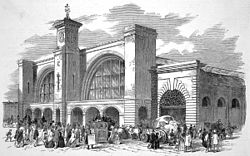
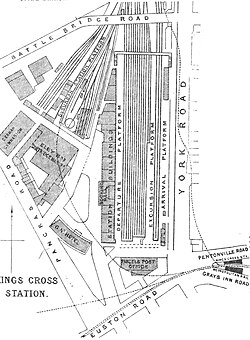
The station was constructed between 1851 and 1852 to serve as the London terminus for the Great Northern Railway (GNR). It was the fifth terminal built in London, replacing a temporary facility near Maiden Lane (now York Way) that had operated since August 1850. In its earliest days, the layout was far simpler than the sprawling complex seen today.
The Era of Steam and Transition
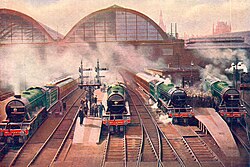
Throughout the early 20th century, the station transitioned through various ownerships. Following the railway grouping of 1923, it became part of the London and North Eastern Railway (LNER). This era solidified the station's role as the gateway to the East Coast Main Line, facilitating rapid travel to cities like York, Newcastle, and Edinburgh.
Modernization and Diesel Power
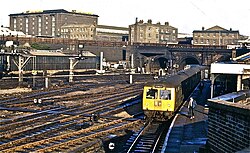
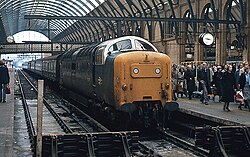
By the mid-20th century, under British Rail, the station saw the transition from steam to diesel and electric power. The 1960s and 70s were defined by the use of Class 55 'Deltic' locomotives, which became the principal express engines for the East Coast Main Line.
Architectural Transformation
The Great Remodelling
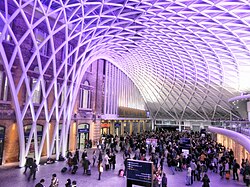
For decades, the station operated with a traditional concourse that eventually became overcrowded. In 2012, a massive refurbishment introduced a new western concourse. This project featured a striking steel roof engineered by Arup, described as a "reverse waterfall"—a white steel grid that swoops from the ground and cascades over the passengers.
![King's Cross following refurbishment in 2012. The steel structure of the roof, engineered by Arup, has been described as being "like some kind of reverse waterfall, a white steel grid that swoops up from the ground and cascades over your head".[65]](/images/04/36/0436146ae896976628aeca0a588304571884c2cf3bae3d458b91ebbb5d5c187a.jpg)
Current Layout and Facilities
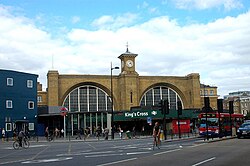
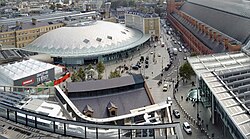
The modern station now integrates a spacious concourse with improved accessibility and cycle parking at platforms 0, 1, 8, and 9. The addition of Platform 0 provided much-needed capacity to handle the increasing volume of passengers.
Current Rail Services
King's Cross is currently served by five different Train Operating Companies (TOCs), providing a wide array of regional and long-distance services:
- London North Eastern Railway (LNER): Operates fast and semi-fast services to Leeds, York, Newcastle, and Edinburgh, with some extensions to Aberdeen.
- Govia Thameslink Railway: Manages the Great Northern route, including services to Cambridge and King's Lynn.
- Hull Trains: Provides direct links between London and Hull/Beverley.
- Grand Central: Operates services to Sunderland and Bradford Interchange.
- Lumo: A budget-focused service connecting London to Edinburgh and Glasgow.
Station Statistics Summary
| Metric | Detail |
|---|---|
| Station Codes | KGX, QQK (IATA) |
| DfT Category | A |
| Number of Platforms | 11 (0–10) |
| 2024–25 Annual Entry/Exit | 27.727 million |
| 2024–25 Interchange Traffic | 1.553 million |
Cultural Impact
Beyond its utility as a transport hub, King's Cross has become a global tourist destination due to its association with the Harry Potter series. The western departures concourse features a dedicated area for Platform 9¾, where fans can recreate the experience of boarding the Hogwarts Express.

Frequently Asked Questions
Why is there a Platform 0 at King's Cross?
Platform 0 was added as part of the station's remodelling to increase capacity and improve the flow of passengers, effectively adding an extra boarding point to the existing layout.
Which train companies operate from King's Cross?
The station is served by LNER, Govia Thameslink Railway, Hull Trains, Grand Central, and Lumo.
Is King's Cross station accessible?
Yes, the station is fully accessible and provides facilities for passengers with reduced mobility.
Where is the Harry Potter Platform 9¾ located?
The themed installation and shop are located in the western departures concourse of the station.
How many people use the station annually?
Usage has grown significantly in recent years, with 27.727 million entries and exits recorded for the 2024–25 period.