Edinburgh Waverley Station
Edinburgh Waverley (Scottish Gaelic: Waverley Dhùn Èideann) is the primary railway hub serving the city of Edinburgh, Scotland. Situated in a dramatic valley between the medieval Old Town and the 18th-century New Town, it stands as the second-busiest station in Scotland, trailing only Glasgow Central. As the northern terminus of the East Coast Main Line—spanning approximately 393 miles from London King's Cross—it serves as a critical gateway for both national and international travelers.
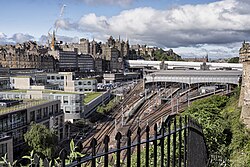
Key Facts
- Classification: DfT category A listed building (Category A).
- Ownership: Managed and owned by Network Rail.
- Capacity: Features 20 platforms to accommodate diverse rail traffic.
- Connectivity: Primary terminus for LNER, ScotRail, CrossCountry, Avanti West Coast, TransPennine Express, Lumo, and Caledonian Sleeper.
- Growth: Passenger numbers have grown significantly, reaching an estimated 22.755 million in 2024/25.
The Evolution of Waverley
Origins and the Nor Loch
The station's location was once the site of the Nor Loch, a "noxious lake" that separated Edinburgh's Old Town from the north. In the 1760s, the loch was drained to make way for the North Bridge and the development of the New Town. This created the valley that would eventually house the city's railway infrastructure.
The Era of Competing Railways
In the mid-19th century, three separate railway companies established termini at the North Bridge site: the North British Railway (opened June 22, 1846), the Edinburgh and Glasgow Railway (opened May 17, 1847), and the Edinburgh, Leith and Newhaven Railway (opened May 17, 1847). By 1854, these three stations were collectively referred to as "Waverley," named after the famous Waverley Novels by Sir Walter Scott.
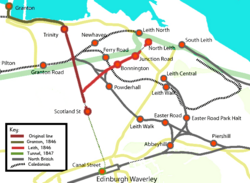
Consolidation and Victorian Grandeur
Between 1866 and 1868, the North British Railway acquired its rivals and demolished the original three stations to build the current Victorian structure. The station saw significant expansions in the late 19th century, most notably the addition of its iconic glass dome in 1897. Adjacent to the station, the North British Hotel opened in 1902; though it closed in 1988, it was reborn in 1991 as the luxury Balmoral Hotel.
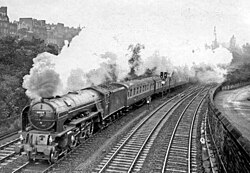
Modernization and Infrastructure
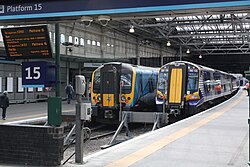
Waverley has undergone several major upgrades in the 21st century to maintain its efficiency. Between 2006 and 2007, the station saw the electrification of platforms 12 to 18. A significant aesthetic and functional improvement occurred between 2010 and 2012, when 34,000 square meters of old roofing materials were replaced with strengthened clear glass panels, flooding the concourse with natural light.
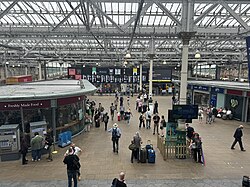
Further improvements from 2012 to 2014 included the installation of covered escalators at Waverley Steps, a widened Market Street entrance, and enhanced accessibility via new lifts and a dedicated drop-off point on Calton Road. Most recently, in 2019, platforms 5 and 6 were extended to better accommodate London North Eastern Railway (LNER) services.
Station Layout and Services
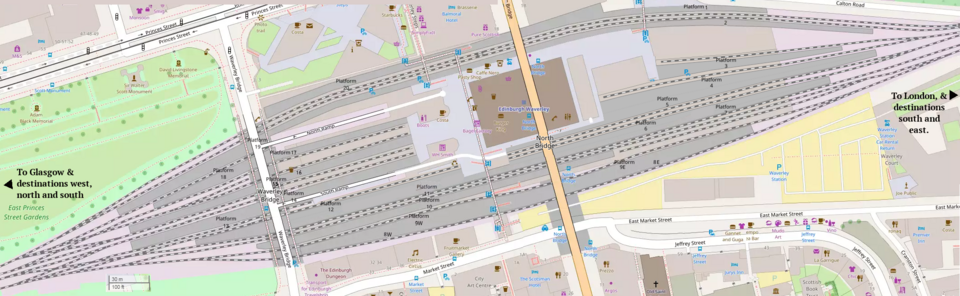
The station is strategically positioned beneath the North Bridge, with the majority of its footprint lying to the west of the bridge. The layout consists of two tracks on the north side and four tracks on the south side, totaling 20 platforms.
The station hosts a wide array of services, ranging from high-speed intercity trains to regional commuter lines. Key operators include LNER and Lumo for London services, ScotRail for regional connections to Glasgow, Aberdeen, and the Borders, and the Caledonian Sleeper for overnight travel to London Euston.
| Financial Year | Main Passengers | Interchange Passengers |
|---|---|---|
| 2020/21 | 2.958 million | 0.203 million |
| 2021/22 | 13.618 million | 0.860 million |
| 2022/23 | 18.213 million | 1.237 million |
| 2023/24 | 21.308 million | 1.466 million |
| 2024/25 | 22.755 million | 1.583 million |
Future Developments
To meet projected demand for 2048, Network Rail has proposed the Waverley Masterplan. This ambitious project, designed by Arup Group, envisions a new mezzanine level concourse above the main platforms. This would improve passenger flow, provide a link to the Waverley Mall, and feature plate glass walls offering panoramic views of the Old Town. Additionally, future tram extensions from Granton to the BioQuarter may include a direct lift connection to the station via North Bridge.
Frequently Asked Questions
Why is the station called Waverley?
The name was adopted around 1854, inspired by the Waverley Novels written by the renowned Scottish author Sir Walter Scott.
How many platforms does Edinburgh Waverley have?
The station currently operates with 20 platforms to handle its high volume of regional and long-distance traffic.
Which train companies operate out of the station?
Major operators include LNER, ScotRail, CrossCountry, Avanti West Coast, TransPennine Express, Lumo, and the Caledonian Sleeper.
What is the significance of the station's location?
It is situated in a valley between Edinburgh's Old Town and New Town, occupying the site where the Nor Loch once existed before being drained for urban development.
Is Edinburgh Waverley a protected building?
Yes, it is designated as a Category A Listed Building, recognizing its architectural and historical importance.