Kayapó People: Guardians of the Brazilian Amazon
The Kayapó (Portuguese: Caiapó) are an Indigenous people of Brazil, inhabiting a vast expanse of the Amazon basin across the states of Pará and Mato Grosso. Situated south of the Amazon River and along the Xingu River and its tributaries, they are often referred to as "the Xingu." They belong to the larger Mebêngôkre nation, a name meaning "people from the water's source." While the world knows them as Kayapó—a term used by neighboring groups—they refer to outsiders as Poanjos.
The Kayapó are renowned for their fierce protection of their ancestral lands and their deep integration with the rainforest ecosystem. Their identity is inextricably linked to the land, from the unique tubers they cultivate to the intricate body art that mirrors the natural world.
Key Facts
- Population: Estimated at 8,638 as of 2018.
- Territory: Over 11 million hectares of protected Neotropical forests and scrubland.
- Language: Kayapo language, part of the Jê language family.
- Subgroups: Includes the Xikrin, Gorotire, Mekranoti, and Metyktire.
- Dietary Staple: A specific type of sweet potato (caiapo) known to reduce insulin resistance in type 2 diabetics.
History and Migration
The Kayapó's history is marked by resilience and movement. In the 18th century, they first encountered Portuguese-Brazilian bandeirantes—explorers and frontiersmen seeking gold, precious stones, and Indigenous slaves—in the northeastern region of present-day São Paulo. To escape these incursions, the Kayapó migrated westward.
By the 1950s and 1960s, the Brazilian government sought to establish peace with the Kayapó, who were perceived as warlike. This period marked a transition toward increased contact, leaving most Kayapó today aware of and integrated with modern Brazilian society.
Geography and Social Structure
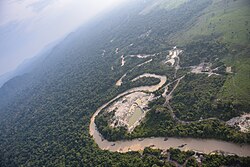
The Kayapó reside in scattered villages along the Xingu River in the eastern Amazon rainforest. These settlements typically consist of a dozen huts, with a central hut serving as the primary meeting place for men to discuss community governance and issues.
Their territory is one of the largest tropical protected areas globally, covering 11,346,326 hectares (28,037,380 acres). The landscape is a diverse mix of tropical rainforest savannah, river valleys, and small hills, providing a sanctuary for numerous endangered species.
Culture and Identity
Art and Body Painting
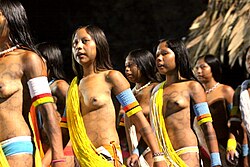
Visual identity is central to Kayapó culture. They utilize intricate black body painting, with patterns unique to each individual. This practice is rooted in the belief that ancestors learned life's ways from insects; by mimicking invertebrates, the Kayapó believe they can better communicate with the great spirit present in all things. Practically, the black paint provides camouflage for hunting, while red pigment applied to the legs leaves a trail on vegetation to help them navigate the dense jungle.
Social Distinctions and Beauty
Beauty is highly prized in Kayapó society, and a beautiful name is considered a sign of wealth. Naming ceremonies are significant events that may require the entire camp to relocate to find the necessary food and materials to honor the newborn's father. Additionally, Kayapó women are distinguished by a characteristic "V" formation shaved into their hair.
Language and Oratory
Speaking the Kayapo language (Jê family), the tribe places immense value on oratory. They refer to themselves as Kaben mei, or "those who speak beautifully." Depending on their history of contact with outsiders, varying levels of Portuguese are spoken among different subgroups.
Environmental Stewardship and Conflict
The Kayapó view the earth through a lens of traditional myth and cosmology. However, the last 30 years have seen intense conflict with mining and logging interests. In the village of Gorotire, an initial agreement with gold prospectors brought economic growth, improved housing, and better education. However, this came at a steep cost: mercury pollution decimated fish populations and contaminated waterways.
Socially, outside influence introduced alcohol and "conspicuous consumption," while limited medical access made the population vulnerable to new diseases. These pressures occasionally led to violent clashes with developers, including soy farmers and cattle ranchers.
The Fight Against the Belo Monte Dam
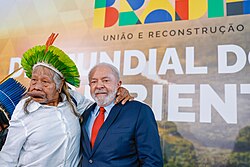
In 1987, the proposal of the Belo Monte Dam on the Xingu River threatened to displace 20,000 people. Under the leadership of Paulinho Paiakan, the Kayapó organized the Altamira Gathering. This global media event featured leaders like Tuíra, who famously confronted government engineers with a machete, and gained the support of rock star Sting, who later founded the Rainforest Foundation Fund in 1989.
Botany and Sustainable Agriculture
The Kayapó employ shifting cultivation, specifically the slash-and-burn technique. They clear small areas of forest for farming and then allow the land to lie fallow to replenish nutrients. This cycle supports various crops with different peak production windows:
| Crop Type | Peak Production Period |
|---|---|
| Sweet Potatoes | 4 to 5 years |
| Yams and Taro | 5 to 6 years |
| Manioc | 4 to 6 years |
| Papaya | 5 or more years |
Beyond these staples, the Kayapó utilize approximately 250 different food plants and 650 medicinal plants. They also maintain "war gardens"—hidden plots used as food reserves during times of scarcity. To further protect their resources, they have entered into conservation partnerships, such as a 1992 agreement with Conservation International Brazil to protect mahogany populations.
Frequently Asked Questions
What does the name "Kayapó" mean?
The name was given by neighboring tribes in the 19th century and means "those who look like monkeys," likely referring to a ritual where Kayapó men wear monkey masks.
How do the Kayapó protect the Amazon?
They use a combination of traditional land management, such as shifting cultivation, and political activism to fight against illegal logging, gold mining, and large-scale hydroelectric projects like the Belo Monte Dam.
What is the significance of their body painting?
Body painting serves both spiritual and practical purposes: it mimics insects to communicate with the great spirit and provides camouflage for hunting in the rainforest.
What is the "caiapo" sweet potato?
It is a tuber cultivated by the Kayapó that has gained international attention, including in Japan, for its ability to decrease insulin resistance in patients with type 2 diabetes.
Who are the Mebêngôkre?
Mebêngôkre is the autonym (the name they use for themselves) for the Kayapó people, meaning "people from the water's source" or "the men from the water hole."