Kach and the Political Legacy of Meir Kahane
The political trajectory of Meir Kahane and his party, Kach, represents one of the most controversial chapters in Israeli political history. From his arrival in Israel in 1971 to the eventual banning of his movements, Kahane's ideology centered on the expulsion of non-Jews and a strict interpretation of Jewish law, sparking intense legal and social battles over the boundaries of racism and democratic expression.
Early Political Ambitions and the Rise of Kach
Meir Kahane immigrated to Israel from the United States in September 1971. While he initially claimed his focus would be limited to Jewish education, he quickly pivoted toward political activism. He began organizing protests that advocated for the expulsion of most Arabs from Israel and the Palestinian territories. In 1972, the Jewish Defense League distributed leaflets in Hebron demanding a trial for the mayor regarding the 1929 Hebron massacre.
In 1973, Kahane founded a party known as "The League List." The party narrowly missed the 1% electoral threshold, receiving 12,811 votes (0.82%). Following this, the party was renamed Kach, derived from the Irgun motto "Rak Kach" ("Only thus"). Despite subsequent attempts in 1977 and 1981, the party failed to secure a seat in the Knesset, the Israeli parliament.
Entry into the Knesset and Legislative Conflict
Kach's profile rose in 1982 during the evacuation of Israeli settlers from the Sinai Peninsula. The government of Menachem Begin utilized Kahane as an intermediary to convince extremists in the settlement of Yamit to surrender.
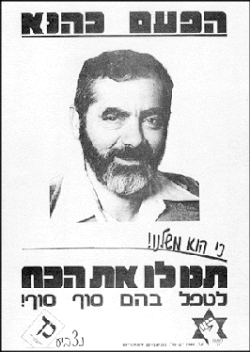
Before the 1984 elections, the Central Elections Committee (CEC) attempted to bar Kach on the grounds of racism. However, the Supreme Court reversed this decision, ruling that the Knesset Elections Law did not explicitly forbid parties based on racism, though it suggested the law be amended. In the 1984 elections, Kach won 1.2% of the vote (25,907 votes), granting Kahane a single seat in the Knesset.
Once in office, Kahane proposed legislation to revoke Israeli citizenship for non-Jews and ban sexual relations or marriages between Jews and Gentiles, citing the Mishneh Torah (the Code of Jewish Law compiled by Maimonides). His presence was marked by extreme isolation; fellow members boycotted his speeches, and he frequently referred to his colleagues as "Hellenists," a term for ancient Jews who assimilated into Greek culture.
The Legal Ban and the Split of the Movement
Following the Supreme Court's earlier suggestion, the Knesset amended the Elections Law to disqualify any party that incited racism or negated the democratic character of the state or the existence of Israel as the state of the Jewish people. Consequently, Kach was barred from the 1988 elections after the court deemed its actions "manifestly racist."
In response, some activists formed the Sicarii, a terrorist group that targeted Jewish left-wing figures with arson and graffiti.
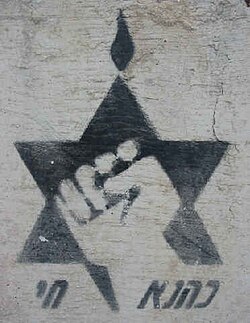
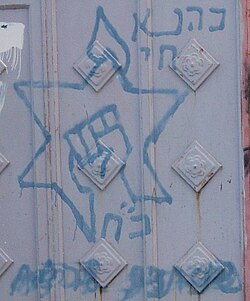
Meir Kahane was assassinated in New York City on November 5, 1990. His death led to a split in the movement. His son, Binyamin Ze'ev Kahane, led a breakaway faction called Kahane Chai based in Kfar Tapuach, while the original Kach remained under the leadership of Rabbi Avraham Toledano and later Baruch Marzel in Kiryat Arba.
Outlawing and Terrorist Designations
In 1994, the Israeli cabinet banned both Kach and Kahane Chai under 1948 anti-terrorism laws. This followed the groups' support for Baruch Goldstein, a Kach supporter who massacred 29 Palestinians at the Cave of the Patriarchs. Many leaders were subsequently held in administrative detention—imprisonment without formal indictment.
The United States also designated Kach as a terrorist organization, citing activities such as the attempted car bombing of a Palestinian girls' school in East Jerusalem and conspiracies to carry out assassinations. This designation remained until May 2022, when the U.S. removed the group from the list due to inactivity.
| Year | Event | Outcome/Detail |
|---|---|---|
| 1971 | Kahane immigrates to Israel | Initial focus on education, then political activism |
| 1973 | First election run | Ran as "The League List"; failed to meet 1% threshold |
| 1984 | Knesset Entry | Won 1.2% of vote; Kahane took one seat |
| 1988 | Electoral Ban | Disqualified for inciting racism under amended law |
| 1990 | Assassination | Meir Kahane killed in NYC; party splits into Kach and Kahane Chai |
| 1994 | Total Ban | Both groups banned by Israeli cabinet under anti-terrorism laws |
| 2022 | U.S. De-listing | Removed from U.S. terrorist list due to inactivity |
Key Facts
- Kach was founded by Meir Kahane and eventually won one seat in the 1984 Knesset elections.
- The party was barred from the 1988 elections after the Knesset amended the law to prohibit incitement to racism.
- The movement split into Kach and Kahane Chai following Meir Kahane's assassination in 1990.
- Both organizations were outlawed in Israel in 1994 following support for the Cave of the Patriarchs massacre.
- The U.S. designated the group as a terrorist organization until May 2022.
- Former followers have since integrated into other movements, including Lehava and the Otzma Yehudit party.
Frequently Asked Questions
Why was Kach banned from running in the 1988 elections?
Kach was disqualified by the Central Elections Committee because its aims and actions were found to be "manifestly racist," violating a new amendment to the Elections Law that prohibited incitement to racism.
What was the difference between Kach and Kahane Chai?
After Meir Kahane's death in 1990, the movement split. Kahane Chai was a breakaway faction led by his son, Binyamin Ze'ev Kahane, while Kach continued under leaders like Rabbi Avraham Toledano and Baruch Marzel.
What were Meir Kahane's primary legislative goals?
Kahane sought to revoke the Israeli citizenship of non-Jews and implement a ban on sexual relations and marriages between Jews and Gentiles, based on the Mishneh Torah.
How did the United States view the Kach movement?
The U.S. designated Kach as a terrorist organization for years, citing the use of explosives, threats of assassination, and the solicitation of funds for terrorism. This designation was lifted in May 2022 due to inactivity.
Who are some of the modern political successors to Kahanism?
Many former followers of Kahane became involved in the segregationist Lehava movement and the Otzma Yehudit political party, including figures such as Itamar Ben-Gvir and Baruch Marzel.