Jurchen Script: The Lost Writing System of the Jin Empire
The Jurchen script was a unique logographic writing system used to record the Jurchen language, the tongue of the people who established the powerful Jin Empire in northeastern China during the 12th and 13th centuries. While it served as a vital tool for administration and culture during the Jin era, much of its complexity remains a mystery to modern scholars, as the script has only been partially decoded.
Derived from the Khitan script—which itself drew inspiration from Chinese Han characters—the Jurchen writing system represents a fascinating chapter in the evolution of East Asian literacy. Although the Jin Dynasty eventually fell to the Mongols, the linguistic lineage of the Jurchen people continued, eventually evolving into the Manchu language.
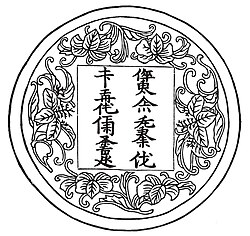
Key Facts
- Creator: Wanyan Xiyin (the "large script") and Emperor Xizong (the "small script").
- Period of Use: 12th to 16th century.
- Script Type: Logographic (using symbols to represent words or morphemes).
- Language: Jurchen, an ancestor to the Manchu language.
- Origins: Derived from the Khitan script and Chinese characters.
- Writing Direction: Left-to-right.
The Evolution of Jurchen Writing
The history of the script is divided into two primary developmental stages: the "large script" and the "small script." Following the Jurchen rebellion against the Khitan Liao dynasty and the subsequent establishment of the Jin dynasty in 1115, the Jurchens initially utilized the Khitan script.
In approximately 1119 or 1120, Wanyan Xiyin, a chancellor of the early Jin Empire, invented the first Jurchen script, known as the "large script," under the orders of Emperor Wanyan Aguda. Later, in 1138, the Xizong Emperor is credited with promulgating a second version known as the "small script," which saw its first official use in 1145.
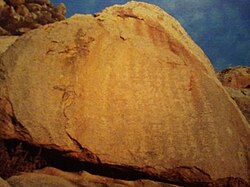
The Large vs. Small Script Debate
Scholars hold differing views on the relationship between these two scripts. One theory, proposed by Daniel Kane, suggests a script continuum. In this view, the "large script" refers to the earlier, more logographic stage (where characters represent whole words), while the "small script" represents a later, more phonetic stage where characters were used to express grammatical endings.
Alternatively, researcher Aisin-Gioro Ulhicun suggests they were two distinct systems. She argues the large script was modeled on Khitan large characters, while the small script was a short-lived phonographic system modeled on Khitan small characters that fell out of use following the murder of Emperor Xizong in a coup d'état.
Structure and Mechanics
The Jurchen script functioned through two main classes of characters:
- Ideographic characters: Used to record a complete word (typically one to three syllables) or the primary syllables of a word.
- Phonetic characters: Used to record specific sounds, such as a CV (consonant-vowel) syllable, a Vn ending, or a single vowel.
Over time, the script transitioned from purely ideographic to a combined ideographic-phonetic system. This meant that a character that once represented an entire word might eventually only represent the first syllable, with phonetic characters added to complete the word's sound.
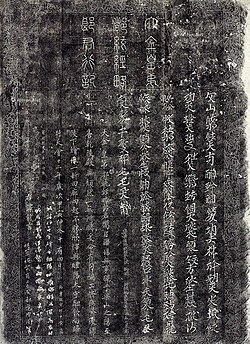
Archaeological Discoveries and Surviving Texts
Because most original Jurchen books were lost to history, modern knowledge relies heavily on epigraphic evidence—inscriptions found on monuments, seals, ceramics, and graffiti. Notable examples include the "Jin Victory Memorial Stele" (1185) and various inscriptions found in northern Korea.
Significant breakthroughs in manuscript discovery occurred in the late 20th century:
- 1968: E.I. Kychanov discovered a unique Jurchen manuscript on paper dating to 1217 among the Tangut papers in Leningrad.
- 1979: Chinese scholars discovered an eleven-page document in Xi'an, believed to be a copy of the Nüzhen zishu (Jurchen Character Book), a textbook written by Wanyan Xiyin.
Despite the destruction of the Jin dynasty by the Mongols, the script persisted in limited capacities during the Ming dynasty, appearing in dictionaries and on specific monuments, such as the Tyr Cliff stele in 1413.
Summary of Jurchen Script Characteristics
| Feature | Description |
|---|---|
| Primary Function | Logographic and Phonetic |
| Ancestry | Khitan script and Chinese characters |
| Key Textbooks | Nüzhen zishu (Jurchen Character Book) |
| Main Sources | Epigraphic inscriptions and rare paper manuscripts |
| Legacy | Preceded the Manchu script |
Frequently Asked Questions
Is the Jurchen script related to the Manchu script?
While the Jurchen language is an ancestor to the Manchu language, the Manchu script itself is not derived from the Jurchen script. Instead, Manchu was written first in Mongolian script and later in a new script derived from Mongolian.
What is the difference between the large and small Jurchen scripts?
The "large script" was the original version created around 1120, primarily using logograms (symbols for words). The "small script," introduced in 1138, is believed to have incorporated more phonetic elements to assist with grammar and pronunciation.
Why is the Jurchen script so difficult to read?
The script is difficult to decipher due to the scarcity of surviving samples. Most available evidence comes from stone inscriptions or very few surviving paper fragments, and the script's transition from logographic to phonetic usage adds complexity to its study.
Who invented the Jurchen script?
The first version, the large script, was invented by the chancellor Wanyan Xiyin under the orders of Emperor Wanyan Aguda. The small script is attributed to the Xizong Emperor.
What are the main types of Jurchen characters?
The characters are divided into ideographic characters, which represent whole words or word roots, and phonetic characters, which represent specific syllables or vowel sounds.