Jund Qinnasrīn: The Military District of Northern Syria
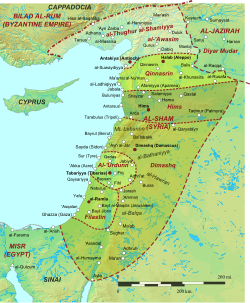
Following the Muslim conquest of Syria in the 7th century CE, the region was organized into several administrative divisions. Among these was Jund Qinnasrīn (Arabic: جُـنْـد قِـنَّـسْـرِيْـن), a term meaning "military district of Qinnasrin." As one of the five sub-provinces of Syria under the Umayyad and Abbasid Caliphates, it served as a critical strategic zone for the early Islamic state.
Initially, the district was governed from the city of Qinnasrin. However, as that city experienced a decline in wealth and population, the administrative capital was shifted to Aleppo, which became the central hub of the province.
Key Facts
- Definition: A military district (Jund) in northern Syria established during the early Caliphates.
- Capitals: Originally Qinnasrin, later moved to Aleppo.
- Founding: Attributed either to Mu'awiya I or his successor Yazid I.
- Major Cities: Included Aleppo, Manbij, Antioch, and Hama.
- Administrative Shift: Subdivided in 786 CE to create Jund al-'Awasim.
The Evolution of Jund Qinnasrīn
Founding and Umayyad Administration
The origins of Jund Qinnasrīn are linked to the separation of northern territories from Jund Hims. Historical accounts differ on the exact founder: some credit the first Umayyad caliph, Mu'awiya I, who established the district after defeating Hasan ibn Ali. Conversely, the 9th-century historian al-Biladhuri suggests that Yazid I founded the district by detaching the northern lands from Jund Hims.
During the Umayyad era, the district was structured into three primary districts: Antioch, Aleppo, and Manbij.
Abbasid Transitions and Subdivision
The geography of the district changed significantly under the Abbasid Caliphate. Following the conquests of southern Anatolia by caliph al-Mansur, the northern frontiers of Syria expanded. By 786 CE, during the reign of Harun al-Rashid, Jund Qinnasrīn had grown too large to manage as a single entity.
To improve administration, the territories of Antioch and the lands extending east toward Aleppo were split off to form a new district known as Jund al-'Awasim. For the remainder of the Abbasid period, Jund Qinnasrīn was reduced in size, consisting primarily of Aleppo (the capital), Qinnasrin, and the Sarmin territory.
Principal Towns and Urban Centers
By the year 985, the district encompassed a wide array of significant towns. These included major centers such as Manbij, Alexandretta, Hama, and Shaizar, as well as Ma'arrat al-Nu'man, Samosata, Jusiya, Wadi Butnan, Rafaniyya, Lajjun, Mar'ash, Qinnasrin, Balis, Suwaydiyya, and al-Tinat (which may have been the ancient city of Issus).
| Period | Capital | Key Territories/Districts | Notable Change |
|---|---|---|---|
| Early Umayyad | Qinnasrin | Antioch, Aleppo, Manbij | Established from Jund Hims |
| Late Umayyad/Early Abbasid | Aleppo | Northern Syria frontier | Capital moved to Aleppo |
| Post-786 Abbasid | Aleppo | Aleppo, Qinnasrin, Sarmin | Subdivided to form Jund al-'Awasim |
Governors of the Umayyad Period
The district was led by a series of governors who managed its military and civil affairs. Notable figures included:
- Sa'id ibn Malik ibn Bahdal (680–683)
- Zufar ibn al-Harith al-Kilabi (684), who briefly shifted allegiance to the anti-Umayyad caliph Ibn al-Zubayr.
- Aban ibn al-Walid ibn Uqba (684–685)
- Maslama ibn Abd al-Malik and Qurra ibn Sharik al-Absi (685–705/709)
- Marthad ibn Sharik al-Absi (709–?)
- Al-Walid ibn Hisham ibn al-Walid ibn Uqba and Hilal ibn Abd al-A'la (717–720)
- Bishr ibn al-Walid (720–724)
- Al-Walid ibn Qa'qa ibn Khulayd al-Absi (737–743)
- Yazid ibn Umar ibn Hubayra al-Fazari (743–744)
- Abd al-Malik ibn Kawthar al-Ghanawi and Majza'a ibn Kawthar ibn Zufar al-Kilabi (744–750), with Majza'a serving as the final Umayyad governor.
Frequently Asked Questions
What does the name Jund Qinnasrīn mean?
The term "Jund" refers to a military district, and "Qinnasrīn" is the name of the ancient town after which the district was named. Therefore, it means the "military district of Qinnasrin."
Why was the capital moved from Qinnasrin to Aleppo?
The capital was moved because the city of Qinnasrin suffered a decline in both its population and its overall wealth, making Aleppo a more viable administrative center.
Who founded Jund Qinnasrīn?
There are two primary historical views: some sources attribute its founding to the first Umayyad caliph, Mu'awiya I, while the historian al-Biladhuri attributes it to his successor, Yazid I.
What happened to the district in 786 CE?
Due to the expansion of the northern frontiers following conquests in southern Anatolia, the district became too large. Under caliph Harun al-Rashid, it was subdivided, and the territories of Antioch and lands east of Aleppo were separated to form Jund al-'Awasim.
Which cities were part of the district by 985 CE?
By 985, the district included Aleppo, Manbij, Alexandretta, Hama, Shaizar, Ma'arrat al-Nu'man, Samosata, Jusiya, Wadi Butnan, Rafaniyya, Lajjun, Mar'ash, Qinnasrin, al-Tinat, Balis, and Suwaydiyya.