July CrisisWorld War IGavrilo PrincipArchduke Franz FerdinandAustro-Hungarian Empire

July Crisis 1914: The Diplomatic Collapse That Sparked World War I

July Crisis 1914: The Diplomatic Collapse That Sparked World War I The July Crisis was a rapid sequence of diplomatic and military escalations among Europe's great powers in mid-1914. Wha...

July Crisis 1914: The Diplomatic Collapse That Sparked World War I

The July Crisis was a rapid sequence of diplomatic and military escalations among Europe's great powers in mid-1914. What began as a regional conflict in the Balkans spiraled into a global catastrophe, resulting in the outbreak of World War I. This descent into war was driven by a volatile mix of nationalist fervor, rigid military planning, and a complex web of mutual defense alliances.

The crisis was triggered on June 28, 1914, when Gavrilo Princip, a Bosnian Serb nationalist, assassinated Archduke Franz Ferdinand, the heir to the Austro-Hungarian throne, and his wife, Sophie. This event acted as a catalyst for leaders who were already navigating deep-seated ethnic tensions and geopolitical rivalries.
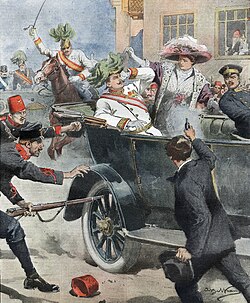
Illustration of the assassination in the Italian newspaper La Domenica del Corriere, 12 July 1914

Key Facts

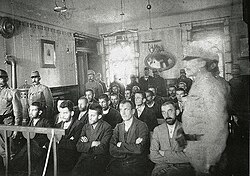
The accused in court. Front row, from left: 1. Trifko Grabež, 2. Nedeljko Čabrinović, 3. Gavrilo Princip, 4. Danilo Ilić, 5. Miško Jovanović.
  • Trigger Event: The assassination of Archduke Franz Ferdinand on June 28, 1914.
  • The "Blank Cheque": Germany's unconditional promise to support Austria-Hungary in any action against Serbia.
  • The Schlieffen Plan: Germany's military strategy to avoid a two-front war by quickly defeating France via Belgium before fighting Russia.
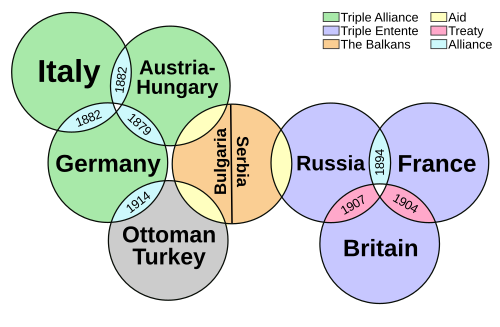
  • Key Alliances: The Central Powers (Germany, Austria-Hungary) versus the Triple Entente (France, Russia, Britain).
  • Timeline: The crisis lasted roughly five weeks, from the assassination in late June to the general declarations of war in early August.

The Road to Escalation: From Sarajevo to Vienna
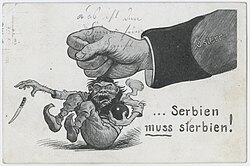
Austro-Hungarian postcard made after the assassination of Archduke Ferdinand depicting an Austrian fist crushing an ape-like caricature of a Serbian holding a bomb and dropping a knife, and stating "Serbia must die!" (Sterben purposefully misspelled as sterbien to make it rhyme with Serbien.)

Following the assassination, Austria-Hungary viewed the event as an opportunity to crush Serbian support for Yugoslav nationalism—the movement for South Slavic unity—which Vienna saw as an existential threat to its multi-ethnic empire.
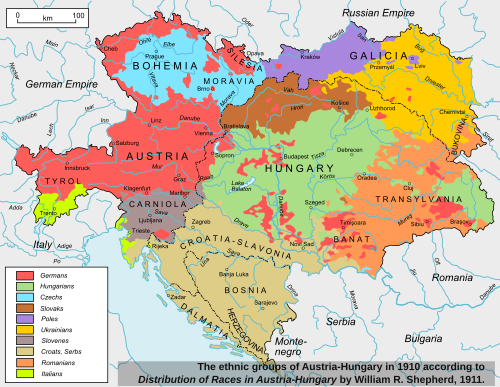
Map of ethnic groups in Austria-Hungary in 1910. Austro-Hungarian leaders believed that irredentism by ethnic Croats and Serbs, abetted by their co-ethnics in Serbia, was an existential threat to the Empire.

However, Austria-Hungary feared the intervention of Russia, Serbia's primary protector. To ensure security, Vienna sought a guarantee from Germany. Berlin provided what became known as the "blank cheque," promising full support regardless of the outcome. While Germany urged a swift strike to keep the conflict localized, Austro-Hungarian leaders spent weeks deliberating, delaying military action until they could achieve full mobilization.

The cartoon "Der Stänker" ("The Troublemaker", literally "The Stinker"), published in the German magazine Kladderadatsch on 9 August 1914, portrays a personified Serbia as the instigator of the July Crisis[a]

The Ultimatum and Serbian Response

On July 23, Austria-Hungary delivered a harsh ultimatum to Serbia, designed to be rejected. Despite Serbia's attempts to accept most of the terms, Austria-Hungary declared war on July 28, 1914. The first shots were fired by the Austro-Hungarian monitor SMS Bodrog, which bombarded Belgrade.
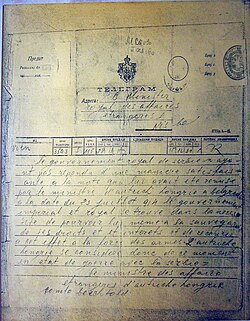
Austria-Hungary's telegram to the Kingdom of Serbia declaring war, 28 July 1914

The Domino Effect: Mobilization and Alliances

Emperor Franz Joseph was 84 years old in 1914. Though disturbed by the murder of his heir and nephew, Franz Joseph largely left decision-making during the July Crisis to foreign minister Leopold Berchtold, army chief of staff Franz Conrad von Hötzendorf, and the other ministers.[27]

The declaration of war set off a chain reaction across Europe. Russia, committed to supporting Serbia, began a partial mobilization of its forces. This move alarmed Germany, whose military leadership, led by Helmuth von Moltke and Erich von Falkenhayn, viewed Russian mobilization as a justification for a preventive war.
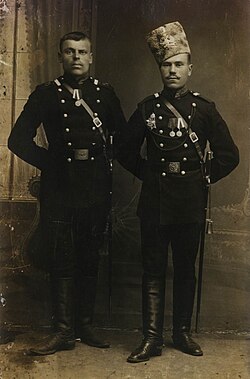
Non-commissioned officers of the Imperial Russian Army, 24 July 1914

The German Military Gamble

German strategists were bound by the Schlieffen Plan, a rigid operational blueprint. To avoid fighting France and Russia simultaneously, Germany planned to knock France out of the war quickly by invading through neutral Belgium. Moltke argued that any diplomatic delay threatened the element of surprise needed to seize the Belgian fortress of Liège.
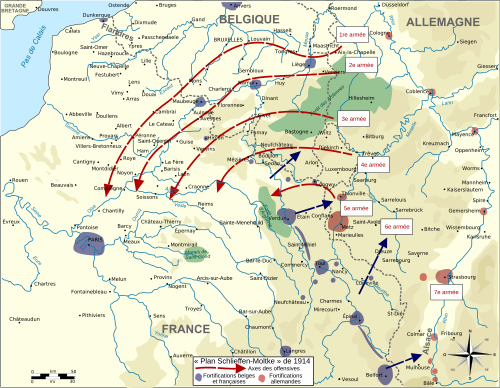
Map depicting the Schlieffen Plan. Germany believed that, in the event of war with France and Russia, the German path to victory would be to quickly defeat France before turning to fight Russia. The need for a quick resolution in the Western Front prompted German plans to avoid French defensive fortifications (depicted here as blue areas) by maneuvering north and violating Belgian neutrality.

The Final Collapse of Peace

By July 30, Russia ordered general mobilization. Germany responded by declaring war on Russia on August 1 and France on August 3. The invasion of Belgium on August 4 prompted Great Britain, which had guaranteed Belgian neutrality, to declare war on Germany.
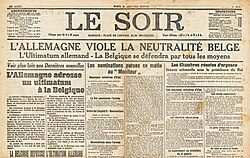
"Germany Violates Belgian Neutrality": Headline in Le Soir, 4 August 1914

Summary of Major Power Positions

Wilhelm II of Germany was known for his impetuous personality, described by one scholar as "not lacking in intelligence, but he did lack stability, disguising his deep insecurities by swagger and tough talk."[33]
Strategic Positions During the July Crisis
Country Primary Goal Key Strategy/Action Outcome
Austria-Hungary Eliminate Serbian nationalism Issued harsh ultimatum; declared war July 28 Triggered general European war
Germany Support ally; avoid two-front war "Blank Cheque"; Schlieffen Plan Invaded Belgium and France
Russia Protect Serbia; maintain prestige General mobilization July 30 Entered war against Central Powers
France Support Russia; counter Germany Plan XVII (all-out counter-offensive) Engaged in Battle of the Frontiers
Britain Maintain balance of power Defended Belgian neutrality Declared war August 4

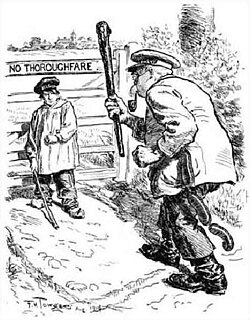
British satirical magazine Punch depicted Belgium as a scrappy youth blocking the passage of elderly, bullying Germany, August 1914

Frequently Asked Questions
European diplomatic alignments before the war. Germany and the Ottoman Empire allied after the outbreak of war.
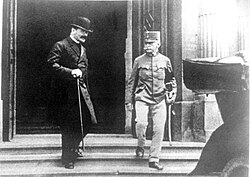
Hungarian Prime Minister Tisza and Chief of the Army General Staff Hötzendorf in Vienna, 15 July 1914
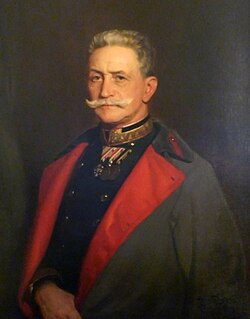
Franz Conrad von Hötzendorf, Chief of the General Staff of the Austro-Hungarian Army from 1906 to 1917, determined the earliest that Austria-Hungary could declare war was 25 July.
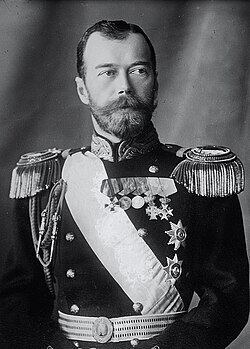
Tsar Nicholas II of Russia
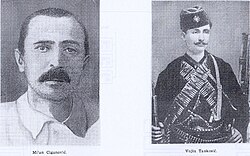
Ciganović and Tankosić, Point 7
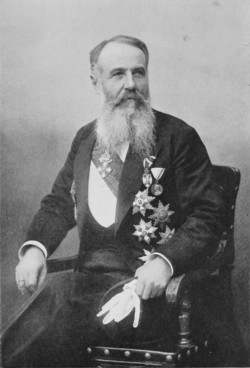
Nikola Pašić, Prime Minister of Serbia
Map of the Kingdom of Serbia in 1913
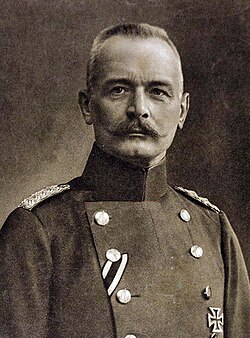
Erich von Falkenhayn, Prussian Minister of War from 1913 to 1914, urged an attack on Russia.
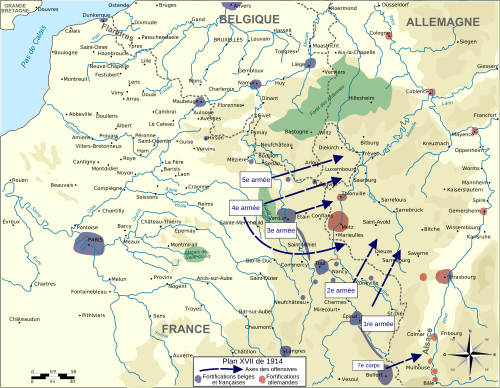
French strategists had approved Plan XVII in May 1913 to be implemented in the event of a war between France and Germany. It envisioned an all-out counter-offensive to meet a German attack. The actual implementation of Plan XVII in five phases begun on 7 August, now known as the Battle of the Frontiers, resulted in a French defeat.
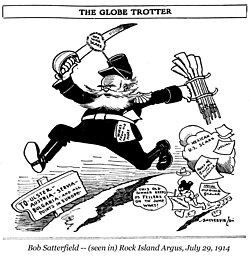
Cartoon titled "The Globe Trotter" in U.S. newspaper Rock Island Argus on 29 July 1914 depicting "General War Scare" running from resolved US-Mexico tension to "all points in Europe"
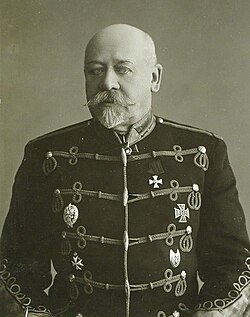
Vladimir Sukhomlinov, Minister of War of the Russian Empire, insisted a partial mobilisation was impossible for Russia.
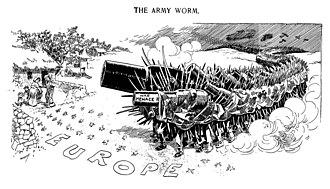
Cartoon titled "The Army Worm" in the US newspaper Chicago Daily News depicting "War Menace" threatening the people of Europe, 1914
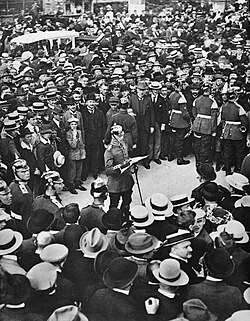
A Berlin crowd listens as a German officer reads Wilhelm II's order for mobilisation, 1 August 1914.
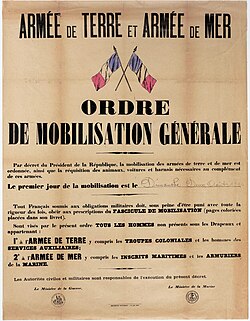
"General mobilization order" poster dated August 2, 1914, held by the French National Archives.
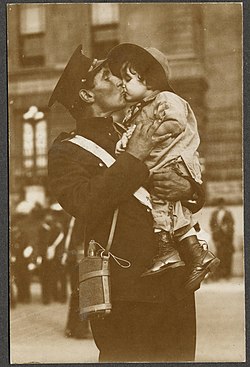
A soldier of the Canadian Expeditionary Force before sailing from Quebec to Britain on 21 August 1914, less than two months after the assassination in Sarajevo

What was the "blank cheque"?

The "blank cheque" was Germany's unconditional promise of military and diplomatic support to Austria-Hungary, which encouraged Vienna to take a hardline stance against Serbia without fearing isolation.

Why did the assassination lead to a world war instead of a local conflict?

A complex system of mutual defense alliances meant that a conflict between Austria-Hungary and Serbia automatically drew in Russia (Serbia's ally) and Germany (Austria-Hungary's ally), which in turn brought in France and Great Britain.

What was the significance of the Schlieffen Plan?

The Schlieffen Plan dictated that Germany must defeat France quickly by invading through neutral Belgium before turning its army east to fight Russia. This violation of Belgian neutrality was the primary reason Great Britain entered the war.

Did any leaders try to stop the war?

Yes, there were attempts. Kaiser Wilhelm II had second thoughts on July 26, and Chancellor Bethmann Hollweg later urged Austria-Hungary to accept Serbian terms on July 30 to avoid a general European war, but these efforts came too late to stop the military momentum.

Why was Russian mobilization so critical?

In 1914, mobilization was seen as an act of war. Because Russian mobilization was slow, Germany felt it had to attack immediately to avoid being crushed by the Russian "steamroller" once it was fully prepared.

References

  1. (1) Britain, France, and Russia sit on one side of the table while Italy, Germany, Austria, and Serbia sit on the other. Serbia's neighbours hold their noses in reaction to the former's foul smells, saying (every five minutes), "This really can't go on any longer."
  2. French: Crise de juillet; German: Julikrise; Hungarian: Júliusi válság; Russian: Июльский кризис; Serbian: Јулска криза
  3. Some German leaders believed that growing Russian economic power would change the balance of power between the two nations, that a war was inevitable, and that Germany would be better off if a war happened soon.[1]
  4. The Russian preparations for mobilization have long been described as a "partial mobilization", but access to archives which became available after the fall of the Soviet Union show that they were not, in fact, a "partial mobilization" but simply various moves which were intended to make a possible future mobilization more efficient.[3]
  5. Previously, the German General Staff had predicted that Russian mobilization in the east would be slower than that of France, Russia's ally to the west; they anticipated that any conflict with Russia would involve first attacking France through Belgium (to avoid French fixed defenses), quickly defeating them, and then turning to face Russia in the east.