Julie Eisenhower: A Life of Public Service and Family Legacy
Following her time in the public eye, Julie Eisenhower settled in Berwyn, Pennsylvania, where she dedicated her life to literature, civic duty, and the preservation of her family's complex historical legacy. Her journey after the White House is marked by a commitment to supporting at-risk youth and ensuring that the history of her father, Richard Nixon, is preserved within the official record of the United States.
Key Facts
- Civic Leadership: Served as Chair of the President's Commission on White House Fellowships (2002–2006).
- Youth Advocacy: Spent over 20 years on the board of Jobs for America's Graduates.
- Historical Preservation: Successfully advocated for the Nixon Library to join the National Archives system in 2007.
- Literary Work: Authored books including Pat Nixon: The Untold Story and Going Home to Glory.
- Recognition: Named a Distinguished Daughter of Pennsylvania for her civic contributions.
Civic Contributions and Professional Leadership
Julie Eisenhower has maintained a robust record of community service, with a particular focus on helping marginalized young people. For more than two decades, she served on the board of directors for Jobs for America's Graduates, a national organization dedicated to helping students graduate high school and successfully transition into their first professional roles.
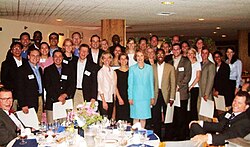
Her leadership extended to the federal level from 2002 to 2006, when she served as the Chair of the President's Commission on White House Fellowships. This program is designed to foster leadership skills in the nation's most exceptional young adults by placing them within the federal government.
Literary Pursuits and Board Memberships
An accomplished writer, Julie authored Pat Nixon: The Untold Story and co-wrote the memoir Going Home to Glory; A Memoir of Life with Dwight D. Eisenhower alongside her husband, David Eisenhower. Additionally, she remains active in the Richard Nixon Foundation, where she serves as a member of the board.
Navigating Family Loss and Legacy
The 1990s were a period of significant personal loss for Julie. She was present with her family when her mother passed away from lung cancer on June 22, 1993, followed by her father's death ten months later in April 1994. These events left Julie and her sister with a vast archive of their father's personal diaries, tapes, and binders.
This inheritance led to several public and legal challenges. Julie has been vocal about her distaste for certain cinematic adaptations of the presidency, including Oliver Stone's film Nixon, which she believed provided young viewers with a "twisted sense of history." This sentiment was echoed by Diane Disney Miller, who wrote to Julie and her sister stating that the film did a grave disservice to the family and American history.
Legal Battles and the Nixon Library
Julie's efforts to manage her father's legacy involved several legal hurdles. In 1999, the U.S. Department of Defense attempted to prevent her from testifying in a legal battle regarding federal compensation for papers and tapes seized during her father's resignation. Later, she and her sister engaged in a legal dispute over approximately $19 million left by Bebe Rebozo for the Richard Nixon Library and Birthplace Foundation. While the sisters disagreed on whether the funds should be overseen by a family-affiliated group or the library's board, the matter was eventually settled.
One of Julie's primary goals was the integration of the Nixon Library into the National Archives and Records Administration (NARA) system. She believed that being part of the official continuum of presidents would help historians view her father in a more balanced light. Her advocacy was successful, and the library officially joined the system in July 2007.
Political Engagement and Personal Milestones
While her family has a long history of supporting the Republican Party, Julie's political contributions have occasionally diverged. In 2008, she donated $2,300 to Barack Obama during the Democratic primary. However, she returned to supporting Republican candidates in subsequent cycles, including Mitt Romney in 2012, and Donald Trump in 2016, 2020, and 2024.
In recent years, Julie has continued to honor her parents' memories, celebrating her mother's centennial birthday in 2012 and opening a holiday exhibit at the Nixon Library in 2013.
| Category | Detail |
|---|---|
| Public Service | Chair, President's Commission on White House Fellowships (2002-2006) |
| Youth Advocacy | Board Member, Jobs for America's Graduates (20+ years) |
| Major Achievement | Integration of Nixon Library into National Archives (2007) |
| Honors | Distinguished Daughter of Pennsylvania |
| Authorship | Pat Nixon: The Untold Story; Going Home to Glory |
Frequently Asked Questions
What was Julie Eisenhower's role with the White House Fellows?
From 2002 to 2006, Julie Eisenhower served as the Chair of the President's Commission on White House Fellowships, a program that develops leadership in exceptional young adults.
Why did Julie Eisenhower want the Nixon Library to join the National Archives?
She believed that by joining the official system of Presidential Libraries, her father would be seen as part of the continuum of presidents, which she felt would encourage historians to view him in a less negative light.
What books has Julie Eisenhower written?
She wrote Pat Nixon: The Untold Story and co-authored the memoir Going Home to Glory; A Memoir of Life with Dwight D. Eisenhower with her husband, David Eisenhower.
Did Julie Eisenhower always support the Republican Party?
While primarily supporting Republicans—including Mitt Romney and Donald Trump—she notably donated $2,300 to Barack Obama during the 2008 Democratic primary.
What was the nature of the legal dispute between Julie and her sister?
The sisters disagreed over the management of approximately $19 million left by Bebe Rebozo for the Richard Nixon Library and Birthplace Foundation, specifically whether the funds should be controlled by the library's board or a family-affiliated group.