The Botanical Legacy of Joseph Pitton de Tournefort
In the history of biological science, few figures have had as profound an impact on how we organize the natural world as Joseph Pitton de Tournefort. A French botanist whose work shaped the study of plants for decades, Tournefort is best remembered for providing one of the first clear definitions of the genus—a taxonomic rank used to group species of closely related organisms.
Early Life and Academic Career
Born on 5 June 1656, in Aix-en-Provence, Kingdom of France, Tournefort was initially destined for a life in the Church. He received his early education at a Jesuit convent, but the death of his father changed his trajectory, allowing him to pursue his passion for botany. After spending two years collecting plant specimens, he moved on to study medicine at Montpellier.
His academic ascent led him to Paris, where in 1683, he was appointed as a professor of botany at the Jardin des Plantes. During his tenure, he conducted extensive botanical collections throughout Western Europe, with a particular focus on the Pyrenees mountain range.
Scientific Expeditions and Travels
Between 1700 and 1702, Tournefort embarked on significant expeditions to the Levant. His travels took him through the islands of Greece and to Constantinople, reaching the borders of the Black Sea, Armenia, and Georgia. These journeys were not solitary endeavors; he was accompanied by the German botanist Andreas Gundelsheimer and the artist Claude Aubriet, who documented the findings.
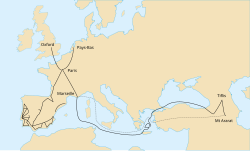
Tournefort's travels were essential to his scientific output, providing the raw data and specimens necessary to build his influential classification systems. His observations during these years would eventually form the basis of his posthumous writings.
Contributions to Botanical Science
Classification and the Concept of Genus
Tournefort's most influential work was published in 1694, titled Éléments de botanique, ou Méthode pour reconnaître les Plantes. This work was later translated into Latin as Institutiones rei herbariae. While his classification system was considered "artificial"—meaning it relied on specific, chosen characteristics rather than the complex evolutionary relationships used in modern systematics (the study of the diversification of living forms)—it was remarkably successful.
Although his method neglected certain important divisions established by earlier botanists, such as the separation of monocots and dicots, the text was so well-structured and clearly written that it became the standard for botanists for nearly fifty years. He is frequently credited with establishing a clear distinction between the genus and the species, even though earlier scientists like Kaspar Bauhin had explored similar concepts.
Terminology and the Herbarium
Beyond classification, Tournefort made lasting contributions to scientific language. He is credited with the invention of the word herbarium to describe a collection of preserved plant specimens. Prior to his usage, such collections were often referred to by various names, such as Hortus siccus.
Death and Posthumous Recognition
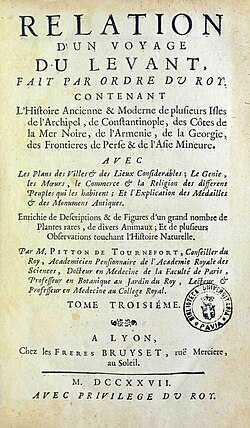
Tournefort's life came to an abrupt end in Paris when he was killed by a carriage. In honor of his contributions, the road where the accident occurred was named Rue de Tournefort in the 5ème arrondissement. Following his death, his detailed descriptions of his travels through the Levant were published in the work Relation d'un voyage du Levant.
His scientific legacy continues through his massive collection of 6,963 specimens. Originally housed in the Jardin du Roi in Paris, this collection is now preserved as part of the Muséum national d'histoire naturelle. Furthermore, his name lives on in the botanical world through the genus Pittoniotis, a group of flowering plants from South America named in his honor in 1858.
Key Facts
- Born: 5 June 1656, Aix-en-Provence, France.
- Died: 28 December 1708, Paris, France.
- Major Achievement: Provided a clear definition of the plant genus.
- Key Publication: Éléments de botanique (1694).
- Terminology: Credited with the term "herbarium."
- Legacy: His herbarium contains 6,963 specimens.
Summary of Life and Work
| Category | Details |
|---|---|
| Profession | Botanist and Professor |
| Alma Mater | University of Paris |
| Primary Institution | Jardin des Plantes, Paris |
| Notable Pupil | Charles Plumier |
| Scientific Focus | Plant classification and taxonomy |
Frequently Asked Questions
What was Tournefort's most significant contribution to botany?
His most significant contribution was making a clear and functional definition of the genus, which helped standardize how plants are categorized.
Why was his classification system so widely used despite being "artificial"?
While his system did not account for all biological divisions, it was exceptionally well-written, clearly structured, and provided valuable information on individual species, making it highly practical for botanists.
What is a herbarium?
A herbarium is a collection of preserved plant specimens used for scientific study. Tournefort is credited with popularizing this specific term.
Where can his plant collection be found today?
His collection of nearly 7,000 specimens is currently held at the Muséum national d'histoire naturelle in Paris.
How did Tournefort die?
He died in Paris after being struck by a carriage; the street where this occurred is now known as Rue de Tournefort.