Joseph MacDonagh: The Life and Political Struggle of a Sinn Féin TD
Joseph Michael MacDonagh was a pivotal figure in the early 20th-century Irish struggle for independence. A dedicated member of Sinn Féin, MacDonagh's life was defined by his commitment to Irish sovereignty, his role in revolutionary governance, and his unwavering opposition to the Anglo-Irish Treaty.
Early Life and Family Background
Born on May 18, 1883, in Cloughjordan, County Tipperary, Joseph was raised in an environment of education and patriotism. His parents, Joseph MacDonagh and Mary Parker, were both national schoolteachers. Joseph received his early education at his father's school in Cloughjordan before attending Rockwell College.
The MacDonagh family was deeply entwined with the Irish revolutionary spirit. Joseph's brothers included John MacDonagh, who became a film director, and Thomas MacDonagh, a prominent leader of the 1916 Easter Rising who was subsequently executed.
Political Ascent and Revolutionary Governance
MacDonagh's formal entry into politics occurred during the 1918 general election, where he was elected unopposed as a Sinn Féin Member of Parliament (MP) for the Tipperary North constituency. This election marked a turning point in Irish history, as Sinn Féin MPs chose to ignore the Parliament of the United Kingdom.
In January 1919, these MPs established Dáil Éireann (the revolutionary parliament of Ireland) at the Mansion House in Dublin. Although MacDonagh was a member, he was unable to attend the initial sessions due to his imprisonment.
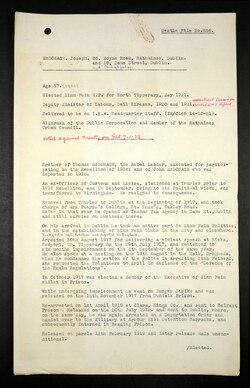
His political influence expanded between 1920 and 1922, during which time he served as an alderman for the Dublin Corporation as well as the Rathmines and Rathgar Urban District Council. In the 1921 elections, he was again elected unopposed, this time as a Teachta Dála (TD)—a member of the Dáil—representing the Tipperary Mid, North and South constituency.
Economic Warfare and the Anglo-Irish Treaty
Beyond legislative duties, MacDonagh took an active role in economic resistance. He served as the Director of the Belfast Boycott from 1920 to 1921, a strategic effort to boycott goods imported into the south of Ireland from Ulster.
The signing of the Anglo-Irish Treaty created a deep rift within the independence movement. MacDonagh stood firmly against the agreement and voted against its adoption. Despite this internal conflict, he was re-elected as an anti-Treaty Sinn Féin TD in the 1922 general election. However, adhering to his principles, he refused to take his seat in the Dáil.
Death and Legacy
Joseph MacDonagh's life came to a premature end at the age of 39. While on hunger strike, he suffered a burst appendix. He passed away on December 25, 1922, in County Tipperary.
Key Facts
- Born: May 18, 1883, Cloughjordan, County Tipperary.
- Political Party: Sinn Féin.
- Key Roles: MP for Tipperary North (1918); TD for Tipperary Mid, North and South (1921).
- Notable Action: Director of the Belfast Boycott (1920–1921).
- Stance: Opposed the Anglo-Irish Treaty.
- Death: December 25, 1922, resulting from a burst appendix during a hunger strike.
| Period | Position | Constituency/Body |
|---|---|---|
| 1918 – 1921 | MP (Sinn Féin) | Tipperary North |
| 1920 – 1922 | Alderman | Dublin Corporation / Rathmines and Rathgar UDC |
| 1921 – 1922 | Teachta Dála (TD) | Tipperary Mid, North and South |
| 1922 | Anti-Treaty TD | Tipperary Mid, North and South |
Frequently Asked Questions
Who was Joseph MacDonagh?
Joseph MacDonagh was an Irish Sinn Féin politician and Teachta Dála who served the people of Tipperary and was a staunch opponent of the Anglo-Irish Treaty.
What was the Belfast Boycott?
The Belfast Boycott (1920–1921) was an attempt to boycott goods from Ulster that were being imported into the south of Ireland, with MacDonagh serving as its Director.
How was Joseph MacDonagh related to the 1916 Rising?
He was the brother of Thomas MacDonagh, one of the leaders of the 1916 Easter Rising who was executed by British forces.
Why did Joseph MacDonagh not take his seat in the Dáil in 1922?
MacDonagh was an anti-Treaty Sinn Féin TD; because he opposed the Anglo-Irish Treaty, he refused to recognize the legitimacy of the parliament formed under its terms.
What caused the death of Joseph MacDonagh?
He died on December 25, 1922, from the effects of a burst appendix while he was on a hunger strike.