Josep Maria Subirachs: The Visionary Sculptor of Barcelona
Josep Maria Subirachs i Sitjar (1927–2014) was a towering figure in late 20th-century Spanish art. A versatile master of sculpture and painting, Subirachs is perhaps most famous for his bold and often controversial contributions to the Sagrada Família in Barcelona. His work is characterized by a deep commitment to public accessibility, believing that art loses its purpose if it is not available to the general spectator.
Throughout his career, Subirachs navigated a diverse array of styles, ranging from Expressionism and Abstract art to new figuration and Mediterranean styles. His ability to integrate sculptural forms into architectural spaces reflected a lifelong passion for architecture, even though his humble beginnings led him toward the artisanal path of sculpture.
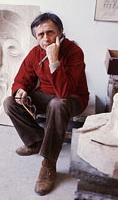
Key Facts
- Most Famous Work: The Passion Façade of the Sagrada Família.
- Artistic Philosophy: Believed art should be placed in public spaces to be accessible to everyone.
- Education: Studied under Enric Monjo and Enric Casanovas; later studied in Paris.
- Key Influence: Influenced by the English sculptor Henry Moore and the Noucentista style.
- Legacy: Honored with the asteroid 134124 Subirachs.
Early Life and Artistic Evolution
Born in the Poblenou neighborhood of Barcelona to a dye factory worker and his wife, Subirachs grew up in a humble environment. While he dreamed of becoming an architect, he lacked the financial resources to pursue formal architectural studies. However, his father encouraged his creative instincts, urging him to experiment with negative and reverse perspectives in his drawings to stimulate his imagination.
Subirachs' professional journey began at age fourteen as an apprentice in a gilder's workshop. He spent years mastering various artisanal trades, working as a decorator, mechanic, and advertising illustrator. His formal artistic training took place between 1942 and 1947 under sculptor Enric Monjo, complemented by evening classes at the Escola Superior de Belles Arts de Barcelona. He was later influenced by Enric Casanovas, who introduced him to Noucentisme, a Catalan cultural movement that sought to return to classical order and harmony.
The Postectura Group and International Influence
In 1950, Subirachs co-founded the Postectura group. This collective viewed itself as an heir to Cubism and Purism, aiming to humanize art through a constructive style derived from the influence of Paul Cézanne. His horizons expanded in 1951 when a scholarship from the Cercle Maillol took him to Paris, where he encountered avant-garde artists and the works of Henry Moore.
Between 1954 and 1956, Subirachs lived in Belgium at the invitation of Luc Peire. This period marked the beginning of his international recognition, as he received numerous commissions from the collector Rémy Vanhoidsenhoven, prompting him to commit to sculpture as a full-time profession.
Public Art and Major Commissions
Subirachs was a staunch advocate for public art. In 1957, he created Forma 212 in the Jardins Mundet, which he identified as the first abstract artwork placed on a public street in Barcelona. This was followed by Evocació marinera in the Barceloneta neighborhood, a piece that sparked controversy due to its abstract nature.
His most significant and debated work is the Passion Façade of the Sagrada Família. Subirachs chose not to compromise his personal style to match the organic architecture of Antoni Gaudí, leading to significant critical debate. Despite the controversy, the work remains one of the most visited sculptural installations in the world.
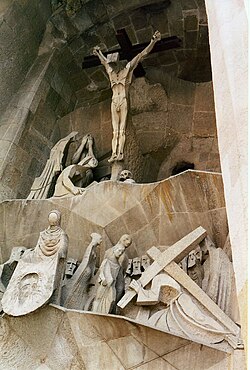
Beyond the Sagrada Família, Subirachs left a permanent mark on the urban landscape of Barcelona and beyond, including the Monument to President Macià in Plaça Catalunya.
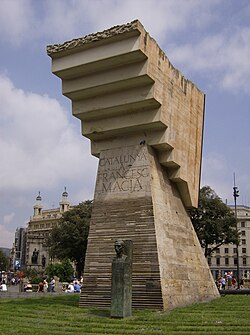
Summary of Major Works
| Year | Work | Location |
|---|---|---|
| 1957 | Forma 212 | Jardins Mundet, Barcelona |
| 1960 | Evocació marinera | La Barceloneta, Barcelona |
| 1962 | Saint Michael's Cross | Santa Maria de Montserrat Abbey |
| 1983 | Olimp | CIO Office, Lausanne, Switzerland |
| 1987+ | Passion Façade | Sagrada Família, Barcelona |
| 1991 | Monument to President Macià | Plaça Catalunya, Barcelona |
Honors and Final Years
Subirachs' contributions were recognized globally. He was a member of the Reial Acadèmia Catalana de Belles Arts de Sant Jordi and the Real Academia de Bellas Artes de San Fernando in Madrid. He received the Creu de Sant Jordi and was named an Officier dans l'Ordre des Arts et Lettres by France.
In his later years, Subirachs struggled with Parkinson's disease, which forced him to stop working in 2010. He passed away in Barcelona on April 7, 2014, at the age of 87.
Frequently Asked Questions
Why was the Passion Façade of the Sagrada Família controversial?
The work was controversial because Subirachs did not adapt his sculptural style to match the specific architectural language established by Antoni Gaudí, creating a stark stylistic contrast.
What was Subirachs' view on the location of art?
He believed that art without a spectator has no reason to exist, and therefore advocated for placing artworks in public spaces where they could be accessed by everyone.
Which artistic movements influenced Subirachs?
He was influenced by Noucentisme, Cubism, Purism, and the works of Henry Moore, while exploring styles such as Expressionism and Abstract art.
What is the significance of the asteroid 134124 Subirachs?
The asteroid was discovered in 2005 and named in honor of the artist to recognize his lasting impact on the world of art.
Did Subirachs have a background in architecture?
While architecture was his greatest vocation from a young age, he did not have the financial resources to study it formally; however, he applied architectural awareness to his sculptures and public installations.