Jorge Rafael Videla: The Rise and Fall of Argentina's Military Dictator
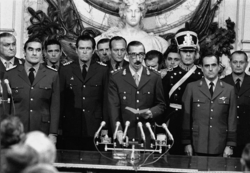
Jorge Rafael Videla was a high-ranking Argentine general and politician who served as the 42nd President of Argentina from 1976 to 1981. His tenure was defined by the National Reorganization Process, a period of military rule characterized by state-sponsored terror and systemic human rights violations. Coming to power through a coup d'état, Videla led one of the most infamous regimes in Cold War-era Latin America.
Videla's rule coincided with the Dirty War (1974–1983), a brutal campaign aimed at eliminating political dissidents. Under his command, the state utilized secret concentration camps to torture, abduct, and murder thousands of activists and opponents. The scale of the violence was immense, with estimates suggesting between 13,000 and 30,000 people were killed or "disappeared" during this era.
Key Facts
- Presidency: Served as President of Argentina from March 29, 1976, to March 29, 1981.
- Rise to Power: Seized control via a coup that deposed President Isabel Perón.
- Human Rights: Oversaw the "Dirty War," resulting in 13,000 to 30,000 disappearances and deaths.
- Criminal Convictions: Sentenced to life imprisonment for crimes against humanity and the systematic kidnapping of children.
- Death: Died in 2013 at Marcos Paz civilian prison following a fall in a shower.
Early Life and Military Ascent
Born on August 2, 1925, in Mercedes, Buenos Aires, Videla entered the National Military College (Colegio Militar de la Nación) in 1942. He graduated as a second lieutenant in 1944 and spent the following decades steadily climbing the ranks of the Argentine Army.
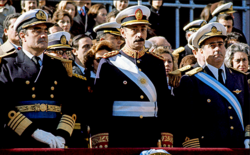
Videla's career was marked by strategic appointments, including directing the Military Academy and serving as the Chief of Staff of the Army. By August 1975, President Isabel Perón appointed him as the General Commander of the Army, the most senior position in the service, setting the stage for his eventual seizure of power.
Military Rank Progression
| Rank | Date of Promotion |
|---|---|
| Second Lieutenant | December 22, 1944 |
| Captain | March 1, 1952 |
| Colonel | January 17, 1966 |
| Brigade General | November 23, 1971 |
| Lieutenant General | October 20, 1975 |
The Dictatorship and State Terrorism
Following the March 1976 coup, Videla concentrated all legislative power within a nine-man military junta. The regime's primary objective was the eradication of political opposition through a systematic program of repression. This included the abduction of families and the kidnapping of children born to female prisoners, who were then given to military families for illegal adoption.
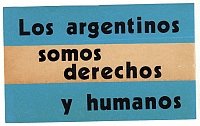
To maintain a positive image, the junta engaged in public relations efforts, including the 1979 "Somos derechos y humanos" (We Argentines are righteous and humane) campaign, which played on the Spanish term for human rights.
International Relations and the World Cup
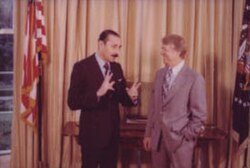
Videla's foreign policy faced challenges during the presidency of U.S. President Jimmy Carter. Carter emphasized human rights in Latin America, leading to the Kennedy-Humphrey Amendment in 1977, which prohibited U.S. military aid and arms sales to Argentina.
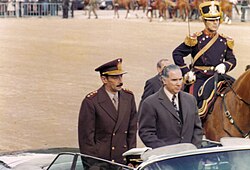
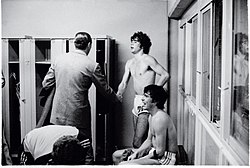
The regime also sought to use the 1978 FIFA World Cup to distract from its internal atrocities, with Videla taking a personal interest in the event's proceedings.
Downfall and Legal Reckoning
Videla relinquished power to Roberto Viola in 1981. The subsequent defeat of Argentina in the Falklands War (1982) accelerated the collapse of the military regime, leading to the restoration of democracy in 1983.
In 1985, Videla was prosecuted in the Trial of the Juntas and convicted of large-scale human rights abuses. Although pardoned by President Carlos Menem in 1990, the legal tide turned again in the 2000s. Under President Néstor Kirchner, the Argentine government repealed amnesty laws and declared the previous pardons unconstitutional.
In 2010, Videla took full responsibility for the army's actions, stating that his subordinates followed his orders. He was sentenced to life imprisonment for the deaths of 31 prisoners. In 2012, he received an additional 50-year sentence for the systematic theft of infants, a crime involving an estimated 400 to 500 babies.
Frequently Asked Questions
How many people disappeared under Videla's rule?
Estimates vary, but it is generally believed that between 13,000 and 30,000 political dissidents were killed or disappeared during the Dirty War.
What was the "National Reorganization Process"?
It was the official name given to the military dictatorship in Argentina from 1976 to 1983, during which the military junta sought to restructure Argentine society by eliminating political opposition.
Why was Videla sentenced to prison for kidnapping children?
Videla was found to be an accomplice in a systematic scheme where babies born to detained prisoners were stolen and given to military families for illegal adoption, stripping the children of their true identities.
How did Jorge Rafael Videla die?
Videla died on May 17, 2013, while serving his sentence at Marcos Paz civilian prison. An autopsy revealed he died from internal hemorrhaging and fractures caused by a fall in a prison shower.
Did the United States support Videla's regime?
While relations varied, President Jimmy Carter actively opposed the regime's human rights abuses, implementing the Kennedy-Humphrey Amendment to cut off military aid and arms sales.