Jordan-Hare Stadium: The Historic Home of Auburn Tigers Football
Located in the heart of Auburn, Alabama, Pat Dye Field at Jordan-Hare Stadium is more than just a sports venue; it is a cornerstone of collegiate athletics. Known for one of the most intimidating atmospheres in the NCAA, the stadium serves as the primary home for the Auburn Tigers. With a current capacity of 88,043, it ranks as the 12th largest stadium in the NCAA and the 8th largest in the Southeastern Conference (SEC).
From its humble beginnings in 1939 to its status as a global landmark for sports, Jordan-Hare has evolved through decades of expansion and modernization to support the passionate fan base of the Plains.
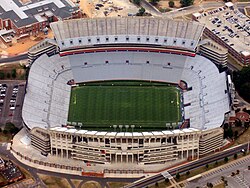
Key Facts
- Full Name: Pat Dye Field at Jordan-Hare Stadium.
- Current Capacity: 88,043 spectators.
- Opened: November 9, 1939.
- Surface: Tifway 419 Bermuda Grass.
- Global Ranking: 21st largest stadium in the world.
- Notable Events: Home to the Iron Bowl and the 2026 Argentina vs. Iceland international soccer friendly.
The Early Years and Evolution
Before the construction of the current stadium, Auburn played at Drake Field, a facility with temporary bleachers that seated only 700 people. This limited capacity forced the team to play most "home" games at neutral sites like Birmingham's Legion Field and Montgomery's Cramton Bowl. Driven by head coach Jack Meagher, the university raised funds to build a permanent home.
The stadium, originally called Auburn Stadium, opened on November 9, 1939. Its official dedication took place on Thanksgiving Day, November 30, 1939, during a 7–7 tie against the University of Florida. While often cited as having an original capacity of 7,500 (the size of the west grandstand), official records from the time suggest the actual capacity was approximately 15,000 when including wooden stands and end zone bleachers.
Renaming and Initial Growth
In 1949, the stadium underwent its first major expansion, replacing wooden bleachers with permanent seating and increasing capacity to 21,500. At this time, it was renamed Cliff Hare Stadium. Later, in 1973, the name of active head coach Shug Jordan was added, making it the first stadium in the United States named after a coach who was still leading the team.
The Journey of the Iron Bowl
For decades, the legendary Iron Bowl—the rivalry game between Auburn and Alabama—was played at Legion Field in Birmingham. This was due to the larger capacity of the neutral site and the logistical difficulties of traveling to Auburn in the mid-20th century.
As Jordan-Hare expanded, Auburn fans pushed to bring the game home. Under the leadership of head coach and athletic director Pat Dye, negotiations began to move the game to Auburn. Despite initial opposition from Alabama's Paul "Bear" Bryant, an agreement was reached to play in Auburn during odd-numbered years. The first Iron Bowl on the Plains took place on December 2, 1989, where Auburn defeated Alabama 30–20.

Modern Enhancements and Technology
In the 21st century, Jordan-Hare has focused on premium experiences and cutting-edge technology. The stadium has seen several modest expansions since 2000, reaching its current capacity of 88,043 in 2023. To enhance the fan experience, Auburn installed a massive LED video board in 2015, which stands at 57 by 190 feet, making it one of the largest video displays in college athletics.
Other modern upgrades include:
- Artistic Murals: Ten large murals on the east exterior depicting the program's greatest moments.
- Gameday Support Facility: A $28 million facility in the southwest corner featuring a new player recruiting lounge and renovated locker rooms.
- North Endzone Videoboard: A new display completed in the summer of 2025.
Versatility Beyond Football
While primarily a football venue, Jordan-Hare has hosted various other events. From 2010 to 2022, it was the site of the Alabama High School Athletic Association (AHSAA) football state championships. More recently, the stadium entered the international stage on June 9, 2026, hosting a FIFA World Cup friendly between Argentina and Iceland. The match, which Argentina won 3–0, set an Alabama state record for soccer attendance with 88,043 fans.
| Years | Capacity |
|---|---|
| 1939–1948 | 15,000 |
| 1949–1954 | 21,500 |
| 1960–1969 | 44,500 |
| 1970–1979 | 61,261 |
| 1987–1999 | 85,214 |
| 2004–2022 | 87,451 |
| 2023–Present | 88,043 |
Frequently Asked Questions
What is the current seating capacity of Jordan-Hare Stadium?
As of 2023, the stadium has a capacity of 88,043, ranking it as the 12th largest NCAA stadium.
Why was the stadium renamed for Shug Jordan?
The stadium was named in honor of head coach Shug Jordan in 1973, notably becoming the first U.S. stadium named for an active coach.
When did the Iron Bowl first move to Jordan-Hare Stadium?
The first Iron Bowl played at Jordan-Hare took place on December 2, 1989, following years of negotiations led by Pat Dye.
Has the stadium ever hosted sports other than American football?
Yes, in June 2026, the stadium hosted an international soccer friendly between Argentina and Iceland, setting a state record for soccer attendance.
Who designed the original stadium?
The stadium was designed by the architects Warren, Knight, and Davis, with Murphy Pond/R.M. Construction serving as the general contractor.