Auburn, Alabama: The Loveliest Village on the Plains
Nestled in Lee County, Auburn, Alabama, is the largest city in eastern Alabama and a vibrant hub of education and culture. Known unofficially as "The Loveliest Village on the Plains"—a nickname inspired by Oliver Goldsmith's poem The Deserted Village—Auburn has evolved from a small 19th-century settlement into one of the fastest-growing metropolitan areas in the United States.
As a principal city of the Auburn-Opelika Metropolitan Area, Auburn serves as a cornerstone of the greater Columbus-Auburn-Opelika Combined Statistical Area (CSA), which housed 563,967 residents as of 2020. The city is most famous for being the home of Auburn University, the highest academically ranked university in the state.
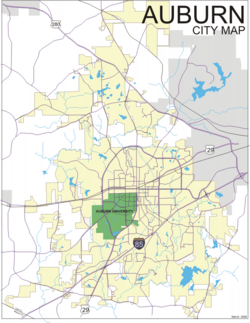
Key Facts
- Founded: 1836 (Incorporated February 2, 1839).
- Population: 76,143 (2020 Census); estimated 80,006 (2022).
- Nickname: "The Loveliest Village on the Plains."
- Economy: Centered on Auburn University and university-affiliated services.
- Growth: One of the 19 fastest-growing metro areas in the U.S. since 1990.
- Geography: Located in Lee County, Alabama, with an elevation of 696 ft.
A History of Education and Growth
Incorporated in 1839 within what was then Macon County, Auburn began as a small community of just two square miles. From its early days, the town prioritized education, establishing Methodist and Baptist churches alongside primary schools and separate academies for boys and girls by the mid-1840s. This academic focus attracted the planter class, and by 1858, students made up roughly half of the town's 1,000 free residents.
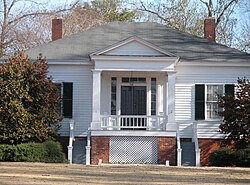
The American Civil War brought a temporary halt to this progress; schools and businesses closed, and the town served as a hospital for Texan Confederate soldiers. However, the post-war era sparked a massive expansion. The construction of Interstate 85 in 1957 connected Auburn to major state cities, boosting tourism and allowing Auburn University (renamed in 1960) to host more home football games locally.
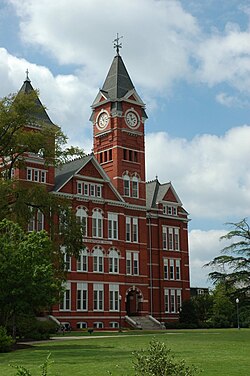
In the late 20th century, the reputation of the Auburn public school system drew thousands of new residents. Between 1980 and 2003, the population grew by 65% and the economy expanded by 220%. This trend continued into the 21st century, with a population increase of over 77% between 2000 and 2020, leading to modern challenges regarding infrastructure and urban sprawl.
Geography and Climate
Auburn features a diverse topography. While the elevation at City Hall is 709 ft, the terrain ranges from 386 ft at Chewacla Creek to 845 ft in the northern reaches near the Chambers County line.
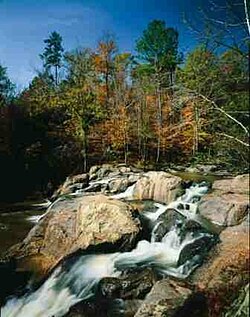
The city experiences a humid subtropical climate. Annual precipitation averages 52.55 inches, with the heaviest rainfall typically occurring in July. Summer temperatures are warm, with a mean daily maximum of 90.8°F in July, while winters are mild, averaging a daily maximum of 56.1°F in January.
Demographics and Community
As of the 2020 census, Auburn's population was 76,143 with a median age of 24.6 years, reflecting the significant influence of the university student population. The racial composition has diversified over the decades; as of 2020, the population included 63.21% White (Non-Hispanic), 18.29% Black or African American, 9.71% Asian, and 4.75% Hispanic or Latino residents.
City Governance
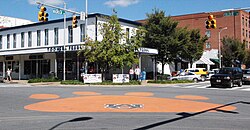
Auburn operates under a system where the Mayor is elected at-large to a four-year term. The role of the Mayor is primarily symbolic and ceremonial, serving as the Governor's contact during emergencies and presiding over Council meetings. Administrative leadership and CEO duties are handled by the City Manager.
Economy and Infrastructure
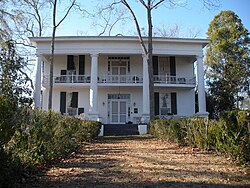
The local economy is heavily driven by Auburn University, which employed 13,545 people as of 2024. Additionally, the city is strategically located between two major automotive hubs: the Kia Motors plant (35 miles east) and the Hyundai Motors plant (55 miles west) via I-85.
Education System
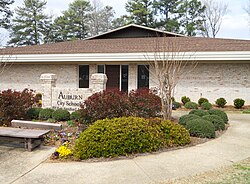
The Auburn City Schools system is highly regarded. The city is served by a massive 350,000 square-foot high school facility (opened in 2017) that houses 10th through 12th graders and has the largest student population of any high school in Alabama. The system utilizes a specialized grade-level structure, with dedicated schools for 6th, 7th, 8th, and 9th grades, and elementary schools paired by grade ranges (K-2 and 3-5).
Culture, Recreation, and Arts
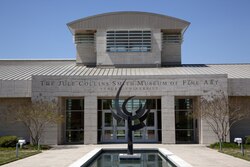
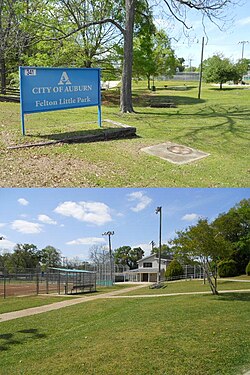
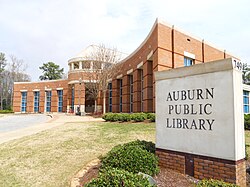
Auburn is a center for the arts and athletics. The city hosts the Jule Collins Smith Museum of Fine Art and provides various public intellectual spaces, including the Auburn Public Library.
The region is also a premier destination for golf. In 2005, Golf Digest ranked the Auburn Metro Area number one in the U.S. for golf, featuring 146 holes across six courses, including the acclaimed Robert Trent Jones-designed Grand National course.
City Summary Table
| Category | Detail |
|---|---|
| County | Lee County |
| Population (2020) | 76,143 |
| Land Area | 61.04 sq mi |
| Median Age (2020) | 24.6 years |
| Primary Employer | Auburn University |
| Sister Cities | Blagoevgrad (Bulgaria), Auburn (New York) |
Frequently Asked Questions
What is the origin of the nickname "The Loveliest Village on the Plains"?
The nickname is derived from a line in the poem The Deserted Village by Oliver Goldsmith, which reads: "Sweet Auburn! Loveliest village of the plain..."
How is the city of Auburn governed?
Auburn has an elected Mayor who serves a four-year term in a primarily symbolic and ceremonial role. The actual administrative duties and CEO responsibilities are managed by a City Manager.
What makes Auburn's school system unique?
The city uses a grade-specific school structure where different facilities are dedicated to specific grade levels (e.g., a dedicated 6th grade school and a 7th grade school), and the high school is the largest in Alabama by student population.
What are the primary economic drivers in Auburn?
The economy is centered on Auburn University and its affiliated services. The city also benefits from its proximity to the Kia and Hyundai automobile manufacturing plants.
Is Auburn known for any specific sports or recreation?
Yes, Auburn is highly regarded for golf. In 2005, it was ranked as the number one area for golf in the United States by Golf Digest, boasting six courses and 146 holes.