John Fiske: The Philosopher of Evolution and American History
John Fiske was a towering intellectual figure of the late 19th century, bridging the gap between rigorous scientific inquiry and public understanding. A prolific author, lecturer, and historian, Fiske dedicated his life to synthesizing the laws of evolution with human history and spiritual belief, seeking a harmonious coexistence between science and religion.
Early Life and Academic Foundations
Born Edmund Fiske Green on March 30, 1842, in Hartford, Connecticut, he was the only child of Edmund Brewster Green and Mary Fiske Bound. His early years were marked by significant transition; following his father's death in Panama in 1852 and his mother's subsequent marriage to Edwin W. Stoughton in 1855, he adopted the name of his maternal great-grandfather, John Fiske.
Fiske demonstrated exceptional precocity as a child. While living with his grandmother in Middletown, he immersed himself in English literature, history, and the study of Greek, Latin, and several modern languages. This intellectual curiosity led him to Harvard, where he graduated from Harvard College in 1863 and Harvard Law School in 1865. Although he was admitted to the bar in 1864, his tenure in the legal profession was brief, as his passion for writing and philosophy quickly took precedence.
A Career in Academia and Public Speaking
Fiske's professional journey was characterized by a blend of institutional roles and freelance intellectualism. He began his writing career in 1861 with a critique titled "Mr. Buckle's Fallacies" in the National Quarterly Review. Between 1869 and 1879, he held various positions at Harvard, including university lecturer on philosophy, instructor in history, and assistant librarian. He also served on the board of overseers for two terms.
His influence extended far beyond Cambridge, Massachusetts. Fiske became a renowned lecturer, delivering hundreds of talks across the United States and Great Britain. He held a professorship of American history at Washington University in St. Louis starting in 1884 and lectured at University College London and the Royal Institution of Great Britain. In 1884, his contributions to scholarship were recognized with his election to the American Antiquarian Society.
The Synthesis of Evolution and Philosophy
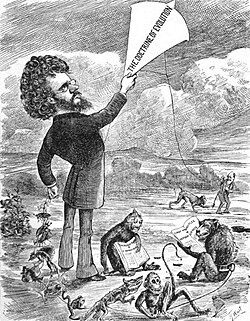
While history occupied much of his later life, Fiske first gained public prominence by popularizing the work of Herbert Spencer. He focused on the philosophical interpretation of Charles Darwin's theories, aiming to explain the nature of human progress through the lens of evolution. His clarity of thought was so profound that Charles Darwin himself wrote to Fiske in 1874, praising him as the most lucid expositor he had ever read.
Fiske's views on evolution were complex. In his 1884 work, The Destiny of Man, he argued that the impact of natural selection (the process where organisms better adapted to their environment tend to survive) on humans had been diminished by social conditions. He believed that intellectual force had superseded bodily strength, leading humanity toward a more moral and non-selfish existence.
Race and Social Beliefs
Influenced by 19th-century scientific trends regarding brain size—championed by figures like Paul Broca and Francis Galton—Fiske held beliefs in the racial superiority of the "Anglo-Saxon race." However, these views did not conflict with his staunch abolitionist convictions. He remained a fierce opponent of slavery, describing the North's victory in the American Civil War as complete despite the protests of "unteachable bigots."
Reconciling Science, Religion, and History
A central theme in Fiske's work was the harmony between faith and reason. In Outlines of Cosmic Philosophy, he argued that there had never been a true conflict between religion and science. He maintained a deep personal connection to Christianity, viewing it as a necessary and vital part of human culture.
In The Idea of God as Affected by Modern Knowledge (1885), Fiske proposed that the developed human mind serves as an indication of the mind of God, which he described as a great immanent cause controlling both moral and physical forces.
In his later years, Fiske shifted his focus toward historical documentation. He authored The Discovery of America (1892) and co-edited Appletons' Cyclopædia of American Biography (1887) with James Grant Wilson. He passed away on July 4, 1901, in Gloucester, Massachusetts.
Key Facts
- Birth Name: Born Edmund Fiske Green; later changed to John Fiske.
- Education: Graduated from Harvard College (1863) and Harvard Law School (1865).
- Core Philosophy: Focused on the popularization of Herbert Spencer and the philosophical interpretation of Darwinism.
- Major Works: The Destiny of Man (1884), The Idea of God as Affected by Modern Knowledge (1885), and The Discovery of America (1892).
- Academic Affiliations: Harvard University and Washington University in St. Louis.
| Period/Year | Role or Achievement | Institution/Work |
|---|---|---|
| 1861 | First published article | National Quarterly Review |
| 1869–1871 | Lecturer on Philosophy | Harvard University |
| 1872–1879 | Assistant Librarian | Harvard University |
| 1884 | Professor of American History | Washington University in St. Louis |
| 1884 | Member Election | American Antiquarian Society |
Frequently Asked Questions
Why did John Fiske change his name?
Originally born Edmund Fiske Green, he assumed the name of his maternal great-grandfather, John Fiske, following his mother's second marriage to Edwin W. Stoughton in 1855.
What was Fiske's relationship with Charles Darwin?
Fiske was a philosophical interpreter of Darwin's work. Darwin highly respected Fiske's ability to explain complex evolutionary concepts, once calling him the most lucid expositor he had ever read.
How did Fiske view the relationship between science and religion?
Fiske believed that science and religion were in harmony rather than conflict. He argued that there was no need for reconciliation because the two had always existed in a state of compatibility.
What were Fiske's views on natural selection in humans?
In The Destiny of Man, Fiske argued that the operation of natural selection on humans had been essentially diminished due to the influence of social conditions, allowing intellectual force to become more dominant than physical strength.
What were his primary contributions to history?
Fiske was a prolific lecturer and author on American history, notably writing The Discovery of America and co-editing Appletons' Cyclopædia of American Biography.