Joe Meek: The Maverick Producer Who Revolutionized Pop Sound
In the early days of the British music industry, the recording studio was largely seen as a place to capture a performance. Then came Joe Meek. A visionary sound engineer and songwriter, Meek transformed the studio itself into a musical instrument, blending technical innovation with an avant-garde sensibility that predated many of the modern production techniques used today.
Operating from his unconventional home studio, Meek pioneered space age pop and experimental sounds, pushing the boundaries of what was possible in a recording environment. His work was characterized by a restless desire to create sonic landscapes that felt otherworldly, often blending rock and roll with futuristic electronic textures.

Key Facts
- Pioneer of Production: One of the first producers to be recognized as an artist in his own right.
- Technical Innovator: Advanced the use of overdubbing, sampling, and reverberation.
- Global Success: Produced "Telstar," the first record by a British rock group to hit number one on the US Hot 100.
- Studio Philosophy: Treated the recording studio as an instrument rather than just a capture device.
- Legacy: His influence persists through the "Tea Chest Tapes" and numerous tributes in popular culture.
The Sound of the Future: Artistry and Innovation
Joe Meek's approach to music was fundamentally different from his contemporaries. He was a devotee of experimental pop, often incorporating electronic sounds to evoke a sense of cosmic wonder. This is most evident in his concept album I Hear a New World (1960), which utilized innovative electronic textures, though it was not fully released during his lifetime.
Meek's technical contributions were vast. He was an early adopter of overdubbing (recording new layers of sound over existing tracks), sampling, and the creative use of reverberation to create depth and atmosphere. His ability to manipulate sound allowed him to create hits that stood out for their unique sonic signatures.

The Holloway Road Studio
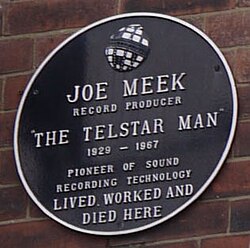
Much of Meek's most famous work was created at his home studio located at 304 Holloway Road in London. It was here in July 1962 that he wrote and produced the instrumental masterpiece "Telstar." The track became a global phenomenon, spending five weeks at number one in the UK and reaching the top of the US Billboard Hot 100 in December 1962. For this achievement, Meek received an Ivor Novello Award for the "Best-Selling A-Side" of 1962.
Career Highlights and Chart Success
Beyond "Telstar," Meek produced a string of successful singles for a wide variety of artists. His versatility allowed him to navigate genres from rock and roll to outsider pop. Notable hits include John Leyton's "Johnny Remember Me" (1961) and The Honeycombs' "Have I the Right?" (1964). He also extended his creative reach into cinema, producing music for the 1963 pop film Live It Up! (released in the US as Sing and Swing).
| Artist | Song Title | Peak Position | Year |
|---|---|---|---|
| The Tornados | "Telstar" | 1 | 1962 |
| John Leyton | "Johnny Remember Me" | 1 | 1961 |
| The Honeycombs | "Have I the Right?" | 1 | 1964 |
| Emile Ford and the Checkmates | "What Do You Want to Make Those Eyes at Me For?" | 1 | 1959 |
| Heinz | "Just Like Eddie" | 5 | 1963 |
Tragedy and the "Tea Chest Tapes"
Despite his professional triumphs, Meek's personal life was marked by struggle. His later years were clouded by mental health challenges and personal turmoil, culminating in a tragic murder-suicide on February 3, 1967, at the age of 37.
Following his death, a fascinating piece of music history emerged. Thousands of recordings that Meek had hidden in tea chests within his flat were purchased by Cliff Cooper of the Millionaires for £300 (approximately £4,780 in 2025). These became known as the "Tea Chest Tapes." While cataloged by Alan Blackburn in the mid-1980s, these recordings remained largely unreleased for decades, serving as a hidden archive of Meek's obsessive creativity.
Frequently Asked Questions
What was Joe Meek's most famous production?
His most famous production was the 1962 instrumental "Telstar" by The Tornados, which was the first record by a British rock group to reach number one on the US Hot 100.
How did Joe Meek change music production?
Meek was one of the first to treat the recording studio as an instrument. He pioneered the use of overdubbing, sampling, and reverberation, moving the producer's role from a passive observer to an active artist.
What are the "Tea Chest Tapes"?
The "Tea Chest Tapes" are thousands of recordings that Joe Meek stored in tea chests in his home. They were discovered and purchased after his death, providing a vast archive of his experimental work.
Which genres is Joe Meek associated with?
He is primarily associated with space age pop, experimental pop, rock and roll, and outsider music.
Where was Joe Meek's primary studio located?
His most influential work was produced at his home studio located at 304 Holloway Road in London.