Remote Recording: Capturing High-Fidelity Live Performances
Remote recording, often referred to as location recording, is the process of capturing high-quality, complex audio of live concerts or other events using multitrack recording techniques outside of a traditional studio environment. Unlike a simple recording, the multitrack data is later carefully mixed to create a polished final product, commonly released as a live album.
This practice differs significantly from field recording, which typically uses fewer microphones and records directly to the final number of channels. It is also distinct from remote broadcasting, where audio is mixed live and sent to a stereo broadcast in real-time. While they are different processes, a single crew can perform both remote recording and remote broadcasting simultaneously using the same set of microphones.
Key Facts
- Purpose: Captures the authentic interaction between performers and a live audience and utilizes unique acoustic spaces like churches or ballrooms.
- Method: Studio-quality gear is transported to a venue and connected via microphone splitters to route signals to separate tracks.
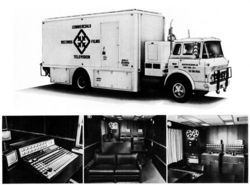
- Equipment: Often utilizes a remote truck, which serves as a mobile control room with a mixing console, monitors, and recorders.
- Pioneers: Wally Heider and Reice Hamel were instrumental in developing the mobile recording truck in the late 1950s.
The Mechanics of Location Recording
To achieve studio-grade results in a live setting, engineers transport professional equipment to the venue. The process begins with a bank of microphone splitters, which allow the signals from the concert microphones to be sent to both the house sound system and the recording equipment. These individual signals are routed to separate tracks, allowing for precise control during the post-production mixing phase.
The heart of this operation is often the remote truck—a rolling recording studio. These vehicles are equipped with a mixing console, studio monitors, and multitrack recorders, providing the engineer with a controlled environment to manage the complex audio streams coming from the stage.
The Evolution of Remote Recording
Early Field Recordings
Remote recording evolved from early field recording practices. In 1923, Ralph Peer began recording musicians directly to disc using a portable disc-cutting machine. By 1941, Alan Lomax became renowned for documenting various musical traditions across the United States. By the 1950s, improvements in tape recorders, mixers, and microphones allowed engineers to bring more sophisticated gear to locations, enabling the mixing of multiple microphones down to a few recorded tracks.
The Rise of the Mobile Studio
The transition to truly mobile studios began in 1958 when American recording engineer Wally Heider reportedly became the first to mount recording equipment in a truck. Shortly after, Reice Hamel adopted a similar approach. Initially, these engineers mixed performances in real-time—similar to a broadcast—onto stereo tape.
Hamel's technical capabilities expanded rapidly between 1959 and 1971, progressing from stereo to three-track (used for a Barbra Streisand concert), then to four-track in 1966, eight-track, and finally sixteen-track recording by 1971.
Industry Impact and Major Milestones
Wally Heider's work led to several critical successes, including Ray Charles's 1964 album Live in Concert at the Shrine Auditorium. The 1967 Monterey Pop Festival marked a turning point, as the need for high-quality sound for concert films increased the demand for professional remote truck operators.
Other major events further solidified the practice. The Woodstock Festival was captured on 12-track tape and mixed at the Record Plant studio in New York. In August 1971, the Record Plant utilized its own remote truck for The Concert for Bangladesh at Madison Square Garden. Chris Stone, co-founder of the Record Plant, noted that remote recording was often more cost-effective than studio time for long performances and provided a spontaneous energy that benefited both the music and the musician.
Remote Recording Comparison
To better understand how remote recording fits into the broader audio landscape, the following table compares it with similar methods.
| Feature | Remote Recording | Field Recording | Remote Broadcast |
|---|---|---|---|
| Primary Goal | High-quality live album | Documentation/Archiving | Real-time transmission |
| Technique | Multitrack recording | Few mics, direct channels | Live stereo mix |
| Post-Production | Extensive mixing | Minimal to none | None (Live) |
| Equipment | Mobile truck/Studio gear | Portable recorders | Broadcast mixers/Transmitters |
Frequently Asked Questions
What is the difference between remote recording and field recording?
Remote recording uses complex multitrack techniques and studio-quality equipment to create a product that is mixed later. Field recording typically uses fewer microphones and records onto the same number of channels as the final intended product.
How does a remote recording truck work?
A remote truck acts as a mobile control room. It contains a mixing console, studio monitors, and multitrack recorders, allowing engineers to capture individual microphone signals from a venue and record them onto separate tracks for later mixing.
Why choose remote recording over a studio session?
Remote recording captures the spontaneous energy of a live audience and allows artists to utilize the unique acoustics of specific venues, such as ballrooms or churches, which cannot be replicated in a studio.
Who were the pioneers of the remote recording truck?
Wally Heider and Reice Hamel were key pioneers. Heider is credited with mounting recording equipment in a truck around 1958, later recording landmark events like the Monterey Pop Festival.
Can a concert be recorded and broadcast at the same time?
Yes. Remote recording (for a future album) and remote broadcast (for immediate listening) can be carried out simultaneously by the same crew using the same set of microphones.