Ribbon Microphones: Engineering, History, and Audio Applications
The ribbon microphone is a specialized transducer prized by audio engineers for its smooth high-frequency response and natural sound reproduction. Unlike common dynamic or condenser microphones, the ribbon microphone utilizes a thin, conductive strip of metal to convert sound waves into electrical signals, offering a distinct sonic character that remains highly valued in professional recording studios today.
Key Facts
- Mechanism: Uses a thin aluminum, duraluminum, or nanofilm ribbon suspended between magnetic poles.
- Operation: Functions via electromagnetic induction, acting as a velocity microphone.
- Polar Pattern: Naturally bidirectional, picking up sound from the front and back while rejecting the sides.
- Frequency Response: Excellent range (20 Hz to 20 kHz) due to a very low resonant frequency (below 20 Hz).
- Output: Typically low native voltage, requiring an internal step-up transformer.
Principle of Operation
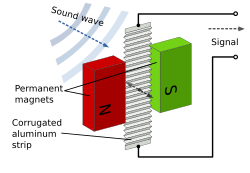
At the heart of a ribbon microphone is a very thin, light metal ribbon—usually corrugated—suspended between the poles of a permanent magnet. When sound waves hit the ribbon, it vibrates. This movement within the magnetic field induces a voltage at right angles to both the ribbon's motion and the direction of the magnetic field. This voltage is then captured by contacts at each end of the ribbon.
Because the induced voltage is proportional to the velocity of the ribbon (and thus the velocity of the air particles in the sound wave), these devices are formally known as velocity microphones. This differs from other microphones where voltage is proportional to the displacement of the diaphragm.
Technical Advantages and Design
One of the primary advantages of the ribbon design is its lightweight construction. Because the ribbon is under very little tension, its resonant frequency is lower than 20 Hz. This allows ribbon microphones to maintain a flat and accurate frequency response across the entire range of human hearing (20 Hz to 20 kHz), whereas other diaphragms often have resonant frequencies within the audible range.
Due to their low native voltage output, most ribbon microphones include an internal step-up transformer to increase the voltage and output impedance. Structurally, they are electrically simple, containing no active circuitry, which makes them possible to construct from basic materials or kits.
Pickup Patterns and Usage
Ribbon microphones are typically bidirectional, meaning they capture sound equally from the front and rear while rejecting sound from the sides. This characteristic makes them ideal for the Blumlein pair recording array, where two microphones are used to create a stereo image.

While bidirectional is the native state, some ribbon microphones are configured for cardioid, hypercardioid, or variable patterns. They are particularly favored for capturing high-frequency detail without the "brittle" or aggressive sound sometimes associated with condenser microphones.
Modern Durability and Power Concerns
Historically, ribbon elements were delicate and expensive. However, modern materials—including strong nanomaterials introduced around 2007—have significantly improved signal purity, output levels, and durability, allowing them to be used in loud environments and on stage.
A critical consideration for users is phantom power (a method of sending DC voltage through the microphone cable). While modern designs are more resilient, improperly wired older ribbon microphones can be damaged if phantom power is applied, as is common when using condenser microphones on the same mixer.
Historical Evolution
The ribbon microphone was co-invented in the early 1920s by Walter H. Schottky and Erwin Gerlach, who also developed the first ribbon loudspeaker by reversing the circuit. Later, Harry F. Olson of RCA advanced the technology using permanent magnets and field coils, leading to the commercial release of the RCA Photophone Type PB-31 in 1931.

In 1933, RCA introduced the Type 44A Velocity Microphone, which became an industry standard. Other iconic models include the BBC-Marconi Type A (1934–1959), the ST&C Coles 4038 (1954), and the Beyerdynamic M 160 (1957), the latter of which used two 15 mm ribbons to create a highly directional pattern.
Although RCA eventually stopped manufacturing ribbon mics, the legacy continued through Audio Engineering Associates (AEA), which began servicing them in 1976 and later released the R44C, a museum-quality replica of the original RCA design. The market expanded further around 2002 with affordable versions from China and modified vintage units like "The Beeb" by XAudia.
Comparison of Microphone Types
| Feature | Ribbon Microphone | Moving-Coil (Dynamic) | Condenser Microphone |
|---|---|---|---|
| Transduction Method | Electromagnetic Induction | Moving Coil in Magnetic Field | Electrostatic Capacitor |
| Native Polar Pattern | Bidirectional | Varies (often Cardioid) | Varies (often Cardioid) |
| High-End Sound | Smooth/Natural | Varies | Can be aggressive/brittle |
| Resonant Frequency | Very Low (<20 Hz) | Within audible range | Within audible range |
| Power Requirement | Passive (usually) | Passive | Requires Phantom Power |
Frequently Asked Questions
What is a velocity microphone?
A velocity microphone is a type of microphone, such as a ribbon mic, where the induced voltage is proportional to the velocity of the diaphragm's movement and the air particles, rather than the total displacement of the diaphragm.
Why are ribbon microphones considered "natural" sounding?
They are prized for their ability to capture high-frequency detail without the harshness or brittleness often found in condenser microphones, and they have a very low resonant frequency that ensures a flat response across the human hearing range.
Can phantom power damage a ribbon microphone?
Yes, in some cases. If an older or improperly wired ribbon microphone is exposed to phantom power, the element can be damaged. However, many modern ribbon microphones are designed to be more resilient to this.
What is a Blumlein pair?
A Blumlein pair is a stereo recording technique that uses two bidirectional ribbon microphones placed at a 90-degree angle to one another to capture a realistic spatial image of a sound source.
What materials are used for the ribbon?
Ribbons are typically made from thin, electrically conductive materials such as aluminum, duraluminum, or modern nanomaterials.