Javier Milei Presidency: A New Era of Libertarian Governance in Argentina
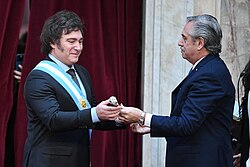
Since taking office on December 10, 2023, Javier Milei has embarked on an ambitious mission to fundamentally restructure the Argentine state. Running under the banner of La Libertad Avanza (Freedom Advances), Milei's presidency is defined by a commitment to libertarian principles, characterized by aggressive deregulation, a drastic reduction in public spending, and a pivot in international alliances.
Accompanied by Vice President Victoria Villarruel, Milei's administration has sought to dismantle what he describes as a bloated state apparatus to combat chronic economic instability and stagflation—a condition where stagnant economic growth is paired with high inflation.
Key Facts
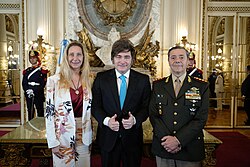
- Inauguration: December 10, 2023.
- Political Party: La Libertad Avanza (formerly Libertarian Party).
- Core Strategy: Massive state deregulation and reduction of public employment.
- Major Legislation: The "Bases Law" and the Decree of Necessity and Urgency (DNU).
- Key Alliances: Strong alignment with the United States, Israel, and figures like Donald Trump and Elon Musk.
State Restructuring and Cabinet Overhaul
Immediately upon taking office, President Milei implemented a sweeping reorganization of the national government. This involved the dissolution of numerous ministries to streamline operations and reduce costs. Many portfolios were merged into the newly created Ministry of Human Capital, which now encompasses education, labor, social development, culture, and gender and diversity policies.
Other dissolved entities, such as the Ministry of Transport and the Ministry of Public Works, were initially merged into a Ministry of Infrastructure before being absorbed by the Ministry of Economy in February 2024. The Ministry of Science, Technology, and Innovation was merged into the Chief of the Cabinet of Ministers.
Current Executive Leadership
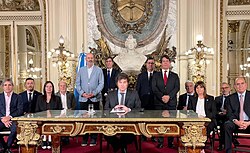
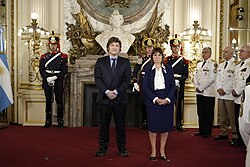
The administration has seen several shifts in its cabinet to align with its evolving goals. Key figures include Luis Caputo as Minister of Economy and Patricia Bullrich as Minister of Security, both of whom have played central roles in implementing the government's austerity and public order measures.
| Portfolio | Notable Ministers | Party/Coalition |
|---|---|---|
| Cabinet Chief | Nicolás Posse → Guillermo Francos → Manuel Adorni | Independent / LLA |
| Economy | Luis Caputo | PRO / LLA |
| Security | Patricia Bullrich → Alejandra Monteoliva | PRO / LLA |
| Foreign Affairs | Diana Mondino → Gerardo Werthein → Pablo Quirno | Independent / LLA |
| Human Capital | Sandra Pettovello | UCEDE / LLA |
Domestic Policy and Economic Shock Therapy
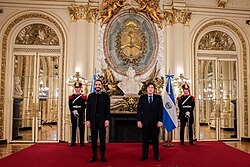
The cornerstone of Milei's domestic agenda is the Decree of Necessity and Urgency (DNU) and the Bases Law (Starting Points for the Freedom of Argentines). These instruments aim to deregulate the economy, reduce the size of the public sector, and attract foreign investment through the RIGI (Incentive Regime for Large Investments).
Economic and Infrastructure Shifts
The administration has focused on exchange-rate policy and the removal of subsidies, which has led to significant increases in public transport fares—some reports indicating a 525% rise in AMBA (Buenos Aires Metropolitan Area) tariffs by late 2025. While these measures aim for long-term stability, they have resulted in the loss of some businesses and industrial challenges.
Public Order and Security
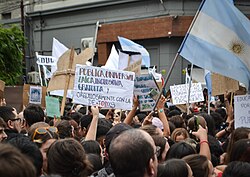
Under Minister Patricia Bullrich, the government introduced the Public Order Protocol, emphasizing the clearing of circulation spaces during demonstrations and the seizure of illegal materials at train stations. Additionally, the "Plan Bandera" was launched to recover security in the Santa Fe province.
Education and Social Services
The government has proposed educational vouchers for private schools and faced significant budget conflicts with national universities, leading to the veto of the National Universities Funding Law. In health, the administration dealt with the 2024 dengue epidemic and implemented cuts to PAMI (the health insurance program for retirees), alongside a withdrawal from the World Health Organization (WHO).
Foreign Policy: A Global Pivot
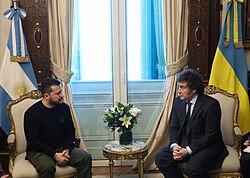
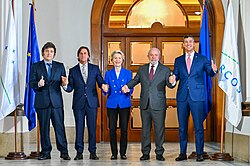
President Milei has shifted Argentina's international orientation, moving away from traditional regional blocs and toward Western allies. He has expressed that Mercosur (the Southern Common Market) has "grown old" and has pursued accession to the OECD (Organisation for Economic Co-operation and Development).
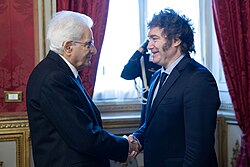
His foreign policy is marked by strong support for the United States and Israel, including support during the 2026 Iran war. He has maintained high-profile relationships with leaders such as Japanese Prime Minister Fumio Kishida and Israeli President Isaac Herzog.
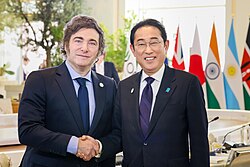
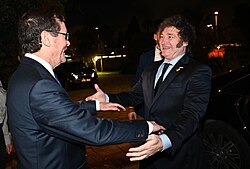
However, this pivot has not been without friction. The administration has experienced diplomatic conflicts with Spain and a strained relationship with Russia, which did not send a representative to Milei's inauguration.

Public Reception and Approval

Public opinion of the Milei presidency has been highly polarized. Approval ratings have fluctuated significantly, peaking in late 2024 and early 2025 with some polls showing positive images above 50%. However, by March 2026, several polls indicated a decline, with disapproval ratings rising as economic hardships persisted for a portion of the population.
Frequently Asked Questions
What is the "Bases Law"?
The Bases Law, or "Starting Points for the Freedom of Argentines," is a legislative package designed to deregulate the Argentine economy, reduce state intervention, and provide incentives for large-scale foreign investments.
Which ministries were dissolved by the Milei administration?
Several ministries were dissolved or merged, including the Ministries of Education, Labour, Culture, and Social Development, which were all integrated into the new Ministry of Human Capital.
How has Milei's foreign policy changed?
Milei has pivoted Argentina toward a closer alliance with the United States and Israel, while distancing the country from Russia and expressing skepticism toward the current structure of Mercosur.
What was the impact on public transport?
The administration's policy of removing subsidies led to a sharp increase in public transport fares, particularly in the AMBA region, where some tariffs rose by over 500%.
What is the Public Order Protocol?
It is a security strategy implemented by the Ministry of Security to ensure that public roads remain clear during protests and to increase police interventions in transport hubs to seize illegal materials.