Argentina Politics: Government Structure and Historical Evolution
Argentina operates as a federal presidential representative republic, a system where power is shared between a central national government and various provincial authorities. Guided by the Constitution of Argentina, the state is organized into three distinct branches to ensure a balance of power: the executive, the legislative, and the judicial.
Key Facts
- Government Type: Federal presidential representative republic.
- Current President: Javier Milei (inaugurated December 10, 2023).
- Legislative Body: Bicameral National Congress consisting of the Senate and the Chamber of Deputies.
- Voting: Obligatory for citizens aged 18; optional for those aged 16–18.
- Major Parties: Justicialist Party (PJ) and Radical Civic Union (UCR).
The Structure of National Government
Executive Branch
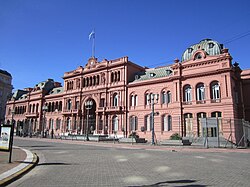
The executive power is vested in the President, who serves as both the head of state and the head of government. The current president is Javier Milei. The executive office is headquartered at the Pink House.
Legislative Branch
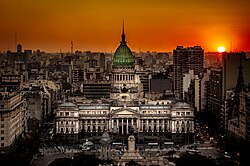
The National Congress is a bicameral legislature, meaning it consists of two houses. The upper house, the Senate, is presided over by the Vice President of Argentina (currently Victoria Villarruel). The lower house, the Chamber of Deputies, is led by a presiding officer, currently Martín Menem. Both houses meet at the Palace of the Argentine National Congress.
Judicial Branch
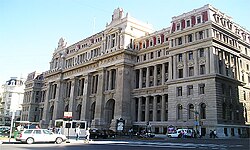
The Judiciary of Argentina is the system responsible for interpreting the law. At its apex is the Supreme Court of Argentina, currently led by Chief Judge Horacio Rosatti.
Historical Political Evolution
Foundations and the Liberal State
Argentina's journey toward autonomy began with the May Revolution in 1810 and the formation of the Primera Junta. After experimenting with various governing bodies like juntas and triumvirates, the provinces signed a declaration of independence on July 9, 1816. Following years of conflict between centralists and provinces, the Constitution of 1853 consolidated the nation, and the Republic of Argentina was formally born after the Battle of Pavón in 1861.
From 1852 to 1930, Argentina was characterized by a liberal government. Initially, a landowning elite controlled elections through fraud. This changed with the 1912 Sáenz Peña Law, which established universal, secret, and obligatory male suffrage, allowing the middle class—represented by the Radical Civic Union (UCR)—to enter government.
The Welfare State and Peronism
The 20th century saw significant instability, with six governments overthrown by the armed forces between 1930 and 1976. A pivotal era began with Juan Perón, who rose to power in 1946. His populist regime focused on labor rights, nationalizing key industries (such as railroads and the central bank), and granting women the right to vote in 1947. This movement, known as Peronism, continues to be a dominant force in Argentine politics.
The Neoliberal State and Return to Democracy
Following a brutal military dictatorship under Jorge Rafael Videla (1976–1983), which collapsed after the Falklands War, full-scale democracy was reestablished in 1983 with the election of Raúl Alfonsín. Subsequent decades saw a shift toward neoliberal programs under Carlos Menem in the 1990s and a period of intense economic crisis between 2001 and 2002, which led to the presidency of Néstor Kirchner and later Cristina Fernández de Kirchner.
Elections and Political Parties
Argentina maintains a complex electoral system with over 16,000 elected positions across national, provincial, and municipal levels. Voting is a civic duty and is mandatory for adults.
| Candidate | Party | Votes | Percentage |
|---|---|---|---|
| Javier Milei | La Libertad Avanza | 14,554,560 | 55.65% |
| Sergio Massa | Union for the Homeland | 11,598,720 | 44.35% |
The political landscape is traditionally dominated by the Justicialist Party (PJ), rooted in labor support, and the Radical Civic Union (UCR), historically supported by the urban middle class. More recently, new coalitions like the center-right PRO (Republican Proposal) have emerged.
Frequently Asked Questions
Who is the current President of Argentina?
Javier Milei is the current President of Argentina, having been sworn into office on December 10, 2023.
Is voting mandatory in Argentina?
Yes, voting is obligatory for all native or naturalized Argentine citizens aged 18. However, it is optional for those between the ages of 16 and 18.
What is the role of the Vice President in the legislature?
The Vice President of Argentina serves as the President of the Senate, the upper house of the National Congress.
What is Peronism?
Peronism is a political movement originating from the presidency of Juan Perón in the 1940s, characterized by populism, strong support for labor unions, and social welfare policies.
How is the Argentine government structured?
Argentina is a federal presidential representative republic with three branches: the Executive (President), the Legislative (Bicameral National Congress), and the Judicial (Supreme Court and lower courts).