J. Lohr Vineyards & Wines: A History of Innovation and Growth
The story of J. Lohr Vineyards & Wines is one of strategic expansion and a commitment to quality. From its humble beginnings in the early 1970s to its current status as a recognized name in California viticulture—the study of grape cultivation—the winery has consistently pushed the boundaries of winemaking through technical innovation and regional exploration.
The Early Years: 1972–1983
The foundation was laid in 1972 when Jerry Lohr and Bernard “Bernie” Turgeon broke ground on 280 acres in the region that would eventually become the Arroyo Seco AVA (American Viticultural Area) in Monterey County. By 1974, the Turgeon & Lohr Winery officially opened its doors in San Jose, California, utilizing a facility previously occupied by the closed Falstaff Brewery.
To lead the production, the company hired Peter Stern, a seasoned winemaker from Napa Valley. Stern implemented a modern design featuring stainless steel tanks, temperature-controlled fermenters, and hundreds of 60-gallon oak barrels. This infrastructure allowed the winery to launch its first commercial offerings in 1975, which included Chenin Blanc, a Rose of Cabernet Sauvignon, Petite Sirah, and a proprietary blend known as Jade. By 1976, production had already scaled to over 10,000 cases.
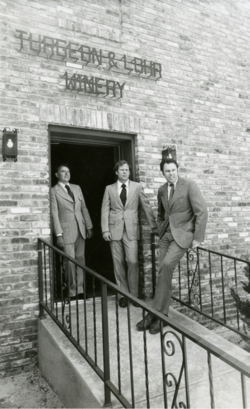
The late 1970s and early 1980s were marked by technical breakthroughs. Barry Gnekow, who joined as an assistant winemaker in 1976 and became Director of Winemaking in 1981, developed a patented double reverse osmosis process. This technology enabled the creation of low and non-alcoholic wines, leading to the launch of the ARIEL Vineyards brand. During this era, the company also expanded its reach, achieving national distribution in 1979 and partnering with the Hyatt Hotel Corporation in 1983.
Expansion and Evolution: 1984 to Present
A pivotal shift occurred in 1984 when Bernie Turgeon retired and sold his shares to Jerry Lohr, who assumed the role of president. The company was subsequently renamed J. Lohr Vineyards & Wines. This period saw rapid geographic expansion, starting with the acquisition of a 35-acre vineyard in St. Helena, Napa Valley, in 1984.
In 1986, the winery expanded into the Paso Robles AVA in San Luis Obispo County, planting Cabernet Sauvignon, Merlot, and other red varieties. This move proved successful; by 1987, the winery produced its first vintage of Seven Oaks Cabernet Sauvignon from Paso Robles. Simultaneously, the debut of Riverstone Chardonnay from the Arroyo Seco appellation established the J. Lohr Estates tier of wines.
Scaling Production and Diversifying Portfolios
By 1990, production had grown to 400,000 cases. The winery continued to refine its offerings through several specialized series:
- Vineyard Series: Launched in 1998 with Arroyo Vista Chardonnay and Hilltop Cabernet Sauvignon, focusing on small-lot winemaking from specific sites. This series grew to encompass eighteen wines by 2007.
- Cuvée Series: Introduced in 2002, featuring three Bordeaux-inspired blends.
- Gesture Tier: Launched in 2009, consisting of limited-release Rhône-style wines.
Further growth included the opening of the Paso Robles Wine Center in 2001 and the planting of vineyards in the Santa Lucia Highlands AVA in 2008.
Leadership and Legacy
The winery's leadership evolved with Jeff Meier, who started his first harvest in 1984 and eventually served as president and COO from 2013 until his retirement in December 2021. Steve Peck joined in 2007, becoming Director of Winemaking in 2018 and vice president of Winemaking in 2022.
In recent years, J. Lohr has focused on sustainability and education. In 2020, the company received the Green Medal Leader Award from a coalition of sustainable winegrowing organizations. In 2022, the winery's commitment to the future of enology—the science of wine and winemaking—was cemented with the opening of the Justin and J. Lohr Center for Wine and Viticulture at California Polytechnic State University San Luis Obispo. This facility includes a 15,600 square-foot research and teaching winery. That same year, Wine & Spirits Magazine named J. Lohr one of the Top 100 Wineries of 2022.
Key Facts
- Founded: 1972 by Jerry Lohr and Bernard Turgeon.
- Key Regions: Arroyo Seco AVA, Paso Robles AVA, and Santa Lucia Highlands AVA.
- Innovation: Patented double reverse osmosis for non-alcoholic wines (ARIEL Vineyards).
- Major Awards: 1988 Gamay "Best of Show" (California State Fair) and the 2020 Green Medal Leader Award.
- Educational Contribution: Funding of the Justin and J. Lohr Center for Wine and Viticulture at Cal Poly SLO.
| Year | Milestone | Significance |
|---|---|---|
| 1972 | Company Founded | Ground broken on 280 acres in Arroyo Seco. |
| 1984 | Rebranding | Renamed to J. Lohr Vineyards & Wines. |
| 1987 | Seven Oaks Debut | First vintage of Paso Robles Cabernet Sauvignon. |
| 1998 | Vineyard Series Launch | Introduction of small-lot site-specific wines. |
| 2022 | Academic Partnership | Opening of the Lohr Family Winery building at Cal Poly SLO. |
Frequently Asked Questions
When was J. Lohr Vineyards & Wines founded?
The company was founded in 1972 as Turgeon & Lohr Winery, with ground broken on 280 acres in the Arroyo Seco region of Monterey County.
What is the significance of the double reverse osmosis process?
Invented by Barry Gnekow, this patented process allowed the winery to produce low and non-alcoholic wines, which led to the creation of the ARIEL Vineyards brand.
Which wine regions does J. Lohr utilize?
The winery operates in several key California regions, including the Arroyo Seco AVA, the Paso Robles AVA, and the Santa Lucia Highlands AVA, as well as having held property in St. Helena, Napa Valley.
What is the J. Lohr Vineyard Series?
Launched in 1998, the Vineyard Series focuses on small-lot winemaking from specific growing sites, beginning with the Arroyo Vista Chardonnay and Hilltop Cabernet Sauvignon.
How has J. Lohr contributed to wine education?
In 2022, the company helped open the Justin and J. Lohr Center for Wine and Viticulture at California Polytechnic State University San Luis Obispo, providing a 15,600 square-foot research and teaching winery for students.