Italian Campaign of World War II: The Liberation of Italy
The Italian Campaign, also known as the Liberation of Italy, was a grueling series of Allied and Axis military operations spanning from July 9, 1943, to May 3, 1945. Following the German occupation in September 1943, the campaign became a focal point of the Mediterranean theatre, characterized by brutal infantry combat and challenging terrain.
Operationally managed by the joint Allied Forces Headquarters (AFHQ), the campaign began with the strategic invasion of Sicily and progressed through the Italian mainland. The ultimate goal was the removal of Axis forces from the peninsula, a task that required pushing through heavily fortified defensive lines in some of the most costly fighting of the Western Front.
Key Facts
- Duration: July 9, 1943 – May 3, 1945 (approximately 1 year, 9 months).
- Primary Belligerents: Allies (USA, UK, Canada, France, Brazil, Poland, and others) vs. Axis (Germany and the Italian Social Republic).
- Outcome: Decisive Allied victory and the surrender of Axis forces in Italy.
- Major Defensive Lines: The Winter Line and the Gothic Line.
- Total Axis Casualties: Estimated between 1.5 million and 1.8 million, including over 1 million captured at the surrender of Caserta.
The Path to Liberation
The Invasion of Sicily and Mainland Italy
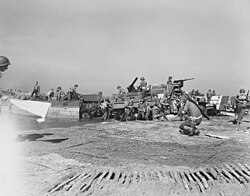
The campaign opened with the invasion of Sicily in July 1943, which destabilized the Fascist regime. By September 1943, Allied forces landed on the Italian mainland, initiating a slow and bloody advance northward.
The Struggle for Rome
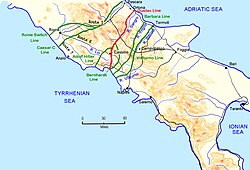
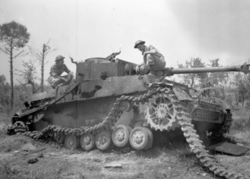
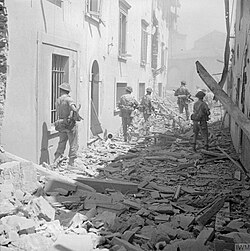
The advance toward Rome was hindered by the German Army's use of the rugged Italian landscape to create formidable defensive barriers. The Winter Line, a series of strongpoints and fortifications, forced Allied infantry into bitter, small-scale battles.
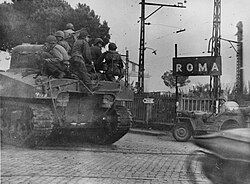
Despite these obstacles, Allied forces continued their push. By May 1944, armored divisions were clearing the roads to the capital, leading to the eventual liberation of Rome on June 4, 1944.
The Final Push into Northern Italy
Following the capture of Rome, the campaign shifted toward Northern Italy. However, the momentum was temporarily slowed in the summer of 1944 when the U.S. VI Corps and the French Expeditionary Corps were redeployed for Operation Dragoon (the invasion of Southern France). To maintain pressure, the Allies integrated new units, including the Brazilian 1st Infantry Division and the U.S. 10th Mountain Division.
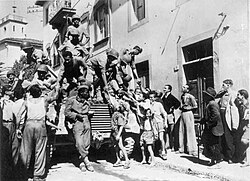
The final offensive began on April 9, 1945, with massive artillery and aerial bombardments. Allied forces broke through the Argenta Gap and captured Bologna on April 21. Brazilian soldiers played a pivotal role in the Battles of Collecchio-Fornovo di Taro, capturing approximately 15,000 German and RSI soldiers.
Campaign Summary and Statistics
The Italian campaign was proportionally more costly for infantry than the Western Front of World War I. The human cost was immense, affecting soldiers and civilians alike.
| Category | Allied Forces | Axis Forces |
|---|---|---|
| Peak Manpower | ~1,333,856 (Overall) | ~439,224 (Overall) |
| Peak Aircraft | 4,000 (March 1945) | 722 (September 1943) |
| Total Casualties | 358,295 – 376,637 | 1,549,590 – 1,793,570 |
| Civilian Deaths | N/A | 152,940 |
Frequently Asked Questions
When did the Italian campaign officially end?
Hostilities formally ended on May 3, 1945, at 17:30 UTC, following the signing of the instrument of surrender by General Heinrich von Vietinghoff on April 29.
What were the most difficult defensive lines for the Allies?
The Allies faced the most intense fighting at the Winter Line, the Anzio beachhead, and the Gothic Line, where German forces utilized strongpoints to stall the advance.
Which non-European nations contributed troops to the campaign?
Significant contributions were made by Brazil (1st Infantry Division), India, and Australia, among other Allied nations.
How many civilians were affected by the fighting in Italy?
The conflict was devastating for the local population, with an estimated 152,940 Italian civilians killed during the campaign.
What was the role of the Italian Resistance?
The Italian Resistance (partisans) acted as co-belligerents starting in September 1943, fighting against Nazi-Fascist forces to help liberate their country.