First Army: The British Field Army of the World Wars
The First Army was a major field army formation of the British Army that played pivotal roles in both the First and Second World Wars. Characterized by its international composition, the First Army frequently integrated allied forces—including Indian, Portuguese, American, and French units—to achieve strategic objectives across two different continents.
Key Facts
- Active Periods: 1914–1918 (WWI) and 1942–1943 (WWII).
- Primary Roles: Western Front operations in WWI; Operation Torch and the Tunisia Campaign in WWII.
- International Cooperation: Commanded diverse forces from India, Portugal, the United States, and France.
- Notable Commanders: Sir Douglas Haig, Sir Henry Rawlinson, and Sir Kenneth Anderson.
- Major WWII Victory: The conclusion of the North African campaign in May 1943.
The First Army in the First World War
The First Army was established on December 26, 1914, as part of the British Expeditionary Force (the primary British army deployed overseas). It was created when the existing corps were divided into two separate armies, with Lieutenant-General Sir Douglas Haig taking command of the First Army.
During its tenure on the Western Front, the First Army commanded the Ist, IVth, and Indian Corps. Its operational history was marked by both progress and hardship. In March 1915, the army achieved an advance of 1,200 yards during the Battle of Neuve Chapelle, though the momentum eventually stalled. The army later faced significant reverses at Vimy Ridge in May 1916 and at Fromelles in June 1916.
By 1917, the formation expanded to include the Portuguese Expeditionary Corps. The First Army remained a critical component of the Allied effort, participating in the decisive 1918 offensive that pushed German forces back and effectively brought the war to a close.
WWI Command Timeline
- Sir Douglas Haig: Dec 1914 – Dec 1915
- Sir Henry Rawlinson: Dec 1915 – Feb 1916
- Sir Charles Monro: Feb 1916 – Aug 1916
- Sir Richard Haking: Aug 1916 – Sept 1916 (Temporary)
- Sir Henry Horne: Sept 1916 – 1918
The First Army in the Second World War
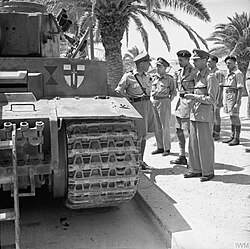
The First Army was reformed in 1942 to lead the land forces during Operation Torch, the Allied invasion of French North Africa. Landing in Morocco and Algeria on November 8, 1942, the army was commanded by Lieutenant-General Sir Kenneth Anderson, who formally activated the headquarters in Algiers on November 9.
Initially composed of British and American formations, the army's order of battle expanded to include French units after the surrender of French forces following the German abrogation of the armistice with Vichy France. At its peak, the First Army consisted of four corps: the US II Corps, the British V Corps, the British IX Corps, and the French XIX Corps.
The army's initial objective was a rapid eastward push to capture the cities of Tunis and Bizerte. While this initial attempt failed, the army used the subsequent period to consolidate its position, improve logistics, and expand its air support bases.
As General Sir Bernard Montgomery's Eighth Army approached from the east, the First Army became the primary weight of General Sir Harold Alexander's 18th Army Group offensive. Supported by the No. 242 Group RAF and the XII Tactical Air Command, the First Army helped secure a massive victory in May 1943. The resulting Axis surrender in North Africa was comparable in scale to the Battle of Stalingrad. Having fulfilled its strategic purpose, the First Army was disbanded shortly after the victory.
WWII Command Timeline
- Lieutenant-General Edmond Schreiber: July 1942 – August 1942
- Lieutenant-General Kenneth Anderson: August 1942 – July 1943
Summary of First Army Operations
| Feature | First World War | Second World War |
|---|---|---|
| Active Dates | 1914–1918 | 1942–1943 |
| Primary Theater | Western Front (Europe) | North Africa |
| Allied Components | Indian, Portuguese | American, French |
| Key Operation | 1918 Final Offensive | Operation Torch / Tunisia Campaign |
| Outcome | German retreat/End of war | Axis surrender in North Africa |
Frequently Asked Questions
When was the First Army first formed?
The First Army was first formed on December 26, 1914, during the First World War, when the corps of the British Expeditionary Force were divided into two separate armies.
Which international forces served under the First Army?
During the First World War, the First Army included Indian and Portuguese forces. During the Second World War, it commanded American and French units.
What was the First Army's role in Operation Torch?
The First Army was formed to command the British and American land forces that invaded French North Africa (Morocco and Algeria) starting on November 8, 1942.
Why was the First Army disbanded in 1943?
The First Army was disbanded shortly after the Axis surrender in North Africa in May 1943 because it had served its specific strategic purpose for that campaign.
Who were the most notable commanders of the First Army?
Notable commanders include Sir Douglas Haig, who led the army at the start of WWI, Sir Henry Rawlinson, and Sir Kenneth Anderson, who commanded during the Tunisia Campaign in WWII.