ISSN: The Global Standard for Periodical Identification
In the vast world of publishing, distinguishing between thousands of magazines, journals, and newspapers can be a challenge—especially when different publications share the same title. The International Standard Serial Number (ISSN) solves this problem by providing a unique eight-digit code to identify periodical publications globally.
First drafted as an International Organization for Standardization (ISO) standard in 1971 and officially published as ISO 3297 in 1975, the ISSN system is essential for ordering, cataloging, and interlibrary loans. Today, it is managed by the ISSN International Centre in Paris, an intergovernmental organization established through an agreement between UNESCO and the French government.
Key Facts
- Purpose: Uniquely identifies periodical publications (serials).
- Format: An 8-digit code divided by a hyphen (NNNN-NNNC).
- Scale: Over 2,500,000 numbers have been issued.
- Governance: Maintained by ISO subcommittee TC 46/SC 9 and the ISSN International Centre.
- Scope: Separate codes are assigned for different media types (print vs. electronic).
The Structure and Logic of an ISSN
An ISSN consists of eight digits, split into two four-digit groups. The first seven digits are the unique identifier, while the eighth is a check digit used for validation. This check digit can be a number from 0 to 9 or the letter "X" (representing the number 10).
To calculate the check digit, each of the first seven digits is multiplied by a weight based on its position (counting from right to left: 8, 7, 6, 5, 4, 3, and 2). These products are summed, and the remainder of the sum modulo 11 is calculated. If the remainder is 0, the check digit is 0. Otherwise, the remainder is subtracted from 11 to find the check digit. If the result is 10, "X" is used.
For example, the journal Hearing Research uses ISSN 0378-5955, where the final 5 is the calculated check digit.

Media-Specific Identifiers and the ISSN-L
Because the ISSN system is media-oriented, a publication that exists in multiple formats requires a different code for each. The two most common labels are:
- p-ISSN: The Print ISSN, used for paper versions.
- e-ISSN: The Electronic ISSN, used for online versions.
To prevent fragmentation, ISO 3297:2007 introduced the Linking ISSN (ISSN-L). The ISSN-L acts as a umbrella identifier that links all media versions of the same content. It is typically based on the ISSN of the first published medium. This allows search engines, library catalogs, and services like OpenURL to group all versions of a journal together regardless of format.
Encoding ISSNs in Barcodes
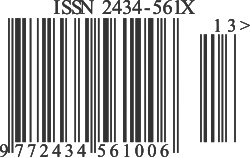
ISSNs can be integrated into EAN-13 barcodes for commercial use. This is achieved by using the "country code" 977, followed by the first seven digits of the ISSN. The barcode then includes two publisher-defined digits and a final EAN check digit. It is important to note that the EAN check digit is calculated differently and will usually not match the original ISSN check digit.
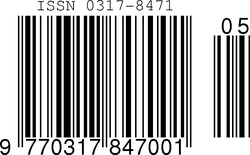
In more complex scenarios, an ISSN can be expanded to a GTIN-13 and paired with an EAN-2 add-on to designate specific issue numbers.
Comparison with Other Identifiers
While often confused with the ISBN (International Standard Book Number), the two serve different purposes. An ISBN identifies a specific book, whereas an ISSN identifies the entire serial title. Because an ISSN is an anonymous identifier—meaning it contains no data about the publisher or location—a new ISSN must be assigned if a publication undergoes a major title change.
For more granular identification, other systems are built upon the ISSN, such as the Publisher Item Identifier (PII) and the Serial Item and Contribution Identifier (SICI), which allow references to specific articles or volumes.
In the digital age, the Digital Object Identifier (DOI) has become the standard for identifying individual articles. Unlike the ISSN, which identifies the journal as a whole, the DOI provides a persistent link to a specific piece of content.
ISSN Summary Table
| Identifier | Full Name | Primary Purpose | Scope |
|---|---|---|---|
| p-ISSN | Print ISSN | Identify paper publications | Media-specific |
| e-ISSN | Electronic ISSN | Identify digital publications | Media-specific |
| ISSN-L | Linking ISSN | Group all media versions | Content-oriented |
| DOI | Digital Object Identifier | Identify specific articles | Item-specific |
Frequently Asked Questions
What is the difference between an ISSN and an ISBN?
An ISSN identifies a periodical publication (like a magazine or journal) as a whole, while an ISBN identifies a specific monograph or book. A single issue of a serial might have both an ISSN for the series and an ISBN for that specific volume.
Can a journal have more than one ISSN?
Yes. If a journal is published in both print and electronic formats, it will have a p-ISSN and an e-ISSN. To link these together, an ISSN-L is used.
Why does some ISSNs end with an 'X'?
The final character is a check digit calculated using a modulo 11 algorithm. When the result of this calculation is 10, the uppercase letter 'X' is used to keep the identifier at exactly eight characters.
How can I find the ISSN of a publication?
The ISSN is typically printed in the publication information of a print serial or listed on the "About" or "Contact" pages of a serial's website. You can also search for publications using the ISSN Register or WorldCat.
What happens if a journal changes its name?
Because the ISSN is associated with the title, a major title change requires the assignment of a new ISSN.