Iron Age Britain: The Era of Hillforts, Celts, and Early Metallurgy
The Iron Age in Great Britain was a transformative era spanning from approximately 800 BC until the Roman conquest in the 1st century AD. Following the Bronze Age, this period was defined by the widespread adoption of iron for tools and weaponry, which revolutionized agriculture and warfare. While the British Iron Age excludes prehistoric Ireland, it saw the rise of complex social hierarchies, the construction of massive defensive earthworks, and the emergence of a distinct Celtic identity.
Early accounts of this period come from the Greek geographer Pytheas (c. 320 BC), who referred to the island as Albion and described its inhabitants as Keltoi (Celts). These people, known as Celtic Britons, spoke Common Brittonic and lived in a society governed by tribal kingdoms and a spiritual tradition overseen by druids.
Key Facts
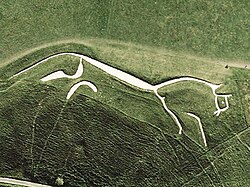
- Timeline: Approximately 800 BC to 43 AD (extending later in non-Romanized areas like Scotland).
- Technology: Transition from bronze to iron for the production of tools and weapons.
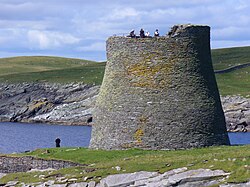
- Architecture: Characterized by massive hillforts in the south and brochs (drystone hollow-walled towers) in Scotland.
- Population: Estimated to have grown to over one million people, supported by improved crops of barley, wheat, peas, and beans.
- Culture: Influenced by the Hallstatt and La Tène material cultures of mainland Europe.
Chronology and Periodisation
Archaeologists have used over 100 large-scale excavations and hundreds of radiocarbon dates—some calibrated via tree ring sequences—to divide the British Iron Age into distinct phases. These phases often align with continental European cultural shifts.
| Period | Approximate Dates | Continental Parallel |
|---|---|---|
| Earliest Iron Age | 800–600 BC | Hallstatt C |
| Early Iron Age | 600–400 BC | Hallstatt D / La Tène I (half) |
| Middle Iron Age | 400–100 BC | La Tène I (rest), II, and III (half) |
| Late Iron Age | 100–50 BC | La Tène III (rest) |
| Latest Iron Age | 50 BC – AD 100 | N/A |
Archaeological Evidence and Architecture
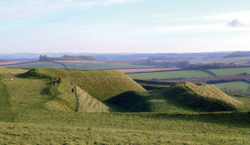
The landscape of Iron Age Britain was dominated by impressive defensive structures. Hillforts—large earthwork enclosures—became common between 550 and 400 BC. While initially simple, they evolved into complex sites like Maiden Castle in Dorset and Cadbury Castle in Somerset.
![Maiden Castle, Dorset, is one of the largest hill forts in Europe.[10][11]](/images/31/1f/311fe6c580607a885abd68b6ff05250d81615fadbcb946c76752fbee09a497d3.jpg)
Evidence suggests these sites were not purely military. Excavations at Danebury reveal that hillforts served domestic purposes, including food storage and industry. However, some may have been occupied only intermittently, acting as regional centers for markets and social contact rather than permanent towns.
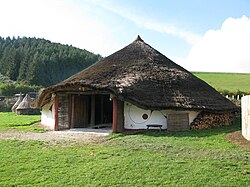
In Northern Scotland, the period is marked by the construction of brochs, unique stone towers. In other regions, people lived in roundhouses, circular dwellings that remained a staple of British prehistoric architecture.
The People and Their Origins
The inhabitants were primarily Insular Celts. Recent archaeogenetic studies suggest that the genetic makeup of southern Britain changed significantly between 1000 and 875 BC due to a gradual migration of people from Gaul. This movement was likely not a single violent invasion but a sustained contact involving traders and family groups, which served as a vector for the spread of Celtic languages.
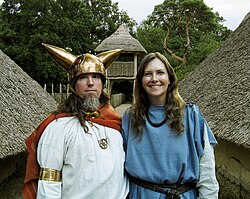
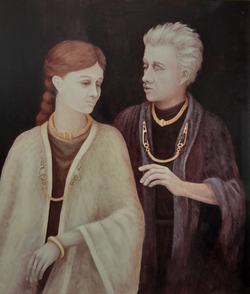
Demographically, the population was concentrated in the fertile agricultural lands of the south. Life expectancy was low, averaging around 25 years at birth, though those who survived to age five could expect to reach 30. High mortality rates among young women during childbirth were common until the Late Iron Age, when increased warfare and social strife began to impact both sexes more equally.
Economy, Trade, and Coinage
The Iron Age economy was based on agriculture and trade. The emergence of coinage in the Late Iron Age reflects growing political complexity. Some coins, such as gold staters, were imported from Europe, while others, like the bronze potin coins of Southeast England, were influenced by Roman designs.
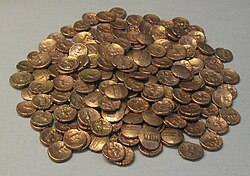
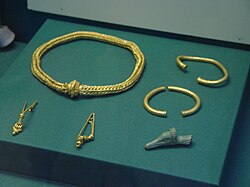
Tribal kings, such as Cunobelinos of Camulodunum, minted their own coins to assert regional identity. Significant finds, such as the Hallaton Treasure—containing 5,294 coins buried in 14 separate hoards—highlight the wealth and ritual practices of tribes like the Corieltavi.
The Transition to Roman Britain
The Iron Age ended in southern Britain with the Roman invasion beginning in 43 AD. While the transition was not instantaneous, the archaeological record shows a shift toward Roman styles. For example, the construction of rectilinear stone buildings replaced traditional roundhouses in some areas by the mid-to-late 1st century AD.
In the north, particularly in Scotland, the Iron Age persisted longer, extending into the 5th century as these regions resisted Romanization.
Frequently Asked Questions
What were hillforts used for?
While their name suggests a military purpose, evidence shows they were used for domestic occupation, food storage, and industry. They likely served as social and economic hubs for markets and community gatherings.
Who were the Insular Celts?
The Insular Celts were the inhabitants of the British Isles during the Iron Age who spoke Celtic languages (such as Common Brittonic) and shared cultural traits with mainland European Celtic groups.
How did the Iron Age end in Britain?
In the south, the period ended with the Roman conquest starting in 43 AD. In the north and in areas that were not Romanized, such as Scotland, Iron Age cultural traits persisted until approximately the 5th century.
What is a broch?
A broch is a type of drystone, hollow-walled tower found primarily in Iron Age Scotland, serving as a sophisticated form of defensive and domestic architecture.
Did the Celts invade Britain in one single event?
Modern genetic evidence suggests that rather than a single violent invasion, the Celtic influence arrived through sustained contact, trade, and small-scale migrations from Gaul over several centuries during the Bronze Age.