Iraq Emblems: A History of National Heraldry
The national emblems of Iraq serve as a visual record of the country's complex political transitions, reflecting shifts from a monarchy to various republican regimes. From the ancient symbols of Mesopotamia to the pan-Arab imagery of the modern era, these heraldic designs encapsulate the identity, aspirations, and ideological changes of the Iraqi state.
The Hashemite Kingdom of Iraq (1921–1958)
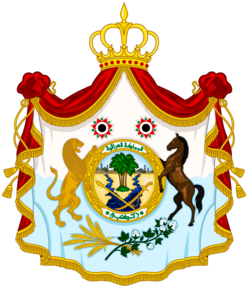
Following the Mandate for Mesopotamia and the establishment of the monarchy, the coat of arms of the Hashemite Kingdom of Iraq was designed to bridge the nation's pre-Islamic and post-Islamic history. The emblem was rich in royal and regional symbolism, centering on the authority of the crown and the geography of the land.
At the pinnacle of the emblem sat a golden crown featuring five beaded arches and a relief design reminiscent of emeralds and rubies. The crown was topped with a spear tip, representing the Hashemite banner, and rested upon a royal mantle. This mantle, lined with white silk and trimmed with golden threads, symbolized purity and sacrifice.
The central shield depicted the heart of Mesopotamia, showing the Tigris and Euphrates rivers flowing through the desert to their confluence at the Shatt al-Arab. A tree at the riverbanks represented the once-vast date palm forests, while a scimitar and spear beneath the tree symbolized the defense of the territory. The shield was flanked by two traditional symbols of royal power: the Lion of Babylon on the dexter (right) side and an Arabian horse on the sinister (left) side.
Above the shield, two stars represented the ancient deities Ishtar and Shamash. The emblem was completed with Kufic script—an early angular form of Arabic calligraphy—stating "Justice is the basis of ruling," and the Hijri year of independence, 1339. Gold ears of wheat and a palm frond adorned the base.
The Republican Transition (1959–1965)
The 1958 Iraqi Revolution led to the overthrow of the monarchy and the rise of the republican government under Abd al-Karim Qasim. The resulting emblem, adopted via Law No. 57 of 1959, marked a sharp departure from royal heraldry, intentionally avoiding pan-Arab symbolism in favor of socialist elements and ancient Mesopotamian motifs.
This emblem featured a golden-yellow sun-disk with eight diffusing beams, drawing inspiration from the symbols of Shamash and Ishtar. At the center of a blue area sat a golden spike surrounded by a black wheel with eight rectangular projections. The design incorporated a white ring embraced by two distinct weapons: an Arabic sword on the left and a Kurdish dagger on the right, symbolizing the diverse components of the state.
The phrase "THE REPUBLIC OF IRAQ" was written in Kufic script above the weapons, with the date of the revolution, "JULY 14" and "1958," positioned between the hilts.
The Era of the Eagle of Saladin (1965–Present)
The 1963 takeover by the Ba'ath Party shifted Iraq's ideological focus back toward pan-Arabism. This was reflected in the adoption of a new coat of arms based on the Eagle of Saladin, a symbol of Arab nationalism popularized after the 1952 Egyptian Revolution.
The Iraqi version of the Eagle of Saladin was nearly identical to that of the United Arab Republic (UAR), with two primary distinctions: the presence of three green stars on the shield's vertical white band (instead of two) and the specific name of the state on the scroll beneath the eagle's feet.
Over the following decades, the emblem underwent several modifications to align with changes to the national flag:
- 1991: The Takbir (the phrase "God is Greatest") was added. To accommodate this text, the bands on the shield were changed from vertical to horizontal, making Iraq the only state using the Eagle of Saladin with a horizontal flag layout.
- 2004: Following the U.S.-led invasion, the interim administration modified the Takbir to be rendered in Kufic script.
- 2008: The three green stars were removed from the shield, leaving only the Takbir in the central white band.
Key Facts
- Monarchy Symbols: The 1921–1958 emblem featured the Lion of Babylon and an Arabian horse as supporters.
- Ancient Influence: Both the monarchical and early republican emblems referenced the deities Ishtar and Shamash.
- Ideological Shift: The 1959 emblem used a Kurdish dagger and Arabic sword to emphasize internal unity over pan-Arabism.
- Unique Design: Since 1991, Iraq has been the only country using the Eagle of Saladin with a horizontal flag on the shield.
- Calligraphy: Kufic script has been a recurring element across different eras of Iraqi state emblems.
| Period | Primary Symbol | Key Themes | Notable Elements |
|---|---|---|---|
| 1921–1958 | Golden Crown & Shield | Monarchy & Mesopotamia | Lion of Babylon, Tigris & Euphrates |
| 1959–1965 | Sun-disk | Republicanism & Socialism | Kurdish dagger, Arabic sword, gear wheel |
| 1965–Present | Eagle of Saladin | Pan-Arabism | Takbir, horizontal flag bands |
Frequently Asked Questions
What did the Lion of Babylon represent in the royal coat of arms?
The Lion of Babylon served as the dexter supporter of the shield and was a traditional symbol representing the power of the king.
How did the 1959 emblem differ from later versions?
The 1959 emblem avoided pan-Arab symbolism, instead incorporating socialist heraldry and a combination of an Arabic sword and a Kurdish dagger to represent the republic's composition.
What is the Eagle of Saladin?
The Eagle of Saladin is a symbol of Arab nationalism that became prominent after the 1952 Egyptian Revolution and was adopted by Iraq in 1965.
Why were the bands on the Eagle of Saladin shield changed to horizontal in 1991?
The bands were changed from vertical to horizontal to allow the Takbir ("God is Greatest") to fit on a single line within the shield.
What changes occurred to the emblem in 2008?
In 2008, the three green stars were removed from the coat of arms to match the changes made to the national flag, leaving only the Takbir in the central band.