Invertebrates: The Diverse World of Animals Without Backbones
When we think of the animal kingdom, it is easy to focus on the mammals, birds, and reptiles that share our environment. However, the vast majority of animal life on Earth consists of invertebrates—animals that lack a vertebral column (backbone). From the microscopic myxozoans to the massive colossal squid, these organisms represent an incredible array of biological forms and adaptations.
Invertebrates are not a single taxonomic group but rather a collection of all animal groups that do not fall under the subphylum Vertebrata. It is estimated that approximately 97% of all animal species are invertebrates, with many individual taxa possessing greater species diversity than all vertebrates combined.
Key Facts
- Dominance: Over 95% of described animal species are invertebrates.
- Size Range: They vary from as small as 10 μm (myxozoans) to as large as 10 meters (colossal squid).
- Diversity: Insects are the most numerous described invertebrate group, with roughly 1,000,000 species.
- Classification: Modern science recognizes over 30 different phyla of invertebrates.
Taxonomic History and Classification
The way we classify these animals has evolved significantly over time. Carl Linnaeus originally divided these organisms into only two groups: Insecta and Vermes (a now-obsolete term for worms). In 1793, Jean-Baptiste Lamarck, serving as the Curator of Insecta and Vermes at the Muséum National d'Histoire Naturelle, coined the term "invertebrate."
Lamarck expanded the classification into ten groups, separating Arachnida and Crustacea from insects, and splitting the "worms" into groups such as Mollusca and Annelida. Today, the classification is far more complex, encompassing a wide range of phyla from simple sponges to highly complex arthropods.
Major Invertebrate Groups and Species Counts
The diversity of invertebrates is staggering. While some groups are small, others, like the Arthropoda, contain millions of species. The following data, based on 2014 IUCN Red List estimates, highlights the distribution of described extant species.
| Invertebrate Group | Phylum | Estimated Described Species |
|---|---|---|
| Insects | Arthropoda | 1,000,000 |
| Arachnids | Arthropoda | 102,248 |
| Gastropods | Mollusca | 85,000 |
| Crustaceans | Arthropoda | 47,000 |
| Bivalves | Mollusca | 20,000 |
| Sea anemones, corals, sea pens | Cnidaria | 2,175 |
| Cephalopods | Mollusca | 900 |
| Velvet worms | Onychophora | 165 |
| Horseshoe crabs | Arthropoda | 4 |
| Others (Jellyfish, echinoderms, sponges, etc.) | Various | 68,658 |
| Total | — | ~1,300,000 |
Biological Diversity and Phyla
Invertebrates are categorized into numerous phyla based on their biological characteristics. Some of the most prominent include:
- Porifera: Simple sponges.
- Cnidaria: Medusozoans and corals.
- Platyhelminthes: Flatworms.
- Annelida: Bristleworms, earthworms, and leeches.
- Arthropoda: Insects, crustaceans, myriapods, and chelicerates.
- Mollusca: Snails, slugs, bivalves, and cephalopods.
- Echinodermata: Starfishes, sea urchins, and sea cucumbers.
Other specialized groups include Tardigrada (water bears), Nematoda (roundworms), and Tunicata (sea squirts). These animals exhibit a vast range of respiratory and nervous systems tailored to their specific environments.
For example, many insects utilize a tracheal system—a network of tubes that delivers oxygen directly to tissues.
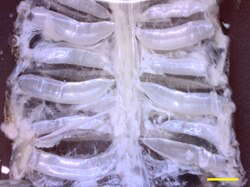
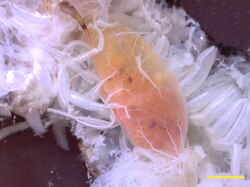
These systems can branch into progressively smaller tubes to supply specific organs, such as the crop.
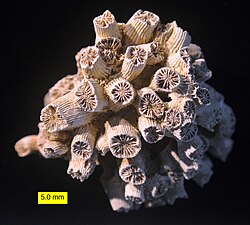
Beyond living species, the fossil record provides insight into ancient invertebrates, such as the Pliocene coral Cladocora found in Cyprus.
Frequently Asked Questions
What percentage of animals are invertebrates?
It is estimated that approximately 97% of all animal species are invertebrates, and over 95% of all described animal species fall into this category.
Which invertebrate group has the most species?
Insects are by far the largest group of described invertebrates, with an estimated 1,000,000 species.
How small and large can invertebrates be?
They exhibit extreme size variation, ranging from myxozoans at 10 μm to the colossal squid, which can reach 9–10 meters in length.
Who first coined the term "invertebrate"?
The term was coined by Jean-Baptiste Lamarck in 1793 while he was serving as the Curator of Insecta and Vermes at the Muséum National d'Histoire Naturelle.
What are some examples of invertebrate phyla?
Examples include Arthropoda (insects and spiders), Mollusca (snails and octopuses), Cnidaria (jellyfish and corals), and Echinodermata (starfish and sea urchins).