Inverness and Aberdeen Junction Railway: Connecting the Scottish Highlands
In the mid-19th century, the expansion of the railway network was the primary driver of economic survival for Scottish towns. For Inverness, a rail connection was not merely a convenience but a necessity to avoid commercial decline. The Inverness and Aberdeen Junction Railway (I&AJR) emerged as the critical link designed to close the gap between the Highlands and the east coast, eventually paving the way for the creation of the Highland Railway.
Key Facts
- Operational Dates: 21 July 1856 to 1 February 1865.
- Primary Purpose: To connect Inverness and Aberdeen by closing the gap between Nairn and Keith.
- Key Engineer: Joseph Mitchell, who advocated for the construction and designed the route.
- Successor: Amalgamated into the Highland Railway Company in 1865.
- Track Gauge: Standard gauge of 1,435 mm (4 ft 8 1⁄2 in).
The Road to Connection: Early Intentions
During the 1840s, railway development focused heavily on Central Scotland. While Aberdeen was connected to the center by 1850, Inverness remained isolated. Initial attempts to bridge this gap were led by the Great North of Scotland Railway (GNoSR), which received parliamentary authorization in 1846. However, due to a lack of investor confidence—raising only £400,000 of the authorized £1.1 million—the GNoSR limited its extension to Keith, leaving Inverness stranded.
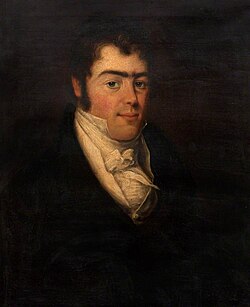
Engineer Joseph Mitchell recognized that a massive single project was financially unfeasible. He instead proposed a modest first stage: a 15-mile line to Nairn. This vision became a reality with the Inverness and Nairn Railway Act 1854, and the line opened on 7 November 1855.
Closing the Gap: Nairn to Keith
With the first stage complete, Mitchell worked to bridge the remaining distance between Nairn and Keith. Despite early attempts to partner with the GNoSR, the relationship was fraught with financial tension and mutual distrust. The GNoSR proved to be a difficult partner, often placing obstacles in the way of joint schemes.
In response, a new prospectus was issued in 1855 for the Inverness and Aberdeen Junction Railway. With a share capital of £325,000, the company received its Act of Parliament on 21 July 1856. Construction progressed rapidly, overcoming significant engineering hurdles, including the bridging of the River Findhorn. The line reached Elgin in March 1858 and finally opened to Keith on 18 August 1858.
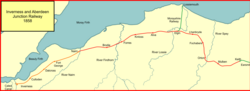
Despite the physical connection, operational cooperation remained poor. There were no through trains between Inverness and Aberdeen; passengers were required to change trains at Keith, with only three of the four daily trains providing a successful connection.
Expanding Southward and the Highland Railway
While the eastern route was established, interests in Inverness sought a more direct path to Perth and the south. Under Mitchell's guidance, the Inverness and Perth Junction Railway was authorized in 1861, branching off at Forres. This route was geographically challenging, featuring high summits at Dava (1,052 feet) and Druimuachdar (1,484 feet), though it required relatively few tunnels and viaducts.
The culmination of these efforts occurred on 1 February 1865, when the Inverness and Aberdeen Junction Railway and the Inverness and Perth Junction Railway amalgamated. By June 1865, this enlarged entity was officially renamed the Highland Railway Company.
The Findhorn Railway Branch
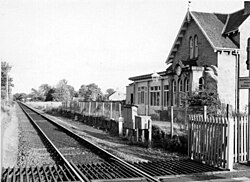
Because the main I&AJR line ran inland, coastal settlements like Findhorn remained isolated. This led to the creation of the Findhorn Railway, a three-mile branch line opening on 18 April 1860. The line utilized a single 0-4-0 saddle tank locomotive built by Neilson and Company.
The branch was a financial failure from the start, unable to cover its basic operating expenses. It was taken over by the I&AJR in 1862 but continued to lose money. The line eventually closed in January 1869, with only occasional goods traffic continuing until 1880. Much of the track bed was later destroyed by the construction of RAF Kinloss.
Summary of Railway Operations
| Railway Entity | Key Date | Primary Route/Role | Outcome |
|---|---|---|---|
| Inverness and Nairn Railway | 1855 | Inverness to Nairn | Merged into I&AJR (1861) |
| Inverness and Aberdeen Junction Railway | 1856–1858 | Nairn to Keith | Became part of Highland Railway (1865) |
| Inverness and Perth Junction Railway | 1861–1863 | Forres to Perth | Became part of Highland Railway (1865) |
| Findhorn Railway | 1860–1869 | Kinloss to Findhorn | Closed due to financial loss |
Frequently Asked Questions
Who was the primary engineer for the I&AJR?
Joseph Mitchell was the driving force behind the project, advocating for the construction and designing the phased approach to connect Inverness to the wider network.
Why were there no through trains to Aberdeen initially?
Poor cooperation and uneasy relations between the I&AJR and the Great North of Scotland Railway (GNoSR) meant that passengers had to change trains at Keith.
What happened to the Findhorn Railway?
The Findhorn Railway suffered from insufficient traffic and high operating costs. After being absorbed by the I&AJR, it closed to passengers in 1869 and completely by 1880.
When did the Highland Railway Company officially form?
The Highland Railway Company was formed on 1 February 1865 through the amalgamation of the Inverness and Aberdeen Junction Railway and the Inverness and Perth Junction Railway.
What were the highest points on the route to Perth?
The route to Perth featured two significant summits: Dava at 1,052 feet (321 m) and Druimuachdar at 1,484 feet (452 m).