Invasion of the Falkland Islands: The Opening Act of the 1982 War
On April 2, 1982, the geopolitical landscape of the South Atlantic shifted violently when Argentine forces launched a coordinated assault on the Falkland Islands. This event, known as Operation Rosario, marked the beginning of the Falklands War, a conflict rooted in a long-standing territorial dispute between the United Kingdom and Argentina.
The invasion was not a sudden surprise to the British administration on the islands. Governor Rex Hunt had been alerted by the British Government on April 1, 1982, that an invasion was possible. Despite the looming threat, the defending forces were vastly outnumbered, consisting of a small detachment of Royal Marines and local volunteers.
Key Facts
- Date: April 2, 1982.
- Primary Location: Stanley, Falkland Islands.
- Outcome: Argentine victory and subsequent occupation until June 1982.
- British Forces: 57 Royal Marines, 11 armed sailors, and approximately 40 militia members.
- Argentine Forces: 550 Marines, 80 Tactical Frogmen, and 20 Armoured Personnel Carriers (APCs).
- Casualties: 1 British killed; Argentine losses disputed (claims range from 1 to 15 killed).
The Defending Forces
The defense of the islands rested on the shoulders of Naval Party 8901, a small group of Royal Marines, and the Falkland Islands Defence Force (FIDF), a local militia. Major Phil Summers led the FIDF volunteers, who were tasked with guarding critical infrastructure, including the power station, radio station, and telephone exchange.
Additional support came from civilians, including former Royal Marines and a Canadian citizen. Even Governor Rex Hunt participated in the defense, armed with a Browning 9 mm pistol. To extend their surveillance capabilities, a civilian coastal ship, the Forrest, acted as an improvised radar screen station off the coast of Stanley.
The Course of Operation Rosario
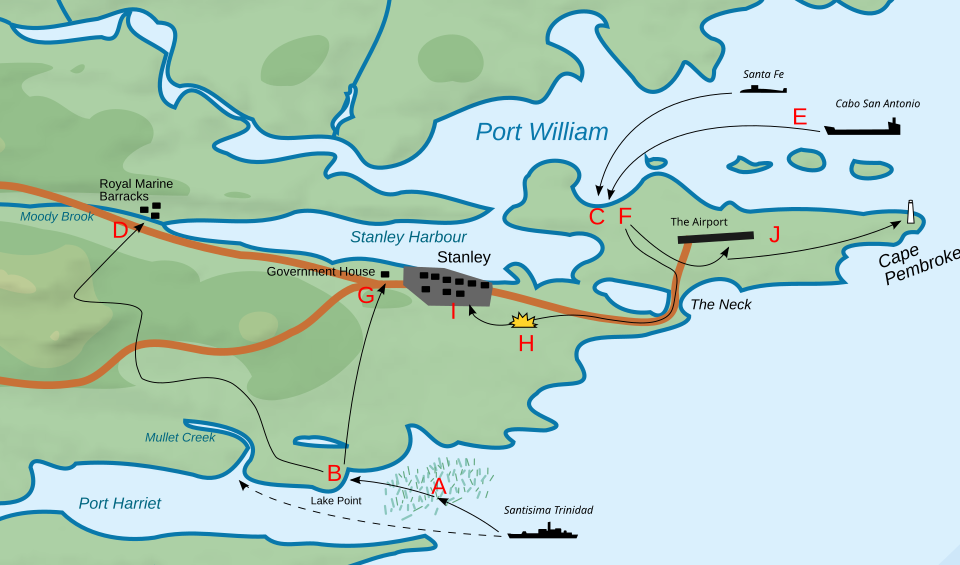
The Argentine operation began on the night of April 1–2. The vessel Santísima Trinidad deployed 21 Gemini assault craft carrying 84 special forces troopers from the 1st Amphibious Commandos Group. Among them was Lieutenant-Commander Pedro Giachino, who volunteered to lead the mission to capture Government House.
The Attack on Moody Brook
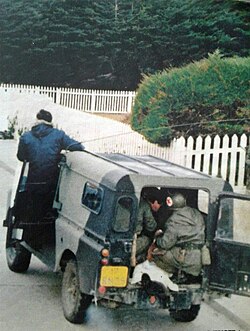
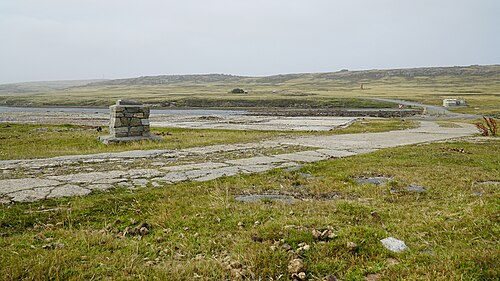
Simultaneously, Argentine forces targeted the Moody Brook Barracks, the island's garrison. This site, which served as an old wireless station, was stormed by Argentine troops, leaving only foundations behind in the years following the conflict.
The Battle of Government House
The most intense fighting occurred at Government House. Argentine forces utilized Armoured Personnel Carriers (APCs) to advance down Airport Road. British Marines engaged the lead APC with 66 mm and 84 mm missiles, successfully destroying the vehicle. However, the remaining APCs deployed their troops, leading to a fierce firefight involving General Purpose Machine Guns (GPMG) and sniper rifles.
The defenders fought a determined battle, with later reports confirming that the British and Royal Navy personnel fired approximately 6,450 small-arms rounds and 12 rockets during the engagement.
Surrender and Aftermath
Faced with overwhelming numerical superiority, Governor Rex Hunt eventually surrendered. By 16:30 local time on April 2, the final telex communication to London confirmed that the islands were under Argentine control. Following the surrender, the Stanley police were deported or left voluntarily, and the FIDF were disarmed at their drill hall.
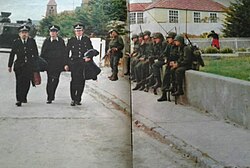
The Argentine victory resulted in the occupation of the islands until June 1982. The international community reacted swiftly, with the United Nations Security Council passing Resolution 502 shortly after the invasion.
Summary of Forces and Casualties
| Category | United Kingdom / Falklands | Argentina |
|---|---|---|
| Personnel | ~108 (Marines, Sailors, FIDF) | 630+ (Marines, Frogmen) |
| Heavy Equipment | Small arms, 12 rockets | 20 Armoured Personnel Carriers |
| Casualties | 1 killed, 6 wounded, 107 captured | Disputed (1 to 15 killed) |
| Key Leaders | Governor Rex Hunt, Major Mike Norman | President Leopoldo Galtieri, Carlos Büsser |
Frequently Asked Questions
Who was the leader of the Argentine mission to capture Government House?
Lieutenant-Commander Pedro Giachino volunteered to lead the party tasked with capturing Government House. He was wounded during the assault and later died.
How many rounds were fired by the British defenders?
Major Mike Norman confirmed in 2007 that the defending Royal Marines and Royal Navy sailors fired 6,450 small-arms rounds and 12 rockets during the fighting on April 2.
What was the role of the Falkland Islands Defence Force (FIDF)?
The FIDF was a local militia tasked with guarding key infrastructure, such as the power station, radio station, and telephone exchange, to support the professional military detachment.
How did the Argentine forces land on the islands?
Argentine forces used a combination of amphibious landings, including the use of Gemini assault craft from the Santísima Trinidad and Armoured Personnel Carriers (APCs) for inland advances.
What was the immediate international response to the invasion?
The United Nations responded to the occupation by issuing Security Council Resolution 502 on April 3, 1982.