Bartolomé Mitre: The Architect of Unified Argentina
Bartolomé Mitre (1821–1906) was a towering figure in 19th-century South America—a versatile general, statesman, historian, and journalist who served as the first president of a unified Argentina. Known for his moderate liberalism, Mitre navigated the volatile transition from a collection of warring provinces to a centralized nation-state, leaving an indelible mark on the country's political and cultural landscape.
Beyond his political tenure, Mitre was a prolific intellectual. He founded La Nación, one of the continent's most influential newspapers, and authored definitive biographies of national heroes. His life mirrored the turbulence of his era, spanning military campaigns, political exile, and the complex task of state-building.
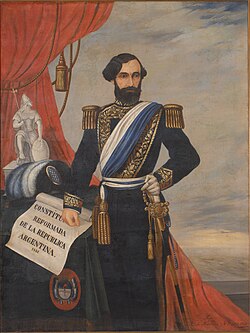
Key Facts
- Presidency: Served as President of Argentina from 1862 to 1868.
- Unification: He was the first president of the unified Argentine Republic.
- Military Rank: Achieved the rank of Lieutenant General in the Argentine Army.
- Intellectual Legacy: Founder of the newspaper La Nación (1870) and a renowned historian.
- Political Stance: A moderate liberal who sought to balance democratic progress with national stability.
Early Life and Political Awakening
Born in Buenos Aires on June 26, 1821, Mitre was of Greek descent (his family name was originally Mitropoulos). His early adulthood was shaped by regional conflict; his family settled in Uruguay in 1831, where he pursued military training. He graduated from the Military School of Montevideo in 1839 as a second lieutenant of artillery.
Mitre's early career was defined by his alignment with the Colorado Party in Uruguay and the Unitario (Unitarian) faction in Argentina. The Unitarians advocated for a strong central government in Buenos Aires, opposing the federalist system and the regime of Juan Manuel de Rosas. This period of exile allowed Mitre to develop his skills as a journalist and poet while fighting in the civil wars of the Banda Oriental.
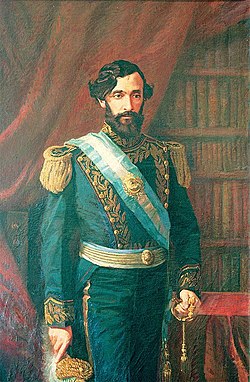
The Path to the Presidency
Mitre returned to Argentina following the defeat of Juan Manuel de Rosas at the Battle of Caseros in 1852. He quickly became a leader in the Province of Buenos Aires, spearheading a revolt against Justo José de Urquiza's federal system during the Revolution of September 11, 1852. This led to a period where Buenos Aires seceded from the Argentine Confederation.
The struggle for national dominance culminated in two pivotal battles. While Mitre suffered a defeat at the Battle of Cepeda in 1860, he emerged victorious at the Battle of Pavón in 1861. This victory granted him significant political leverage, including the amendment of the Constitution to implement indirect elections via an electoral college. On October 12, 1862, Mitre was inaugurated as the constitutional president of the Nation, with Marcos Paz as his vice president.
![Mitre's cabinet: Gelly y Obes, Minister of War and Navy; Lucas González [es], Minister of Finance; Guillermo Rawson, Minister of the Interior; Rufino de Elizalde, Minister of Foreign Affairs and Worship; and Eduardo Costa, Minister of Justice and Public Instruction. (Drawing by H. Meyer).](/images/26/b1/26b1174d4bad802b237e9114b3fc034e5d67599ecaa6ad419d4bacbf2d38beaf.jpg)
Organizing the Modern State
Upon taking office, Mitre faced a precarious republic with an exhausted treasury and fragmented institutions. His administration focused on creating the basic infrastructure of a modern nation:
Judiciary and Law
Mitre prioritized the organization of the Judiciary. The Supreme Court of Argentina began operations on January 15, 1863, and federal courts were established across all provinces. Additionally, the Commercial Code of Buenos Aires was nationalized to standardize trade laws.
Economic and Infrastructure Development
To stimulate growth, Mitre leveraged British capital to expand the railway network. Key projects included the Central Argentine Railway (Rosario to Córdoba), the Buenos Aires Northern Railway, and the Buenos Aires Great Southern Railway. He also resolved customs disputes through a 1863 law that lowered foreign trade taxes to favor European commerce.
Educational Expansion
Believing that liberal ideas should be spread among the youth, Mitre expanded secondary education. He founded national colleges in Salta, Tucumán, Mendoza, San Juan, and Catamarca, and nationalized the Colegio Nacional de Buenos Aires.
Internal Conflict and the Fall of "Chacho"
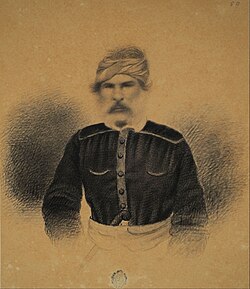
Mitre's drive for centralization met fierce resistance from regional caudillos (local political-military leaders). One of the most prominent opponents was Ángel Vicente "Chacho" Peñaloza.
In 1863, Peñaloza launched a revolution in La Rioja. Mitre responded with a "police war" strategy, stripping the rebels of political status and labeling them as common thieves to justify harsh measures. After a series of defeats, including the Battle of Las Playas, Peñaloza surrendered in Olta on November 12, 1863. He was subsequently executed, and his head was displayed as a warning to other federalists.
Later Years and Political Legacy
After his presidency ended in 1868, Mitre remained a central figure in Argentine politics. He attempted to regain the presidency in 1874 but was defeated by Nicolás Avellaneda. In a desperate bid to stop the inauguration, Mitre hijacked a gunboat, though he was eventually defeated and spared by Avellaneda.
In his final years, Mitre broke with the conservative National Autonomist Party (PAN) to co-found the Civic Union with Leandro Alem. This later split into the National Civic Union (led by Mitre) and the Radical Civic Union (led by Alem).
Mitre died on January 19, 1906, from a gastrointestinal illness. He is buried in the La Recoleta Cemetery, mourned by a massive crowd that recognized him as the paradigm of the 19th-century Argentine statesman.
| Role | Period/Date | Key Achievement/Event |
|---|---|---|
| Governor of Buenos Aires | 1860–1862 | Led the province during the transition to national unity. |
| President of Argentina | 1862–1868 | First president of unified Argentina; organized the Judiciary. |
| Military Commander | 1861 | Victorious at the Battle of Pavón. |
| Journalist/Founder | 1870 | Established the newspaper La Nación. |
| Historian | Throughout life | Authored definitive histories of Belgrano and San Martín. |
Frequently Asked Questions
Who was Bartolomé Mitre?
Bartolomé Mitre was an Argentine general, author, and statesman who served as the first president of a unified Argentina from 1862 to 1868. He is remembered as a moderate liberal who helped build the country's national institutions.
What was Mitre's role in the unification of Argentina?
Mitre achieved national political unity after his victory at the Battle of Pavón in 1861, which allowed him to integrate the Province of Buenos Aires with the rest of the Argentine Confederation and assume the presidency in 1862.
What is the significance of La Nación?
Founded by Mitre in 1870, La Nación became one of South America's leading newspapers, serving as a platform for intellectual discourse and political influence.
How did Mitre handle the rebellion of "Chacho" Peñaloza?
Mitre treated the rebellion as a criminal matter rather than a political one, authorizing a "police war." This resulted in the defeat and execution of Peñaloza in 1863.
What were Mitre's main contributions to Argentine infrastructure?
He promoted the construction of several major railway lines using British capital and established the national judiciary, including the Supreme Court of Argentina.