Intervertebral Discs: Structure, Function, and Common Pathologies
The intervertebral disc (also spelled disk in American English) is a specialized fibrocartilaginous joint, known as a symphysis, located between adjacent vertebrae in the vertebral column. These discs are essential for spinal mobility and protection, serving three primary roles: allowing slight movement between vertebrae, acting as ligaments to hold the spine together, and functioning as critical shock absorbers for the body.
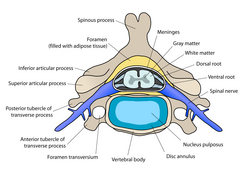
Key Facts
- Total Count: There are 23 discs in the human spine (6 cervical, 12 thoracic, and 5 lumbar).
- Composition: Each disc consists of a tough outer ring (anulus fibrosus) and a gel-like center (nucleus pulposus).
- Primary Function: They distribute hydraulic pressure and absorb impact to protect the vertebrae.
- Aging: Disc degeneration is common; over 60% of people over age 40 show evidence of it on MRI.
- Blood Supply: While present at birth, healthy adult discs have almost no direct blood supply.
Anatomy and Structure
The architecture of an intervertebral disc is designed to manage heavy compressive loads while maintaining flexibility. It is composed of two distinct regions:
The Anulus Fibrosus
The anulus fibrosus is the outer fibrous ring. It is made of several layers (laminae) of fibrocartilage containing both type I and type II collagen. Type I collagen is concentrated at the edges to provide maximum strength, allowing the stiff laminae to withstand significant compressive forces.
The Nucleus Pulposus
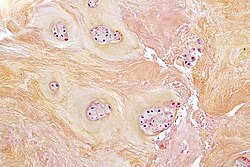
At the center lies the nucleus pulposus, a gel-like core that is a remnant of the embryonic notochord. This core consists of loose fibers suspended in a mucoprotein gel, including collagen fibrils and aggrecan (a proteoglycan that binds to hyaluronan). The negatively charged aggrecan increases oncotic pressure, drawing extracellular fluid into the nucleus to maintain its volume and shock-absorbing capabilities.
Distribution and Nomenclature
Discs are found between every pair of vertebrae except for the first cervical segment, the atlas. The atlas rotates around the axis (the second cervical segment), which allows the neck to swivel. To identify specific discs, clinicians name them based on the vertebral bodies they sit between; for example, the disc between the fifth and sixth cervical vertebrae is called "C5-6".
Clinical Significance and Pathologies
When a condition originates from the intervertebral disc, it is described as discogenic, and the resulting pain is termed discogenic pain.
Spinal Disc Herniation
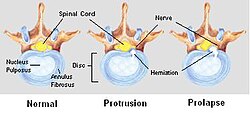
Commonly known as a "slipped disc," a herniation occurs when mechanical pressure deforms the anulus fibrosus, allowing the nucleus pulposus to obtrude. This can be caused by trauma, chronic deterioration, poor posture, or potentially Propionibacterium acnes infection. The bulging material can press against nearby nerves, leading to paresthesia (tingling), numbness, muscle tone loss, or acute pain along a dermatome.
A specific variation known as vertical disc herniation occurs when the nucleus pulposus forms Schmorl's nodes.
Degeneration and Aging
Degeneration is a normal part of aging. As people age, the nucleus pulposus dehydrates and proteoglycan concentrations decrease, reducing the disc's ability to absorb shock. This shrinkage contributes to the general decrease in height seen in older adults. Additionally, the anulus fibrosus weakens and the cartilage endplates may thin or develop fissures, which can lead to the nucleus seeping out and pressing on nerves, potentially causing sciatica.
Scoliosis and Other Spinal Deformities
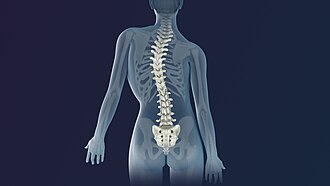
Other morphological changes can affect disc health. Patients with scoliosis (a lateral 'S' curvature of the spine) often exhibit ectopic calcification—calcium deposits—in the cartilage endplate or the disc itself. Other curvatures include kyphosis (hunchback), often seen in old age, and lordosis (swayback), common in obesity or pregnancy.
Summary of Spinal Disc Characteristics
| Feature | Anulus Fibrosus | Nucleus Pulposus |
|---|---|---|
| Position | Outer ring | Inner center |
| Composition | Type I & II Collagen (Fibrocartilage) | Mucoprotein gel, Aggrecan, Water |
| Primary Role | Structural strength and containment | Shock absorption and pressure distribution |
| Age-related Change | Weakening and tearing | Dehydration and shrinkage |
Frequently Asked Questions
What is the difference between a bulging disc and a herniated disc?
While often used interchangeably, a herniation specifically occurs when the anulus fibrosus is deformed enough to allow the inner nucleus pulposus to obtrude or seep out. The disc does not actually "slip" but rather bulges in a specific direction.
Does disc degeneration always cause pain?
No. Evidence shows that over 60% of people over age 40 have disc degeneration visible on an MRI, but these changes are often a normal part of aging and do not necessarily correlate with pain.
How many discs are in the human spine?
There are 23 intervertebral discs in total: 6 in the cervical (neck) region, 12 in the thoracic (middle back) region, and 5 in the lumbar (lower back) region.
Can exercise help prevent disc degeneration?
Some evidence suggests that long-term running may help mitigate age-related degeneration specifically within the lumbar intervertebral discs.
What are Schmorl's nodes?
Schmorl's nodes are protrusions of the nucleus pulposus into the body of the vertebrae, resulting in a type of vertical disc herniation.