Intervertebral Disc Disorders: Herniation, Degeneration, and Spinal Morphology
The intervertebral discs serve as critical shock absorbers for the human spine. When these structures are compromised, the resulting conditions are termed discogenic, particularly when they lead to discogenic pain. From the gradual wear of aging to sudden traumatic injuries, the health of these discs profoundly impacts mobility and neurological function.
Spinal Disc Herniation
A spinal disc herniation, commonly known as a "slipped disc," occurs when unbalanced mechanical pressures cause the anulus fibrosus (the tough outer ring of the disc) to deform. This deformation allows the nucleus pulposus (the gel-like inner core) to obtrude or bulge outward. Contrary to the common name, the disc does not actually slip; it bulges, typically in a single direction.
These events can be triggered by peak physical performance, acute trauma, chronic deterioration often linked to poor posture, or infections such as Propionibacterium acnes. When the nucleus pulposus or the deformed anulus is forced laterally or posteriorly, it can distort local muscle function and compress nearby nerves.
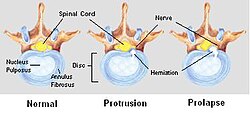
This compression often leads to nerve root entrapment, resulting in symptoms that vary depending on the affected dermatome (the area of skin supplied by a single spinal nerve). Common symptoms include:
- Paresthesia (tingling sensations) and numbness.
- Acute or chronic pain, such as sciatica.
- Loss of muscle tone.
- Decreased homeostatic performance.
Additionally, a specific type of herniation known as vertical disc herniation can occur when the nucleus pulposus forms Schmorl's nodes, protruding into the vertebral body rather than outward.
Disc Degeneration and Aging
Degeneration is a common aspect of the aging process. Research indicates that approximately 25% of people under age 40 show evidence of disc degeneration at one or more levels. This number rises to over 60% for those over age 40, as seen on magnetic resonance imaging (MRI). It is important to note that these degenerative changes are often a normal part of aging and do not always correlate with pain.
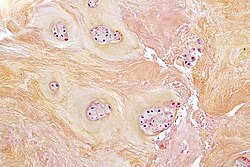
As discs degenerate, the nucleus pulposus dehydrates and the concentration of proteoglycans (proteins with linked sugar chains that retain water) in the matrix decreases. This reduces the disc's ability to absorb shock and leads to a general shrinkage in disc size, contributing to the decrease in height typically seen in older adults.
Other age-related changes include:
- Weakening and increased tearing risk of the anulus fibrosus.
- Thinning of cartilage endplates and the formation of fissures.
- Sclerosis (hardening) of the subchondral bone.
When fissures form due to general degeneration or osteo-arthritic bones, the inner nucleus pulposus can seep out and pressure vertebral nerves. While treatments range from physical therapy to surgery (such as intervertebral disc arthroplasty), some evidence suggests that long-term running may help mitigate age-related degeneration in the lumbar discs.
Further vertebral degeneration may include diffuse idiopathic skeletal hyperostosis (DISH), where ligaments surrounding the vertebrae calcify or ossify. This can cause stiffness and curvature in the thoraco-lumbar and lumbar regions.
Scoliosis and Spinal Morphology
The morphology, or shape, of the spine can also influence disc health. Scoliosis, characterized by a lateral "S" curvature of the spine, is often associated with ectopic calcification (calcium deposits in abnormal places) within the disc or the cartilage endplate. While some individuals with scoliosis experience no pain, others suffer from chronic pain.
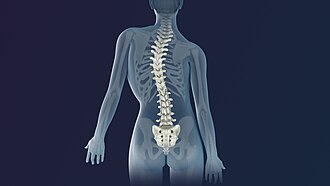
Other morphological abnormalities include kyphosis (an exaggerated forward rounding of the back, or "hunchback"), often seen in old age, and lordosis (an exaggerated inward curve of the lower back, or "swayback"), which is frequently observed in cases of obesity or during pregnancy.
Key Facts
- Discogenic pain refers to pain arising specifically from the intervertebral discs.
- Herniation occurs when the nucleus pulposus protrudes through a deformed anulus fibrosus.
- Age statistics: Over 60% of people over 40 show disc degeneration on MRI, though this doesn't always cause pain.
- Physical changes: Dehydration of the nucleus pulposus and loss of proteoglycans contribute to height loss with age.
- Scoliosis is a lateral "S" curve of the spine often linked to ectopic calcification in the discs.
| Condition | Primary Characteristic | Common Cause/Association |
|---|---|---|
| Disc Herniation | Nucleus pulposus obtrudes through anulus fibrosus | Trauma, poor posture, or P. acnes infection |
| Vertical Herniation | Formation of Schmorl's nodes | Internal disc protrusion |
| Degeneration | Dehydration and loss of proteoglycans | Natural aging process |
| DISH | Calcification of spinal ligaments | Systemic degeneration |
| Scoliosis | Lateral "S" curvature of the spine | Associated with ectopic calcification |
Frequently Asked Questions
What is the difference between a slipped disc and a herniated disc?
A "slipped disc" is a common term for a spinal disc herniation. In reality, the disc does not slip out of place; instead, it bulges in one direction because the outer ring (anulus fibrosus) has deformed, allowing the inner core (nucleus pulposus) to push through.
Does disc degeneration always cause pain?
No. Degenerative changes are a normal part of aging. MRI evidence shows that more than 60% of people over 40 have some level of degeneration, but these changes do not always correlate with the experience of pain.
What are the symptoms of nerve root entrapment?
Symptoms can include numbness, paresthesia (tingling), and either acute or chronic pain. This pain can be localized or felt along the dermatome served by the compressed nerve, and may be accompanied by a loss of muscle tone.
How does aging affect the height of a person?
As people age, the nucleus pulposus in the intervertebral discs dehydrates and loses proteoglycans. This causes the discs to shrink in size, which contributes to an overall decrease in height.
What is the difference between kyphosis and lordosis?
Kyphosis is an abnormal outward curvature of the spine resulting in a "hunchback" appearance, often seen in the elderly. Lordosis is an exaggerated inward curve of the lower back, commonly associated with pregnancy or obesity.