Interstate 40: The History and Evolution of a Transcontinental Giant
Interstate 40 (I-40) stands as one of the most critical east-west arteries in the United States, connecting the Atlantic coast to the Pacific gateway. Its path is not merely a feat of modern engineering but a layer of history built upon ancient trails and early federal experiments in transportation. From the use of camels in the 19th century to the atomic ambitions of the Cold War, the story of I-40 reflects the broader evolution of American westward expansion and infrastructure.
Predecessors and Planning
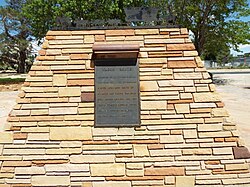
Long before the arrival of asphalt, Native American trails crisscrossed the region. In 1857, Lt. Edward Fitzgerald Beale led an expedition to establish a trade route along the 35th parallel north, stretching from Fort Smith, Arkansas, to Los Angeles, California. Known as Beale's Wagon Road, this route was constructed by 100 men and 22 camels. Completed in 1859, it is widely regarded as the first federal highway in the Southwestern United States.
As the automotive era dawned in the early 20th century, private organizations created "auto trails" to guide motorists. The National Old Trails Road served the western portion toward Albuquerque, while the Lee Highway covered much of the east. By 1926, the United States Numbered Highway System formalized these routes into US 66 and US 70. US 66 became a cultural icon of the American road trip, while US 70 was hailed as part of the "Broadway of America" connecting New York to California.
The Birth of the Interstate
Plans for a south-central trans-continental freeway emerged in the 1930s and 1940s. The general alignment for I-40 was first detailed in a 1947 plan by the Public Roads Administration. The route between Barstow and Greensboro was officially authorized by the Federal-Aid Highway Act of 1956, with numbering approved by the American Association of State Highway Officials (AASHO) in 1957.
The planning phase was not without eccentricity. Between 1963 and 1966, the US government explored Project Plowshare, a proposal to use atomic bombs to excavate the highway's path through California. The project was eventually scrapped due to the high cost of explosives and the inability to create a "clean bomb" (one without significant radioactive fallout).
Construction and Expansion
Construction of I-40 began in the late 1950s, often reusing existing freeways. Early segments included the Magnolia Avenue Expressway in Knoxville, Tennessee, and sections of US 421 in Winston-Salem, North Carolina. The first project built specifically for I-40 began in 1958 along the Pigeon River in Western North Carolina.
The highway was completed in stages across several states:
- Tennessee: The major stretch between Memphis and Nashville opened on July 24, 1966.
- Arkansas: The final internal stretch opened June 30, 1972, followed by the Hernando de Soto Bridge on August 2, 1973.
- California: The final segment in Needles opened August 13, 1973.
- Oklahoma: The final 17-mile stretch near Erick opened June 2, 1975.
In 1990, the final connection between Wilmington and Raleigh, North Carolina, was dedicated. Upon its completion, journalist Charles Kuralt famously remarked that the Interstate Highway System now allowed travelers to cross the country "without seeing anything."
Key Facts
- First Federal Highway: Beale's Wagon Road (1859) served as the precursor to the I-40 corridor.
- Cultural Predecessors: The route largely replaced the legendary US 66 and US 70.
- Atomic Ambitions: Project Plowshare once proposed using nuclear explosives for excavation.
- Legal Landmark: The Citizens to Preserve Overton Park v. Volpe case established modern judicial review for infrastructure projects.
- Major Bridges: The Hernando de Soto Bridge is a critical link over the Mississippi River.
Major Projects and Urban Redesign
Over the decades, I-40 has undergone massive renovations to handle increasing traffic. In Knoxville, the "Malfunction Junction" cloverleaf was replaced by a three-level stack interchange between 1980 and 1982. Similarly, the "Big I" interchange in Albuquerque was reconstructed between 2000 and 2002, earning praise from the FHWA for urban design excellence.
In Winston-Salem, the highway was relocated south of the downtown area in 1992 to reduce congestion, turning the old route into a rare full-freeway business loop (now Salem Parkway). In Knoxville, the "SmartFix 40" project (2008-2009) saw a total closure of a short stretch to accelerate construction, winning multiple AASHTO awards.
Challenges: Geology and Incidents
Geological Hazards
The Pigeon River Gorge, spanning the Tennessee and North Carolina border, is notorious for landslides due to the road being cut into steep mountain slopes. A major landslide in October 2009 closed the road for six months. More recently, Hurricane Helene in September 2024 caused severe damage, washing portions of the highway into the Pigeon River and resulting in an indefinite closure expected to last until early 2025.
Major Incidents
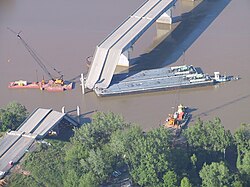
The highway has seen several catastrophic events. In 1988, a propane tanker crash in Memphis created a massive fireball that killed nine people. In 2002, a barge collision near Webbers Falls, Oklahoma, caused a 580-foot section of the bridge to collapse into the Arkansas River, killing 14 people.
More recently, the Hernando de Soto Bridge was closed in May 2021 after a crack was discovered in a tie girder. The bridge remained closed for several months for emergency repairs, reopening in August 2021.
Summary of I-40 Evolution
| Era | Primary Route/Project | Key Characteristic |
|---|---|---|
| 1850s | Beale's Wagon Road | First federal highway; used camels |
| 1920s | US 66 & US 70 | Numbered highway system; cultural icons |
| 1950s-70s | Interstate 40 | Controlled-access freeway construction |
| 1980s-Present | Modernization Projects | Interchange redesigns (e.g., Big I, SmartFix 40) |
Frequently Asked Questions
What was Project Plowshare?
Project Plowshare was a US government plan considered between 1963 and 1966 that proposed using atomic bombs to excavate the path for I-40 through California. It was canceled due to costs and the lack of a "clean bomb."
Why is the case Citizens to Preserve Overton Park v. Volpe important?
This 1971 Supreme Court ruling stopped I-40 from being built through a Memphis public park. It is a landmark case because it established the modern process of judicial review for infrastructural projects.
What happened at the I-40 bridge in Oklahoma in 2002?
A barge collided with a bridge foundation member near Webbers Falls, causing a 580-foot section of the highway to collapse into the Arkansas River, resulting in 14 deaths.
How did Hurricane Helene affect I-40?
In September 2024, the hurricane caused severe landslides in western North Carolina, washing parts of the highway into the Pigeon River and causing indefinite closures in some sections.
Which famous highways did I-40 replace?
I-40 largely follows the corridors previously served by US 66 (particularly in the west) and US 70 (particularly in the east).