Mohave War and Aftermath
During the mid-19th century, the Mohave people faced an increasing influx of white immigrants into their ancestral lands. This period of transition was marked by deep internal division among the kwanami (Mohave leaders). While some leaders advocated for an aggressive stance to deny passage through their territory, others, most notably Irataba, sought a peaceful approach or strategic alliances to strengthen the Mohave against traditional rivals such as the Paiute, Chemehuevi, and Walapai.
The Battle of Pima Butte
On September 1, 1857, a combined force of Mohave and Quechan warriors launched a massive assault on a Maricopa village near Maricopa Wells, Arizona, along the Gila River. Witnessed by white mail carriers, the Battle of Pima Butte was fought primarily with bows, arrows, and clubs. The conflict resulted in heavy losses for the attacking party, with estimates suggesting over 100 warriors died.
This engagement is historically significant as the last major battle involving only Native American nations. The defeat left the Mohave vulnerable and wary that white settlers would exploit their weakened state to seize tribal lands.
The Rose–Baley Party and Escalating Tensions
In 1857, Edward Fitzgerald Beale established a trade route from Fort Smith, Arkansas, to Los Angeles, California, known as Beale's Wagon Road. While Beale's official reports indicated a peaceful relationship with Irataba, his assistant, Humphrey Stacy, noted that the Mohave had obstructed Beale's travel downriver.
Tensions peaked in 1858 with the arrival of the Rose–Baley Party, a group of at least one hundred settlers traveling with wagons and cattle. Conflict erupted when the settlers began cutting down cottonwood trees—a vital resource for the Mohave. In response, warlike kwanamis attacked the party, slaughtering cattle and engaging in a battle on August 30. The skirmish left one settler dead and eleven wounded, while seventeen Mohave warriors were killed.
A separate incident involving the death of another family was widely publicized as a "massacre." Although often blamed on the Mohave, Colonel William Hoffman later suggested the attack was likely carried out by a band of Walapai and a few renegade Mohave. This publicity alarmed Californians and prompted the US War Department to move toward the subjugation of the tribe.
The Establishment of Fort Mohave
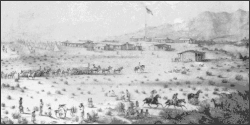
To secure the wagon trail, the US War Department ordered the creation of a military outpost at Beale's Crossing. In December 1858, Colonel William Hoffman and fifty dragoons attempted to confront the Mohave. Despite Irataba's attempts to arrange a peaceful meeting, Hoffman ordered his troops to fire, and the Mohave successfully repelled the force.
Hoffman returned in April 1859 with a significantly larger force of five hundred soldiers from the 6th Infantry Regiment. Facing overwhelming odds, the Mohave opted not to attack. On April 23, Hoffman met with leaders including Cairook, Irataba, Homoseh quahote, and Pascual of the Quechan. The meeting was an ambush of sorts; the Mohave leaders were surrounded by armed soldiers and given a choice between peace and war.
As a condition of peace, Hoffman demanded hostages: one member from each clan and three warriors involved in the Rose-Baley attack. While Homoseh quahote was identified as the leader of the attack, Cairook offered himself as a hostage instead. Along with eight others—including Irataba's son, Tekse thume, and nephews—they were transported to Fort Yuma via the steamer General Jessup.
The hostages were held for over a year. On June 21, 1859, Cairook and one other captive were killed by soldiers during an escape attempt, though most other captives eventually escaped.
The Final Conflict at Irataba's Ranch
The final major clash occurred in July 1861 under Major Lewis Armistead. Suspecting the Mohave of attacking a mail carrier, Armistead ordered his troops to fire into a group of Mohave. He later targeted Irataba's ranch, where he shot and killed a boy planting beans from a hidden position.
This provocation led to a full-day battle. While Armistead reported 23 Mohave dead, tribal memory and historical speculation suggest the casualties were much higher, including women and children. This event is remembered by the Mohave as the first and last battle with Federal Troops.
Key Facts
- Beale's Wagon Road: A trade route established by Edward Fitzgerald Beale connecting Arkansas to California.
- Battle of Pima Butte: The last major conflict fought exclusively between Native American nations.
- Fort Mohave: Established in 1859 at Beale's Crossing to secure white passage through tribal lands.
- Irataba: A Mohave leader who consistently advocated for peace and diplomacy with white settlers.
- Hostage Crisis: Cairook and others were held at Fort Yuma as a condition of peace; Cairook was killed during an escape attempt.
| Event | Date | Primary Opponents | Outcome |
|---|---|---|---|
| Battle of Pima Butte | Sept 1, 1857 | Mohave/Quechan vs. Maricopa | Mohave defeat; heavy casualties |
| Rose–Baley Attack | Aug 30, 1858 | Mohave vs. Settlers | Settlers repelled; 17 Mohave killed |
| Hoffman's First Expedition | Dec 26, 1858 | Mohave vs. US Dragoons | US force repelled |
| Establishment of Fort Mohave | April 1859 | US Army vs. Mohave | Mohave surrender; hostages taken |
| Battle of Irataba's Ranch | July 1861 | Mohave vs. US Army | US victory; high Mohave casualties |
Frequently Asked Questions
Why did the Mohave attack the Rose–Baley Party?
The conflict was triggered when the settlers began cutting down cottonwood trees, which were a critical natural resource for the Mohave people.
Who was Irataba and what was his role?
Irataba was a kwanami (leader) who advocated for peace and alliances with white settlers to avoid war and protect the Mohave from traditional enemies.
What was the significance of the Battle of Pima Butte?
It is recognized as the last major battle fought exclusively between Native American nations, involving the Mohave, Quechan, and Maricopa.
How was Fort Mohave established?
Colonel William Hoffman established the fort in 1859 after returning with 500 soldiers to force the Mohave into a peace agreement and secure Beale's Crossing.
What happened to the Mohave hostages?
Hostages, including Cairook and Irataba's son, were held at Fort Yuma for over a year. Cairook and one other were killed during an escape attempt in June 1859.