Indo-European Languages: The Ancestry of Global Communication
The Indo-European language family stands as one of the most significant linguistic groupings in human history. Spoken by an estimated 3.4 billion people worldwide, this massive family encompasses a vast array of modern tongues, from English and Spanish to Hindi and Russian. At the heart of this diversity lies a single, prehistoric ancestor known as Proto-Indo-European (PIE).
By studying the shared structures, vocabulary, and sounds of modern languages, linguists can reconstruct the lost speech of our ancestors. This scientific process, known as comparative linguistics, allows us to trace the movement of ancient peoples and the evolution of human thought across millennia.
Key Facts
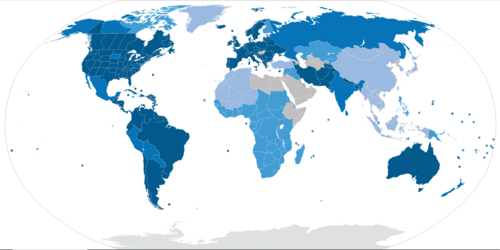
- Estimated Speakers: Approximately 3.4 billion people.
- Common Ancestor: Proto-Indo-European (PIE).
- Primary Homeland: The Pontic–Caspian steppe (the Kurgan hypothesis).
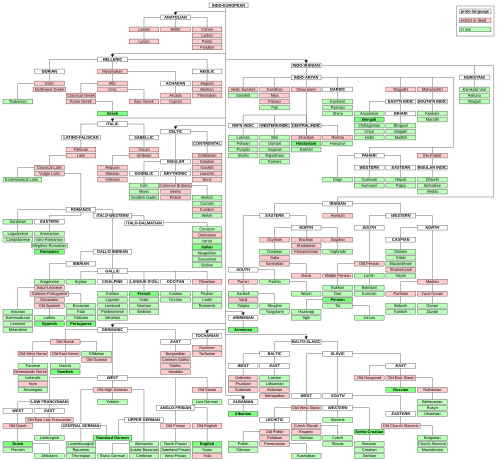
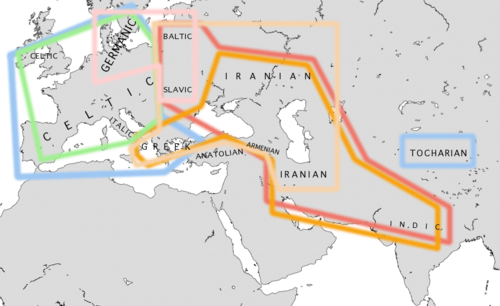
- Major Branches: Germanic, Italic, Indo-Iranian, Balto-Slavic, Celtic, Hellenic, Armenian, and Albanoid.
- Extinct Branches: Anatolian and Tocharian.
The Origins of Proto-Indo-European
Linguists believe that all Indo-European languages descended from a single prehistoric language spoken during the Neolithic or early Bronze Age, roughly between 3300 and 1200 BC. Determining exactly where these people lived—the Proto-Indo-European homeland—is a central debate in archaeology and linguistics.
The prevailing academic consensus is the Kurgan hypothesis. This theory posits that the PIE speakers originated in the Pontic–Caspian steppe, a region encompassing parts of modern-day Ukraine and Southern Russia. This expansion is closely associated with the Yamnaya culture during the 4th and early 3rd millennia BC.
![Scheme of Indo-European language dispersals from c. 4000 to 1000 BC, according to the widely held Kurgan hypothesis.– Center: Steppe cultures1 (black): Anatolian languages (archaic PIE)2 (black): Afanasievo culture (early PIE)3 (black) Yamnaya culture expansion (Pontic-Caspian steppe, Danube Valley) (late PIE)4A (black): Western Corded Ware4B-C (blue & dark blue): Bell Beaker; adopted by Indo-European speakers5A-B (red): Eastern Corded ware5C (red): Sintashta (Proto-Indo-Iranian)6 (magenta): Andronovo7A (purple): Indo-Aryans (Mittani)7B (purple): Indo-Aryans (India)[NN] (dark yellow): Proto-Balto-Slavic8 (grey): Greek9 (yellow):Iranians– [not drawn]: Armenian, expanding from western steppe](/images/5d/8a/5d8ac82e0011f6d648aa45bd889d9b8886e37a85e33637273930d3615e80f028.jpg)
Timeline of Diversification
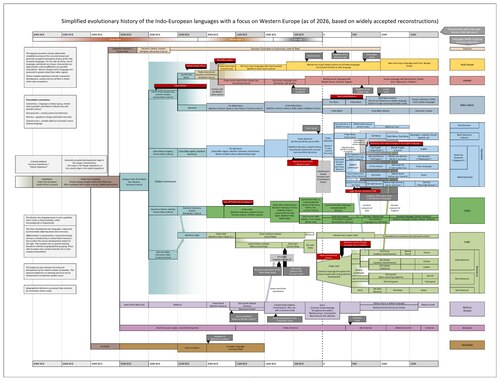
The breakup of the single PIE language into distinct branches happened in stages. While exact dates are debated, researchers like David Anthony suggest a sequence of divergence:
- c. 4200 BC: Pre-Anatolian
- c. 3700 BC: Pre-Tocharian
- c. 3300 BC: Pre-Germanic
- c. 3000 BC: Pre-Italic and Pre-Celtic
- c. 2800 BC: Pre-Armenian and Pre-Balto-Slavic
- c. 2200 BC: Proto-Indo-Iranian
![Indo-European language family tree based on "Ancestry-constrained phylogenetic analysis of Indo-European languages" by Chang et al. 2015[43]](/images/a3/78/a378e02148efe39272a146b688e861c5c3365f6482d205f4cfbf6b4f1992894d.jpg)
Classification and Major Branches
The Indo-European family is divided into several major subgroups. Some of these branches are still vibrant and widely spoken, while others have vanished into history.
Living Branches
Modern speakers belong to several primary subdivisions:
- Germanic: Includes English, German, and Dutch.
- Italic: Includes the Romance languages like Latin, Spanish, and Portuguese.
- Indo-Iranian: A massive group containing Indo-Aryan (such as Hindi) and Iranian languages (such as Persian).
- Balto-Slavic: Includes Slavic languages (Russian, Polish) and Baltic languages (Lithuanian).
- Hellenic: Represented by Greek.
- Celtic: Includes Irish and Welsh.
- Armenian and Albanoid: Distinct branches with unique evolutionary paths.
Extinct Branches
Not all branches survived. The Anatolian branch, which includes the ancient Hittite language, became extinct by Late Antiquity. The Tocharian branch, once spoken in Central Asia, is also extinct. The Anitta text, written in Hittite around 1700 BCE, remains one of the oldest known Indo-European texts.
Linguistic Evolution and Sound Changes
One of the most fascinating aspects of Indo-European studies is observing how sounds change over time. Linguists use cognates—words in different languages that share a common origin—to track these shifts. For example, the PIE word for "foot" ("*pṓds") evolved into the Latin pes, the Greek poús, and the English foot.
A famous way to categorize these languages is through the Centum and Satem distinction. This classification is based on how certain consonant sounds shifted in different branches. Centum languages (like Latin and Germanic) and Satem languages (like Indo-Iranian and Balto-Slavic) represent two different paths of phonetic evolution.
In the Germanic branch specifically, we see significant shifts in consonants. For instance, the PIE aspirated sounds often transformed into simple voiceless fricatives in English. A PIE "*bʰ" might become an "f" in English, as seen in the relationship between the PIE root for "bear" ("*bʰéroh₂") and the English word bear.
Summary of Indo-European Languages
| Category | Details |
|---|---|
| Total Speakers | ~3.4 Billion |
| Proto-Language | Proto-Indo-European (PIE) |
| Major Subgroups | Germanic, Italic, Indo-Iranian, Balto-Slavic, Celtic, Hellenic, Armenian, Albanoid |
| Extinct Branches | Anatolian, Tocharian |
| ISO Code | ine |
Frequently Asked Questions
What is Proto-Indo-European?
Proto-Indo-European is the reconstructed common ancestor of all Indo-European languages. It was a prehistoric language spoken thousands of years ago, and while no written records exist, linguists can recreate its structure by comparing its descendant languages.
Where did Indo-European speakers come from?
Most scholars support the Kurgan hypothesis, which suggests that the speakers originated in the Pontic–Caspian steppe (modern-day Ukraine and Southern Russia) and spread outward during the Bronze Age.
What are Centum and Satem languages?
These are two groups of Indo-European languages categorized by how they pronounce certain ancient consonant sounds. Centum languages include Latin and English, while Satem languages include Sanskrit and Slavic languages.
How do we know these languages are related?
Linguists use the comparative method to identify cognates—words that sound similar and have similar meanings across different languages (like "mother" in English and "mater" in Latin). These patterns reveal a shared genetic origin.
Are all Indo-European languages part of the same family?
Yes, they all descend from the same Proto-Indo-European root, though they have diverged significantly over thousands of years into distinct branches like Germanic, Romance, and Indo-Iranian.