Imperial Amazon: The Rare National Bird of Dominica
The Imperial amazon (Amazona imperialis), also widely known as the Sisserou or Dominican amazon, is one of the rarest birds in the world. Endemic exclusively to the Caribbean island of Dominica, this striking parrot is more than just a biological treasure; it is a national symbol, serving as the national bird of Dominica and appearing prominently on the country's national flag.
Despite its cultural significance, the Sisserou faces a precarious future. Classified as Critically Endangered by the IUCN, estimates from 2019 suggest that only about 50 mature individuals remain in the wild.

Key Facts
- Scientific Name: Amazona imperialis
- Conservation Status: Critically Endangered (IUCN 3.1)
- Location: Endemic to Dominica, Caribbean
- Population: Approximately 50 mature individuals (2019 estimate)
- Distinctive Feature: Dark green plumage with a purple chest
- Legal Protection: CITES Appendix I
Physical Characteristics
The Imperial amazon is a large member of its genus, measuring an average of 48 cm (19 in) in length. There is a noticeable size difference between the sexes, with males averaging 900 g (32 oz) and females averaging 650 g (23 oz).
As a member of the Psittacidae family, the Sisserou possesses zygodactyl feet (two toes pointing forward and two backward) and a thick, hooked bill. This specialized bill, combined with a muscular tongue and hinged mandibles, allows the bird to manipulate food with great precision.
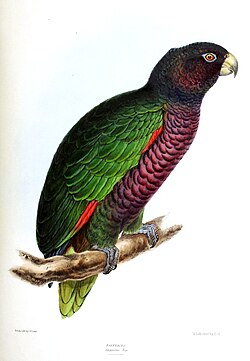
Both males and females share identical plumage: a dark green body with black-edged feather tips and a distinctive dark purple chest. Their eyes are a blend of orange and red, surrounded by a dark brown eye-ring. Juveniles look similar but typically exhibit more green plumage and strictly brown eyes.
Behavior and Ecology
Sisserous are shy, elusive birds that are difficult for humans to approach. They typically travel in small groups of three or fewer, though they occasionally flock with red-necked amazons. Known as powerful flyers and skilled climbers, they prefer perching on the highest canopy of trees, where their green plumage provides excellent camouflage.
Their vocalizations are distinct, consisting of high-frequency, loud, and "squeaky" sounds that blend shrieks, squawks, and trills.
Diet and Foraging
These parrots primarily feed during the morning and evening. Their diet is diverse, consisting of seeds, nuts, berries, blossoms, palm shoots, and fruits. They are particularly fond of the fruits of Dacryodes species, Licania ternatensis, Richeria grandis, and the young shoots of Euterpe palms.
Breeding and Life Cycle
The breeding season occurs between February and April. The female lays a clutch of two white eggs in a deep cavity of a rainforest tree, often returning to the same nesting site year after year. After an incubation period of 26–28 days, the chicks hatch.
Both parents share the responsibility of feeding and caring for the chicks until they fledge between June and early September. Due to high mortality rates, usually only one chick survives to fledging, and pairs typically produce a single successful offspring every other year.
One of the most poignant aspects of their behavior is their mating habit: Sisserous mate for life. They are extremely faithful, and it has been observed that a surviving partner may grieve to death rather than seek a new mate.
Distribution and Habitat
The Imperial amazon is found in the mountain rainforests and elfin forests of Dominica, typically at elevations between 600 and 1,300 meters (approximately 2,100 to 4,265 ft). While they prefer higher altitudes, they have been spotted as low as 150 to 300 meters when foraging or storing food.
Key populations are found in the Morne Diablotins, particularly the upper Picard River Valley. Additionally, a small population has been reintroduced into the Morne Trois Pitons National Park.
| Feature | Detail |
|---|---|
| Average Length | 48 cm (19 in) |
| Male Weight | 900 g (32 oz) |
| Female Weight | 650 g (23 oz) |
| Primary Habitat | Mountain Rainforest |
| Clutch Size | 2 white eggs |
| Incubation Period | 26–28 days |
Conservation Status and Threats
The Sisserou has the lowest reproductive potential of any Amazona species, making its recovery slow and difficult. Several critical threats contribute to its decline:
- Natural Disasters: Severe hurricanes, such as Hurricane David (1979) and Hurricane Maria (2017), have caused extensive habitat destruction and population loss.
- Habitat Loss: Deforestation, selective logging, and the expansion of banana plantations have reduced available living space.
- Human Interference: Illegal trapping for the black market and food remains a threat, though educational programs have reduced local trade.
- Competition and Predation: They compete for nesting cavities with owls and red-necked amazons. Natural predators include the Dominican boa, broad-winged hawks, rats, and common opossums.
Conservation efforts are led by Dominica's Forestry and Wildlife and Parks Division, alongside the Rare Species Conservatory Foundation (RSCF). These groups manage the Northern and Central Forest Reserves and conduct research and public education. A milestone in conservation occurred in 2011 with the first successful human-led captive breeding of the species.
The Guadeloupe Amazon Connection
There is scientific debate regarding the Guadeloupe amazon (A. violacea), a bird now considered hypothetical or extinct. Based on historical descriptions and a bone discovered on Marie-Galante, some researchers suggest that A. violacea may actually be the same species as the Imperial amazon, or a very close relative that once inhabited multiple islands in the region.
Frequently Asked Questions
Why is the Imperial amazon so rare?
The species is rare due to a combination of a very low reproductive rate, habitat loss from deforestation and agriculture, and devastating hurricanes that destroy their nesting sites and food sources.
What does the Sisserou parrot eat?
Their diet consists of various fruits, seeds, nuts, berries, blossoms, and palm shoots, with a preference for specific plants like Dacryodes and Euterpe palms.
How does the Imperial amazon behave toward its mate?
They are monogamous and mate for life. They are known for extreme faithfulness, sometimes grieving to death if their partner dies.
Where can the Imperial amazon be found?
They are endemic to the island of Dominica in the Caribbean, primarily inhabiting mountain rainforests at elevations above 2,100 feet.
Is the Imperial amazon kept as a pet?
No. It is a critically endangered species protected under CITES Appendix I, and illegal trading is strictly prohibited to prevent the species from going extinct.