Ibrahim Pasha: The Military Architect of the Muhammad Ali Dynasty
Ibrahim Pasha (1789–1848) was a towering figure in 19th-century geopolitics, serving as a brilliant general and politician who expanded the influence of the Egyptian state across the Middle East and Mediterranean. As the eldest son of Muhammad Ali, the founder of the modern Egyptian state, Ibrahim was instrumental in transforming the Egyptian army into a professional force capable of challenging the Ottoman Empire.
Though he only officially ruled as Regent and effective leader of Egypt and Sudan for a few months in 1848, his legacy is defined by decades of military conquest and administrative reform. Today, he is remembered as one of the most capable commanders in military history, with his contributions immortalized by a prominent statue in Cairo.
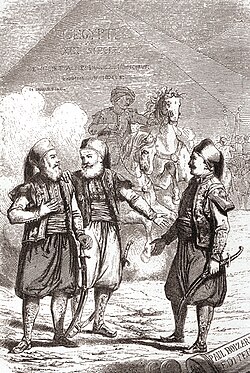
Key Facts
- Role: General of the Egyptian and Ottoman armies; Regent of Egypt and Sudan.
- Dynasty: Alawiyya (Muhammad Ali dynasty).
- Major Conquests: Significant victories in Arabia, the Peloponnese (Morea), and Syria.
- Military Influence: Integrated European drilling and discipline into the Egyptian army via Colonel Sève.
- Identity: Despite his Albanian roots, he strongly identified as Arab.
Early Life and Rise to Power
Born in 1789 in the Ottoman province of Rumelia (modern-day Greece), Ibrahim was the son of Muhammad Ali and Amina Hanim. His early life was marked by political volatility; at age 16, he was sent as a hostage to the Ottoman Kapudan Pasha during his father's struggle for power in Egypt. He returned home only after his father was recognized as the Wāli (governor) of Egypt by the Ottoman Sultan.
Ibrahim's military apprenticeship began early. By 1813, while his father campaigned in Arabia, Ibrahim was entrusted with the command of Upper Egypt, where he successfully suppressed the Mameluks—a military caste that had long dominated Egyptian politics. By 1816, he took command of Egyptian forces in Arabia, marking the start of his reputation as a formidable strategist.
Major Military Campaigns
The War Against the House of Saud
Ibrahim's first major campaign focused on the destruction of the House of Saud as a political power. Operating in the desert of Nejd, he utilized superior artillery and European-style discipline to overcome the Saudi forces. The campaign culminated in September 1818 with the fall and sacking of the stronghold of Diriyah. His perceived brutality during this conflict earned him the moniker Qahir Al Wahhabiyyin (Annihilator of the Wahhabis).
The Greek War of Independence
In 1824, the Ottoman Sultan Mahmud II appointed Muhammad Ali as governor of the Morea (the Peloponnese peninsula) to quell the Greek Revolution. Ibrahim led an army of 17,000 men to the region. While he achieved significant victories in the open field and successfully captured Missolonghi in 1826, he struggled against Greek guerrilla warfare in Mani.
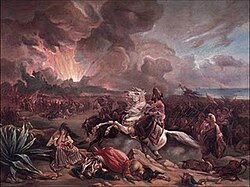
The harshness of Ibrahim's repression, including the enslavement of thousands of inhabitants, sparked international outrage. This led to the intervention of the United Kingdom, France, and Russia at the Battle of Navarino in 1827, eventually forcing Ibrahim to evacuate the Morea in 1828.
The Egyptian–Ottoman Wars
The most ambitious phase of Ibrahim's career occurred during the conflicts with the Ottoman Porte. In 1831, he invaded Syria, capturing Acre and Damascus and routing the Ottoman army at the Battle of Konya in 1832. His administration of Syria and Mount Lebanon was characterized by a centralized Egyptian regime, though it eventually faced revolts due to heavy taxation, conscription, and forced labor (corvée).
Despite a final victory at the Battle of Nezib in 1839, international pressure from Britain and Austria, combined with internal revolts, forced Ibrahim to evacuate Syria in 1841. His retreat was marked by persistent attacks from local tribes, resulting in the loss of much of his army and equipment by the time he reached Gaza.
Administrative Legacy and Final Years
Ibrahim was a proponent of modernization, working closely with the French officer Colonel Sève to implement European military standards. He also had a profound personal identity shift, famously claiming that the "Egyptian sun" had changed his blood, leading him to identify as Arab rather than Turkish.
In his final years, Ibrahim's health declined. He visited Western Europe in 1846 and was later appointed Regent for his ailing father. He held this position from July 1848 until his death on November 10, 1848, in Cairo. He was succeeded by his nephew, Abbas I.
| Category | Details |
|---|---|
| Reign as Regent | July 20, 1848 – November 10, 1848 |
| Key Territories Governed | Egypt, Sudan, Syria, Hejaz, Morea, Thasos, Crete |
| Notable Victories | Diriyah, Missolonghi, Konya, Nezib |
| Key Allies/Advisors | Colonel Sève (Suleiman Pasha), Beaufort d'Hautpoul |
| Burial Site | Hosh al-Basha, Mausoleum of Imam al-Shafi'i, Cairo |
Frequently Asked Questions
How did Ibrahim Pasha change the Egyptian army?
Ibrahim Pasha integrated European military discipline and drilling into the Egyptian forces, largely through the guidance of French officers like Colonel Sève. He led by example, submitting himself to recruit-level drilling to ensure the army's modernization.
Why did Ibrahim Pasha identify as Arab despite his origins?
Although of Albanian descent through his father, Ibrahim spent his formative years in Egypt. He expressed a deep respect for Arab culture and a disdain for the Ottoman Turks, stating that living under the Egyptian sun had made him "wholly Arab."
What led to the end of Ibrahim Pasha's rule in Syria?
His rule ended due to a combination of internal revolts—triggered by oppressive taxation and conscription—and external military and diplomatic intervention by the United Kingdom and the Austrian Empire, who sought to preserve the integrity of the Ottoman Empire.
Who succeeded Ibrahim Pasha as the ruler of Egypt?
Following Ibrahim's death in November 1848, his nephew Abbas I succeeded him as Regent, and later inherited the throne upon the death of Muhammad Ali Pasha.