I-10 Twin Span Bridge: The Engineering Evolution of a Louisiana Landmark
Spanning the eastern reaches of Lake Pontchartrain, the I-10 Twin Span Bridge serves as a critical artery connecting New Orleans and Slidell, Louisiana. Officially designated as the Frank Davis "Naturally N'Awlins" Memorial Bridge, this nearly 5.5-mile causeway consists of two parallel trestle bridges that facilitate the movement of approximately 55,000 vehicles daily.
The current structure is the result of a massive reconstruction effort following the devastation of Hurricane Katrina. By replacing vulnerable older spans with taller, wider, and more resilient engineering, the Louisiana Department of Transportation and Development (DOTD) ensured a more reliable link for the region's commuters and travelers.
Key Facts
- Official Name: Frank Davis "Naturally N'Awlins" Memorial Bridge.
- Total Length: 29,039 feet (8,851 meters).
- Capacity: 6 lanes of I-10 traffic.
- Clearance: 30 feet generally, with an 80-foot high-rise section.
- Daily Traffic: Approximately 55,000 vehicles.
- Maintenance: Managed by the Louisiana DOTD.
The Original Twin Span (1965–2010)
The original bridge system opened on December 21, 1965. These initial spans were constructed using 433 concrete segments, each 65 feet long. At the time, each span provided two lanes of traffic with a standard clearance of 8.5 feet, increasing to 65 feet at the navigational channel to allow for maritime passage.
Impact of Hurricane Katrina
On August 29, 2005, Hurricane Katrina brought a massive storm surge that severely compromised the original bridges. The force of the water shifted or completely removed numerous bridge segments from their piers. The eastbound span lost 38 segments and saw 170 others misaligned, while the westbound span lost 26 segments with 265 misaligned.
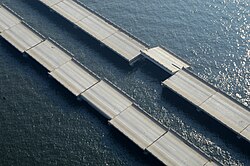
This damage created a logistical crisis, leaving the U.S. Route 11 bridge as the only remaining eastern entrance into New Orleans. In response, the DOTD contracted Boh Brothers Construction Company for $30.9 million to perform emergency repairs. To expedite the process, segments from the westbound span were scavenged to repair the eastbound span, which reopened on October 10, 2005—15 days ahead of schedule. The westbound span followed on January 6, 2006, though it required temporary speed limits of 45 mph and weight restrictions due to the use of prefabricated steel spans.
The Modern Reconstruction (2009–Present)
Recognizing that the original design was too vulnerable to storm surges, officials decided to build entirely new, taller spans. Ground was broken on July 13, 2006, for an $803 million project located 300 feet east of the original structures.
The new bridges were designed for significantly higher capacity and safety. Each span is 60 feet wide, featuring three 12-foot lanes and 12-foot shoulders on both sides. This design eliminated previous bottlenecks and increased traffic capacity by 50 percent. To improve motorist safety, the DOTD integrated electronic message boards and traffic cameras.
The transition occurred in phases: the eastbound span opened on July 9, 2009, and the westbound span opened on April 7, 2010. The project was fully completed with a ribbon-cutting ceremony on September 8, 2011, opening all six lanes to traffic the following morning.
Legacy and Memorial
Following the opening of the new spans, the original bridges were demolished. The resulting debris was repurposed as an underwater reef on the lake bottom, while a small section near Slidell was preserved as a public fishing pier. On August 1, 2014, the bridge was named in honor of Frank Joseph Davis (1942–2013), a beloved WWL-TV News personality and avid fisherman.
Construction Incident
The reconstruction process was not without tragedy. On October 30, 2008, a girder collapsed during the preparation of a concrete pour. Ten workers fell approximately 30 feet into Lake Pontchartrain; one worker, Eric Troy Blackmon, lost his life in the accident.
Technical Specifications Summary
| Feature | Original Spans (1965) | Current Spans (2009-2011) |
|---|---|---|
| Total Lanes | 4 (2 per span) | 6 (3 per span) |
| Standard Clearance | 8.5 feet | 30 feet |
| High-Rise Clearance | 65 feet | 80 feet |
| Span Width | Not specified | 60 feet |
| Storm Resilience | Low (vulnerable to surge) | High (elevated design) |
Frequently Asked Questions
Why was the I-10 Twin Span Bridge rebuilt?
The original bridges were extensively damaged by the storm surge of Hurricane Katrina in 2005. Engineers determined the old design was too vulnerable to such events, leading to the construction of taller, more resilient spans.
Who is the bridge named after?
The bridge is officially the Frank Davis "Naturally N'Awlins" Memorial Bridge, named after Frank Joseph Davis, a former WWL-TV News personality who frequently fished in the area.
What happened to the original bridge structures?
Most of the original bridges were demolished after the new spans opened. The debris was used to create an underwater reef, though a small portion remains in Slidell as a public fishing pier.
How does the new bridge improve traffic flow?
The new bridge expanded from four lanes to six lanes and eliminated bottlenecks at both ends, allowing it to accommodate 50 percent more traffic than the original structure.
When did the current bridge fully open to traffic?
While the spans opened incrementally in 2009 and 2010, all six lanes were officially open to traffic on September 9, 2011.