Hydrothermal Vents: The Geochemical Engines of the Deep Ocean
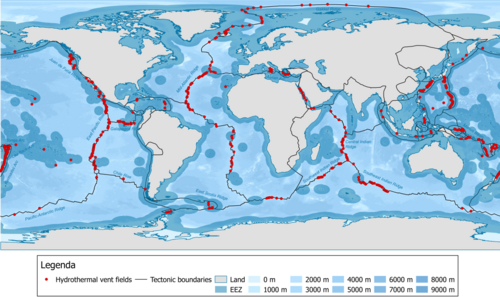
Deep beneath the ocean surface, where sunlight cannot penetrate, the Earth reveals some of its most violent and productive geological features. Hydrothermal vents are fissures on the seabed that discharge geothermally heated water. These vents typically emerge in volcanically active regions, such as mid-ocean ridges where tectonic plates pull apart, ocean basins, and hotspots.
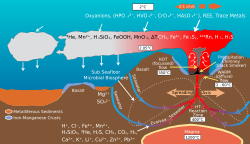
These systems are more than just underwater geysers; they are critical drivers of global marine biogeochemistry. By dispersing hydrothermal fluids into the ocean, they create massive plumes that transport minerals across the seafloor. The resulting mineral deposits, known as hydrothermal deposits, form rich ore bodies of rock and metal.
Key Facts
- Location: Primarily found at mid-ocean ridges, hotspots, and tectonic plate boundaries.
- Energy Source: Driven by geothermal heat from the Earth's interior rather than sunlight.
- Biological Base: Fueled by chemosynthetic bacteria and archaea.
- Chimney Height: Some structures can reach up to 60 meters (200 ft).
- Extraterrestrial Potential: Likely exist on Europa (Jupiter's moon) and Enceladus (Saturn's moon).
The Mechanics of Deep-Sea Chimneys
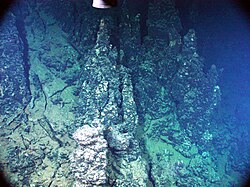
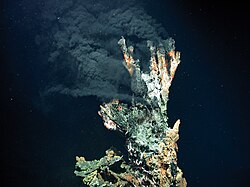
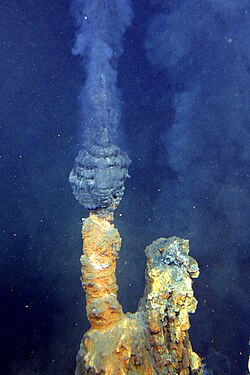
Hydrothermal vents often manifest as towering, cylindrical chimney structures. These form when superheated, mineral-rich water erupts from the crust and hits the near-freezing seawater. This sudden temperature drop causes minerals to precipitate—solidifying out of the fluid—and accumulate into stacks.
One of the most famous examples was "Godzilla," a vent near Oregon that reached a height of 40 meters (130 ft) before collapsing in 1996.
Black Smokers
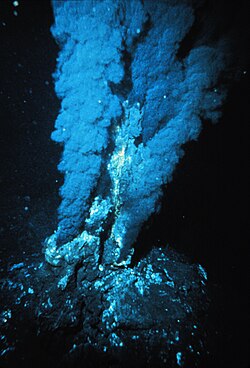
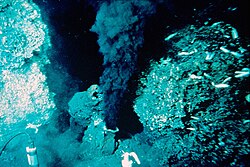
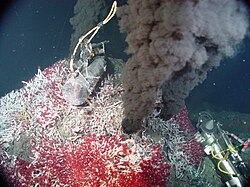
Black smokers are high-temperature vents that emit dark, particle-rich fluids. These particles are primarily metal sulfides, which give the plume its characteristic smoky appearance. First discovered in 1979 on the East Pacific Rise, these vents are hallmarks of intense volcanic activity.
White Smokers
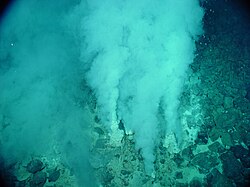
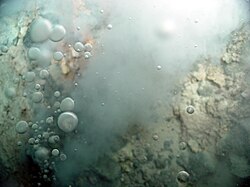
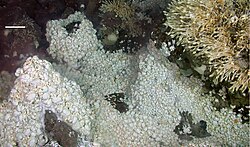
White smokers generally emit cooler fluids and contain different mineral compositions, such as barium, calcium, and silicon. These minerals create lighter-colored plumes. Some white smokers, such as those at the Champagne vent site in Eifuku, are known to emit bubbles of carbon dioxide.
Life in the Abyss: Chemosynthesis and Symbiosis
While most life on Earth relies on photosynthesis, vent communities utilize chemosynthesis. This is a process where bacteria and archaea generate energy from the chemicals dissolved in vent fluids, such as hydrogen sulfide, rather than from sunlight.
These microorganisms form the foundation of a complex food web, supporting a dense population of specialized fauna that can survive extreme pressure and temperature.
Diverse Biological Communities
The areas surrounding these vents are significantly more biologically productive than the surrounding deep sea. Common inhabitants include:
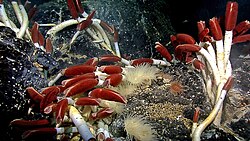
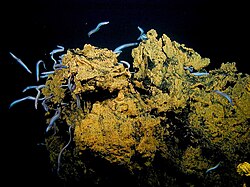
- Giant Tube Worms (Riftia pachyptila): These organisms lack a digestive system and rely entirely on symbiotic bacteria.
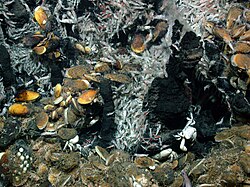
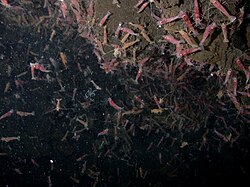
- Crustaceans: Including Alvinocaris shrimp and various squat lobsters.
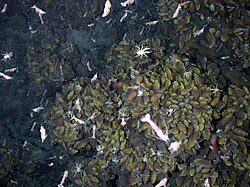
- Mollusks: Such as Bathymodiolus bivalves, clams, and limpets.
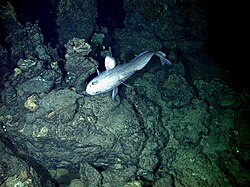
- Specialized Fish: Including Macrouridae and swarms of synaphobranchid eels (Dysommina rugosa) found in areas like "Eel City" on Nafanua.
The Origin of Life and Abiogenesis
Many scientists hypothesize that hydrothermal vents played a pivotal role in abiogenesis—the process by which life arises from non-living matter. The unique chemical gradients and heat provided by these vents are conducive to the synthesis of organic molecules essential for life.
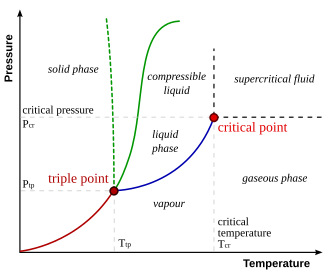
Research suggests that alkaline vents or those containing supercritical carbon dioxide (CO2) may have been particularly effective environments for the formation of primitive life. This theory extends beyond Earth, as scientists speculate that ancient vents once existed on Mars and currently exist on the icy moons of Jupiter and Saturn.
Global Distribution and Exploration
Hydrothermal vent systems are distributed globally across several biogeographic provinces. According to Rogers et al. (2012), these include the Mid-Atlantic Ridge, the East Scotia Ridge, and various sectors of the East Pacific Rise (northern, central, and southern), as well as the Indian Ocean province.
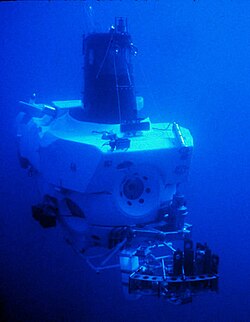
Exploration of these depths has been made possible by advanced submersibles like Alvin, which began exploring these vents in the late 1970s.
| Feature | Black Smokers | White Smokers |
|---|---|---|
| Fluid Temperature | Very High | Lower (Relative to Black) |
| Primary Minerals | Metal Sulfides | Barium, Calcium, Silicon |
| Plume Color | Black/Dark Grey | White/Light Grey |
| Common Emissions | Iron, Copper, Zinc | CO2, Alkaline fluids |
Frequently Asked Questions
How do hydrothermal vents form?
They form when seawater seeps into the Earth's crust through fissures, is heated by underlying magma, and then erupts back into the ocean, carrying dissolved minerals from the crust.
Can animals survive without sunlight at these vents?
Yes. They rely on chemosynthetic bacteria that convert chemical energy from the vent fluids into organic matter, which then supports larger animals like tube worms and shrimp.
What is the difference between a black smoker and a white smoker?
The difference lies in the temperature and mineral content. Black smokers are hotter and rich in metal sulfides, while white smokers are generally cooler and rich in minerals like barium and calcium.
Are hydrothermal vents found outside of Earth?
While not yet proven, spacecraft data suggest that Jupiter's moon Europa and Saturn's moon Enceladus may harbor hydrothermal activity in their subsurface oceans.
Why are these vents important for the origin of life?
They provide the necessary heat, mineral catalysts, and chemical energy gradients that may have allowed the first simple organic molecules to form and evolve into primitive life.