Hwacha: The Innovative Multiple Rocket Launcher of Ancient Korea
The hwacha (Korean: 화차; Hanja: 火車), literally translating to "fire cart," was a sophisticated 15th-century Korean weapons platform. Combining the capabilities of a multiple rocket launcher and a volley gun, this mobile artillery piece allowed the Joseon Dynasty to project devastating firepower across the battlefield. Designed as a wooden cart equipped with a specialized launch pad, the hwacha could deploy a massive barrage of rocket-powered arrows or iron-headed bolts, making it a formidable tool for national defense.
These weapons played a pivotal role during the Japanese invasions of the Korean Peninsula between 1592 and 1598. Many historians credit the hwacha, alongside the famous turtle ships, as having a decisive impact on the outcome of the conflict.
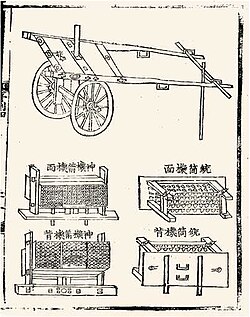
Key Facts
- Function: Served as both a multiple rocket launcher and a volley gun.
- Capacity: Could fire up to 200 singijeon (rocket-powered arrows) or up to 600 bullets depending on the model.
- Range: Rocket projectiles could reach distances of up to 2,000 meters.
- Notable Success: Played a critical role in the Battle of Haengju, helping 3,400 Koreans repel 30,000 Japanese forces.
- Mobility: Built on a wooden cart chassis with iron axles and tar oil for friction reduction.
The Evolution of Korean Firearms
The development of the hwacha was the culmination of decades of military innovation. By 1350, Goryeo military leaders recognized the urgent need for firearms to defend coastal towns against Japanese raiders. While gunpowder technology was imported from China in 1374, the Chinese maintained a strict embargo on the expertise required for production.
This changed when Ch'oe Musŏn successfully acquired the methods for purifying potassium nitrate from Chinese merchants between 1374 and 1376. In 1377, the government established a dedicated office for gunpowder and firearms development under Ch'oe's leadership, leading to the creation of hand cannons and early rockets known as juhwa.
Design and Variants of the Hwacha
The hwacha evolved from the juhwa and singijeon. The first version was created in 1409 by scientists Yi To and Ch'oe Haesan. By 1451, under a decree from King Munjong, the weapon was standardized and deployed in large numbers, including 50 units in Hanseong (modern-day Seoul) and 80 on the northern border.
The Munjong Hwacha
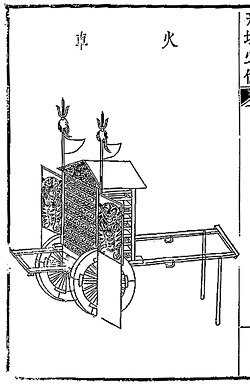
Purportedly developed by King Munjong and his brother, this version featured interchangeable modules. It could be configured as a rocket launcher firing 100 arrows or a volley gun using 50 Chongtong gun barrels to fire 200 darts.
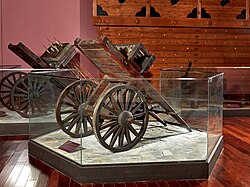
The Mangam Hwacha
The Mangam variant was a box-cart design featuring forty seungja-chongtong gun barrels. With each barrel holding up to 15 projectiles, a single Mangam hwacha could fire a salvo of 600 bullets. These units were often visually striking, decorated with painted dokkaebi (goblin) faces on three sides and operated by a two-man crew.
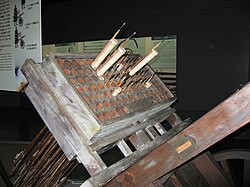
Technical Components and Projectiles
The hwacha's structure was based on a handcart. The top featured a mobile wooden launch pad with 100 to 200 cylindrical holes. To fire, operators placed igniters—similar to those used in Korean cannons—into these holes.
Ammunition Types
The hwacha utilized two primary types of ammunition: arrows and ball ammunition. Because these projectiles were lighter than the heavy iron balls used in Western medieval cannons, the hwacha was significantly more nimble and easier to maneuver.
- Singijeon: Specialized small arrows (called so) with a black powder pouch attached near the fletching.
- Sejeon: Small arrows with metal tips used in the Chongtonggi hwacha.
- Steel-tipped Rockets: High-impact projectiles capable of long-range strikes.
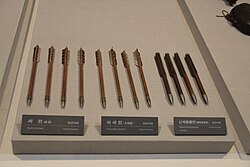
Operational Mechanics
To prepare for combat, operators filled boot-like bags with gunpowder for each igniter. Once primed and loaded, the crew would step back, cover their ears, and pull a rope to trigger the volley. On Panokseon warships, operators adapted their positions, firing from windows on the rowers' deck or from the main deck to target enemy sails.
Summary of Hwacha Variants
| Variant | Primary Mechanism | Max Projectiles per Salvo | Key Feature |
|---|---|---|---|
| Munjong Hwacha | Interchangeable Modules | 100-200 | Versatility between rockets and darts |
| Mangam Hwacha | Seungja-chongtong Barrels | 600 | High volume of fire; Dokkaebi decorations |
| Singijeon Launcher | Rocket Launch Pad | 100 | Long range (up to 2,000m) |
Frequently Asked Questions
What was the primary purpose of the hwacha?
The hwacha was designed as a mobile artillery platform to provide massed firepower, serving as both a multiple rocket launcher and a volley gun for defensive and offensive operations.
How did the hwacha differ from Western cannons of the time?
Unlike Western cannons that fired heavy iron balls requiring thick, heavy barrels, the hwacha fired lighter arrows and small-caliber ammunition. This made the hwacha much lighter, more mobile, and easier to deploy on the battlefield.
What was the significance of the Battle of Haengju?
The Battle of Haengju demonstrated the hwacha's effectiveness; 40 units helped a small Korean force of 3,400 soldiers successfully repel a Japanese army of 30,000.
Who were the key figures in the development of the hwacha?
Early development was made possible by Ch'oe Musŏn's discovery of potassium nitrate purification. The first hwacha was created in 1409 by Yi To and Ch'oe Haesan, with further advancements led by King Munjong in 1451.
How were hwachas used in naval warfare?
On Panokseon warships, hwachas were positioned either on the rowers' deck to fire through windows or on the main deck to target the sails of enemy vessels.