Huns: The Nomadic Empire that Challenged Rome
The Huns were a formidable nomadic people who emerged from the vast Eurasian steppes to become one of the most feared adversaries of the Roman Empire. Between the 4th and 5th centuries CE, they forged a powerful tribal confederation that disrupted the geopolitical balance of Europe, driving other Germanic tribes into Roman territories and launching devastating raids that reached the heart of Italy and Gaul.
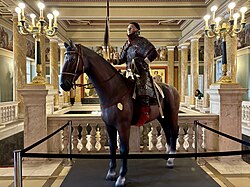
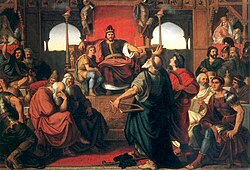
At the height of their power, the Huns were led by the legendary King Attila, whose military genius and political ambition brought the Eastern and Western Roman Empires to the brink of collapse. Their legacy persists not only in historical records but also in the folklore and national identities of Central and Eastern Europe.
Key Facts
- Peak Power: Reached its zenith under Attila (r. 434–453 CE).
- Core Territory: Based primarily on the Great Hungarian Plain and the Pontic Steppe.
- Military Specialty: Expert horse archers utilizing the composite reflex bow.
- Major Conflicts: The Battle of the Catalaunian Plains (451) and the invasion of Italy (452).
- Collapse: The empire fragmented rapidly after Attila's death in 453 and the Battle of Nedao in 454.
Origins and Migration
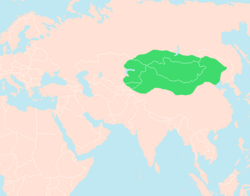
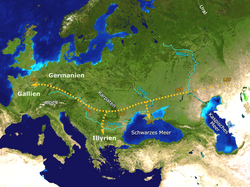
The precise origins of the Huns remain a subject of scholarly debate, though they first appeared to Roman historians north-west of the Caspian Sea before the 370s. Many historians hypothesize a connection to the Xiongnu, a nomadic people from the borders of ancient China, suggesting the Huns may have formed the cradle of this culture before migrating westward.
By the 370s, the Huns had conquered the Alans and Goths, pushing further into Europe. By the 390s, they were likely centered around the Volga and Don rivers on the Pontic Steppe. By the 420s, they had established their base on the Great Hungarian Plain, the only grassland near the Roman Empire capable of supporting their massive herds of horses.
The Rise and Reign of Attila
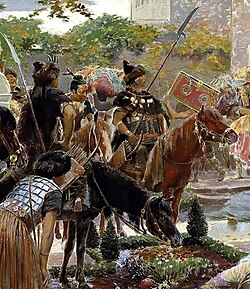
While early leaders like Uldin, Octar, and Rugila established the Huns as a regional power, it was Attila and his brother Bleda who united the various tribes into a cohesive empire. After Bleda's death in 445, Attila became the sole ruler, transforming the Huns into a superpower that demanded tribute from the Eastern Roman Empire.
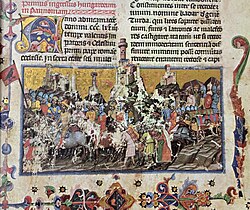
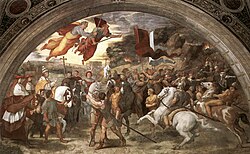
Attila's campaigns were characterized by extreme mobility and brutality. In 451, he invaded Gaul, leading to the Battle of the Catalaunian Plains, where a coalition of Romans and Visigoths managed to halt his advance. Undeterred, Attila invaded northern Italy in 452, though he famously met with Pope Leo I to negotiate a withdrawal from Rome.
The Fall of the Empire
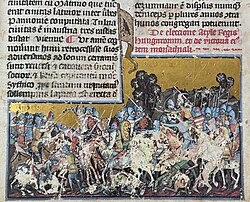
The Hunnic Empire was heavily dependent on the charisma and strength of its leader. Following Attila's death in 453, his sons, including Dengizich and Ernak, struggled to maintain control. The Battle of Nedao (c. 454) saw the Huns defeated by their former subject peoples, such as the Gepids. By 469, with the death of Dengizich, the Huns ceased to be a major political threat to Rome.
Society, Culture, and Warfare
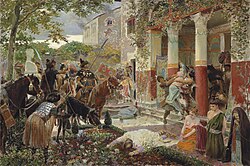
The Huns practiced pastoral nomadism, a lifestyle centered on the herding of livestock and constant movement. Their economy was tied to the Silk Road and supplemented by heavy tributes extracted from the Romans.
Military Prowess
The Huns revolutionized warfare in Europe through their mastery of the horse. Their primary weapon was the reflex bow, a powerful bow made of composite materials that allowed for high velocity and accuracy while riding. They also utilized the spatha (a long sword) and wore armor suited for high mobility.
![A ceremonial "Hun-style" reflex bow reconstructed from sheet gold found in a nomad burial at Jakuszowice, modern Poland[261]](/images/da/c9/dac928f61f89797e2ad7d448b30483a2f63cce396c732bf5aadce408ce44b320.jpg)
Cultural Practices
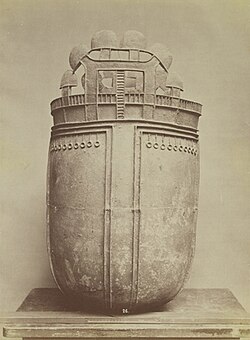
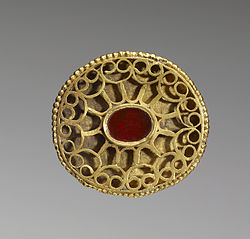
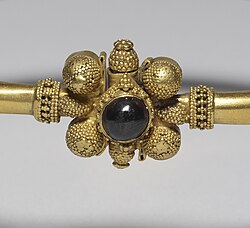
Archaeological evidence reveals a distinct material culture, including ornate gold and garnet jewelry and large cauldrons. One of the most striking cultural markers was artificial cranial deformation—the practice of binding the skull during infancy to create an elongated shape, a trait found in over 200 skulls in the Carpathian Basin.
![Skull of a Hun-period person found in Hungary showing artificial cranial deformation. Over 200 artificially deformed skulls have been found in the Carpathian Basin from the Hun and Avar periods.[173]](/images/9e/6b/9e6b60e48b0ee00d6c68d9313190b4dd420e234f21f0364241001cba3f683996.jpg)
Summary of the Hunnic Empire
![Nomad-style burial of a warrior from Ługi, Migration period in Silesia. The grave shows many similarities to burials along the Black Sea among the Alano-Sarmatian milieu.[217]](/images/88/ff/88ffacd981016bf1bd966a5ab7ffb17a0b3992cd2c0d5424865e691a9c0066e1.jpg)
| Category | Details |
|---|---|
| Timeline | 370s – 469 CE |
| Key Leaders | Uldin, Rugila, Attila, Dengizich |
| Primary Languages | Hunnic, Gothic, and various tribal tongues |
| Government | Tribal Confederation led by a King or Chief |
| Core Territory | Great Hungarian Plain, Pontic Steppe, Pannonia |
Legacy and Historical Memory
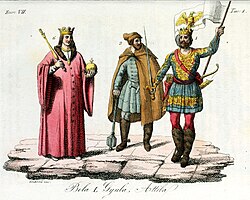
The Huns left a lasting mark on European legend. In Germanic mythology, they are often depicted as the ultimate agents of chaos. In Hungary, a tradition emerged during the High Middle Ages claiming a relationship between the Huns and the Magyars. Simon of Kéza, writing in the 13th century, proposed that the Huns and Hungarians descended from two brothers, Hunor and Magor, a claim used to legitimize the Hungarian conquest of Pannonia.
Frequently Asked Questions
![A spatha buried in a Hun-period grave with a nomadic background from Jakuszowice in modern Poland[223]](/images/18/2f/182f02cbe3b6f7305ef6ddfad99cf9cb05277828148fd0905b51c7cfd5110229.jpg)
Who was the most famous leader of the Huns?
Attila the Hun is the most famous leader. He ruled as sole emperor from 445 to 453 CE and is remembered for his devastating invasions of the Eastern and Western Roman Empires.
What was the primary weapon of the Hunnic army?
The Huns relied primarily on the composite reflex bow, which allowed them to shoot accurately and powerfully from horseback, giving them a significant tactical advantage over infantry-based armies.
Did the Huns actually conquer Rome?
While the Huns invaded northern Italy in 452 and caused widespread destruction, they did not permanently conquer or occupy the city of Rome, largely due to negotiations between Attila and Pope Leo I.
What happened to the Huns after Attila died?
The empire fragmented quickly. Following the Battle of Nedao in 454, many of their subject tribes rebelled, and the Huns were eventually driven out of Pannonia, with some returning to the Pontic Steppe.
What is artificial cranial deformation?
It is the practice of intentionally altering the shape of the skull during infancy through binding. This was a cultural marker among the Huns and later the Avars in the Carpathian Basin.