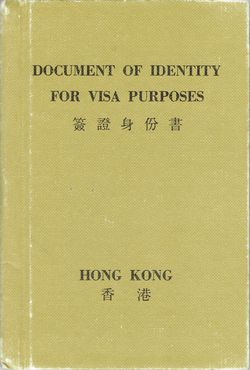
Hong Kong Document of Identity for Visa Purposes
The Hong Kong Special Administrative Region (HKSAR) Document of Identity for Visa Purposes is a biometric travel document issued by the Hong Kong Immigration Department. Unlike a standard passport, this document is specifically designed for residents of Hong Kong who are unable to obtain a national passport from their country of citizenship.
While it serves as an international travel document, it carries different privileges and restrictions compared to a formal HKSAR passport. It is most commonly utilized by individuals in transitional residency statuses or those with specific nationality constraints.
Key Facts
- Purpose: Serves as an international travel document for those ineligible for national passports.
- Validity: Typically valid for 7 years.
- Issuing Authority: Hong Kong Immigration Department.
- Technology: Biometric, machine-readable document with a polycarbonate identification page.
- Primary Users: Often issued to PRC citizens who have migrated via a One-way Permit but have not yet met the 7-year residency requirement for an HKSAR passport.
Eligibility Requirements
The Document of Identity (DI) is available to individuals connected to Hong Kong who cannot secure a national passport or travel document from any other country. Eligibility falls into three primary categories:
- Individuals currently on a limit of stay in Hong Kong.
- Those with unconditional stay (possessing the right to land) who do not hold the right of abode in Hong Kong.
- Individuals who hold a permanent identity card and have the right of abode, but are either not of Chinese nationality or are ineligible for it.
Physical Characteristics and Identification
The document features a high-security polycarbonate insert located between the front cover and the first page. This page utilizes laser engraving technology to print the holder's photograph in black and white. For efficient border control, the document is machine-readable and includes the holder's Hong Kong Identity Card number printed vertically next to the portrait.
The identification page contains the following specific data:
- Travel document type: PH
- Code of Issuing State: CHN
- Personal Details: Surname and given names (in English and Traditional Chinese), sex, and place of birth.
- Dates: Date of birth, issuance, and expiry (formatted as DD-MMM-YY).
- Authority: Immigration Department, Hong Kong Special Administrative Region.
International Use and Restrictions
Because the Document of Identity is not a formal passport, its acceptance varies significantly by destination. Many countries that offer visa-free access to HKSAR passport holders do not extend the same privileges to DI holders.
Mainland China and Macau
Mainland Chinese authorities do not recognize the DI as a valid travel document for Chinese citizens. Citizens permanently resident in Hong Kong must use a Mainland Travel Permit for Hong Kong and Macau Residents to enter or transit through the mainland.
In Macau, Hong Kong permanent residents can enter for one year using their permanent ID. Non-permanent residents holding a Document of Identity and a Hong Kong identity card may enter Macau for up to 30 days.
Taiwan and Europe
Travelers to Taiwan using a Document of Identity must apply for an Entry and Exit Permit in advance. In Europe, specific rules apply to refugees and stateless persons. While Hungary allows visa-free entry for stateless individuals holding a DI, Germany's visa exemption is practically unavailable because Hong Kong does not recognize refugees under its own legislation, nor is it a signatory to the 1954 Stateless Persons Convention.
Additionally, school pupils who are Annex I nationals (those usually requiring visas for Schengen states) may enter Malta, Poland, and Slovakia visa-free for up to 90 days if traveling on a teacher-led school trip.
Consular Protection
Holders of the Document of Identity who are not Chinese citizens are not entitled to consular protection from the People's Republic of China government. However, Chinese foreign missions can provide assistance if the document is lost or stolen while abroad.
Document Summary
| Feature | Details |
|---|---|
| Validity Period | 7 Years |
| Cost (44 pages) | HK$ 285 |
| Cost (92 pages) | HK$ 370 |
| Issuance Volume (2021) | 23,968 documents |
| Issuance Volume (2009-2010) | 54,554 documents |
Frequently Asked Questions
Who is the primary target for the Document of Identity?
It is primarily issued to residents of Hong Kong who cannot obtain a national passport, most notably PRC citizens who migrated via a One-way Permit and lost their mainland hukou but have not yet resided in Hong Kong for the seven years required for an HKSAR passport.
Can I use the Document of Identity to enter Mainland China?
No. Mainland Chinese authorities do not accept the DI as a valid travel document for Chinese citizens. You must use a Mainland Travel Permit for Hong Kong and Macau Residents.
How long is the Document of Identity valid?
The document is usually valid for a period of seven years.
Does the Document of Identity provide the same visa-free access as an HKSAR passport?
No. It has more restrictions than a formal passport, and fewer countries offer visa-free access to DI holders compared to HKSAR passport holders.
What happens if I lose my Document of Identity while traveling?
While non-Chinese citizens do not receive full consular protection, Chinese foreign missions are able to assist holders in the event that the document is lost or stolen abroad.