Holarctic Realm: Biogeography, Ecosystems, and Conservation
The Holarctic realm is a vast biogeographic region encompassing the majority of habitats across the Northern Hemisphere. Corresponding to the floristic Boreal kingdom, this realm is a massive ecological expanse that bridges two primary zoogeographical regions: the Nearctic, which covers most of North America, and the Palearctic, which includes North Africa and nearly all of Eurasia (excluding the Indian subcontinent, Southeast Asia, and the southern Arabian Peninsula).
The continuity of these regions is not accidental; it is the result of a shared glacial history that has allowed ecosystems, plants, and animal communities to extend across multiple continents.
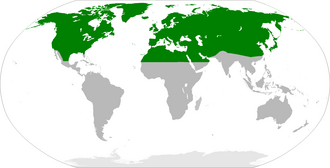
Key Facts
- Composition: Combines the Nearctic (North America) and Palearctic (Eurasia and North Africa) regions.
- Climate Drivers: Shared glacial history and the influence of the Pleistocene Ice Age.
- Key Ecosystems: Ranges from Arctic tundra and boreal forests to temperate grasslands and deserts.
- Connectivity: Historically linked by the Bering land bridge, allowing faunal interchange.
- Primary Threats: Global warming (especially in the north) and habitat fragmentation (especially in the south).
Major Ecosystems of the Holarctic
The distribution of ecosystems within the Holarctic realm is primarily determined by latitude and local geography. These environments transition from frozen northern wastes to diverse southern landscapes.
Arctic Tundra and Boreal Forests
In the far north, a band of Arctic tundra encircles the Arctic Ocean. This region is defined by permafrost—ground that remains frozen year-round—which creates harsh conditions where only a few specialized plants can survive. Immediately south of the tundra lies the boreal forest, a massive belt of coniferous trees stretching across both North America and Eurasia.
Temperate and Arid Zones
As one moves further south, biodiversity increases. The landscape shifts into temperate forests dominated by deciduous trees and expansive temperate grasslands. In the southernmost reaches of the realm, the environment transitions into deserts, where flora and fauna are specifically adapted to arid conditions.
Animal Species with Holarctic Distribution
Due to the historical connectivity of the Northern Hemisphere, several species are found across both the Nearctic and Palearctic regions.
| Species | Scientific Name | Key Habitat/Trait |
|---|---|---|
| Brown Bear | Ursus arctos | Mountainous and semi-open wilderness areas. |
| Grey Wolf | Canis lupus | Highly adaptable; ranges from tundra to desert. |
| Red Fox | Vulpes vulpes | Widest distribution of any terrestrial carnivore. |
| Moose | Alces alces | Boreal forests and montane regions. |
| Caribou/Reindeer | Rangifer tarandus | Tundra and boreal forests; domesticated in Eurasia. |
| Common Raven | Corvus corax | Wooded northern areas and human-developed zones. |
Other distributed species include the wolverine (Gulo gulo), a large weasel found in arctic and boreal forests; the red ant Leptothorax acervorum; the orb-weaving spider Zygiella x-notata; and the brown lacewing Hemerobius humulinus.
Origins and Glacial History
The biological similarity between North America and Eurasia is rooted in the Pleistocene epoch. During this Ice Age, repeated glaciations scoured the land. Species survived in refugia—small areas with suitable climates—primarily in the south, though some existed in sheltered northern pockets.
When glaciers receded during interglacial periods, species recolonized the land at different rates. Insects shifted ranges quickly due to high mobility, while trees recolonized at an exponential rate. Large mammals, such as brown bears, were among the first to move back into the newly opened territories.
A critical factor in this distribution was the Bering land bridge. Lowered sea levels during ice cap expansion exposed this bridge, allowing cold-tolerant species to migrate between the Palearctic and Nearctic regions in several faunal interchanges.
Environmental Threats
The Holarctic realm faces two primary international challenges: global warming and habitat fragmentation.
Global Warming and Permafrost
Cold-adapted ecosystems are particularly vulnerable. Milder winters have decreased the mortality of certain insects, leading to devastating outbreaks. For example, spruce beetle outbreaks have destroyed up to 90% of spruce trees on the Kenai Peninsula since 1987. Furthermore, the melting of permafrost can transform forests into peatlands or tundra into shrublands. This process also threatens to release locked-up carbon as carbon dioxide or methane, further accelerating the greenhouse effect.
Habitat Fragmentation
In the southern Holarctic, where many of the world's most developed nations are located, urbanization and intensive agriculture have fragmented natural habitats. This is especially dangerous for keystone species—large carnivores like wolves and brown bears that regulate prey populations. These animals require vast, intact territories to maintain genetic diversity and sustainable populations.
Conservation Actions
International and regional efforts are underway to preserve Holarctic biodiversity. On a global scale, agreements like the Kyoto Protocol have aimed to reduce greenhouse gas emissions to mitigate climate change.
On a regional scale, initiatives like the Yellowstone to Yukon Conservation Initiative (started in 1997) work to create a contiguous network of protected areas. By establishing core protected zones connected by corridors and buffer zones, the initiative seeks to ensure that wide-ranging species, such as grizzly bears, can migrate and survive alongside human activity.
Frequently Asked Questions
What exactly is the Holarctic realm?
The Holarctic realm is a biogeographic region that covers most of the Northern Hemisphere, combining the Nearctic (North America) and Palearctic (Eurasia and North Africa) zoogeographical regions.
How did species move between North America and Eurasia?
Species migrated via the Bering land bridge, which was exposed during the Pleistocene Ice Age when sea levels dropped due to the expansion of ice caps.
What is the impact of melting permafrost?
Melting permafrost can cause forests to shift into peatlands or tundra to become shrublands. It also risks releasing large amounts of stored carbon into the atmosphere as methane or carbon dioxide.
Why are large carnivores more affected by habitat fragmentation?
Large carnivores like brown bears and wolves require immense areas of intact land to find food and maintain a genetically healthy population, making them highly susceptible when land is divided by cities or farms.
What is the purpose of the Yellowstone to Yukon Conservation Initiative?
It aims to create a connected network of protected areas and corridors from Wyoming to the Alaska-Canada border to support the migration and survival of wide-ranging species.