Calcariidae: The Specialized World of Longspurs and Snow Buntings
The Calcariidae are a small but distinct family of passerine birds—perching birds characterized by their song and specialized toe structures. Comprising only six species across three genera, this family includes the longspurs and snow buntings. These hardy birds are primarily found across the vast landscapes of North America and Eurasia, where they have adapted to some of the most challenging environments on Earth.
From the frozen expanses of the Arctic tundra to the sweeping grasslands of the Great Plains, members of the Calcariidae family are migratory specialists. They occupy a variety of open habitats, including prairies, mountains, and coastal beaches, filling a specific ecological niche as ground-foraging insectivores and granivores.
Key Facts
- Species Count: Six species divided into three genera: Calcarius, Plectrophenax, and Rhynchophanes.
- Distribution: Found mainly in North America and Eurasia.
- Weight Range: Between 20 grams (chestnut-collared longspur) and 42 grams (McKay's bunting).
- Diet: A mix of insects, seeds, and grasses.
- Evolution: Diverged from a common ancestor approximately 4.2 to 6.2 million years ago.
Physical Characteristics
Birds in the Calcariidae family are generally small and subtly colored to blend into their open environments. Their plumage typically consists of shades of brown, grey, and white, while their irises are usually black or dark brown.
Leg color serves as a distinguishing feature between the genera. The snow bunting and McKay's bunting possess dark gray or black legs. In contrast, other species in the family exhibit leg colors ranging from brown to a dull pink.
Taxonomy and Evolutionary History
Historically, these birds were classified under the family Emberizidae, which includes Old World buntings and New World sparrows. However, a 2008 phylogenetic study—the study of evolutionary relationships—revealed that Calcariidae forms a distinct clade (a group consisting of a common ancestor and all its descendants) separate from Emberizidae.
Research suggests they share closer affinities with tanagers (Thraupidae), cardinals (Cardinalidae), or New World warblers (Parulidae), though the exact connection remains unclear. The International Ornithological Congress officially recognized them as a separate family in 2010. DNA analysis of the cytochrome b gene indicates that the family diverged during the early Pliocene epoch, likely coinciding with the spread of North American grasslands as the climate became cooler and drier during the late Miocene.
Genera and Species Relationships
The family is divided into three genera: Calcarius (longspurs), Plectrophenax (snow buntings), and Rhynchophanes (thick-billed longspur). Genetic data shows that the thick-billed longspur is most closely related to the two snow bunting species. Meanwhile, Smith's and the chestnut-collared longspur are sister taxa, meaning they are each other's closest relatives.
The timeline of divergence varies significantly across the family. While the Lapland longspur diverged roughly 4.4 to 6.2 million years ago, the snow and McKay's buntings split much more recently, within the last 100,000 to 125,000 years. Similarly, Smith's and collared longspurs likely diverged around 1.5 to 2 million years ago at the start of the Pleistocene.
Distribution and Habitat
The geographic reach of the Calcariidae is extensive, though it varies by species. The snow bunting and Lapland longspur are the most widespread, appearing in both North America and Eurasia. The remaining four species are endemic to North America.
The snow bunting breeds across northern Alaska, Canada, Greenland, Scandinavia, and Russia. It winters in southern Canada, the northern United States, and a broad band across Europe and Asia from Germany to China. It has even been spotted as a vagrant—a bird found outside its normal range—in North Africa and the Mediterranean.
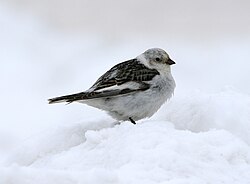
The Lapland longspur follows a similar pattern, breeding in northern Canada, Siberia, and coastal regions of Alaska and Greenland, while wintering in the northern U.S., Canada, and across Central Asia to the Sea of Japan.
Other species have more restricted ranges. McKay's bunting breeds on Bering Sea islands and winters on the Alaskan coast. Smith's longspur breeds in Alaska and northern Canada, wintering in the south-central U.S. The chestnut-collared and thick-billed longspurs are primarily associated with the prairie regions of the northern Great Plains and southern Canadian Prairies, wintering in the southern U.S. and Mexico.
Habitat Preferences
Across all species, there is a strong preference for open, treeless areas. This includes:
- Prairies and plains
- Coastal shores and beaches
- Farmland
- High-altitude mountainous regions (specifically for the snow bunting)
Behavior and Diet
Members of the Calcariidae family are diurnal, meaning they are active during the day. Their foraging behavior is characteristic of ground-feeders; they walk across the terrain and pick up food directly from the soil. Their diet is opportunistic, consisting of a combination of seeds, grasses, and various insects.
Summary of Calcariidae Species
| Genus | Species | Primary Breeding Range | Wintering Range |
|---|---|---|---|
| Calcarius | Lapland longspur | N. Canada, Scandinavia, Siberia | N. USA, Canada, Russia, China |
| Calcarius | Smith's longspur | Alaska, N. Canada | Central Southern USA |
| Calcarius | Chestnut-collared longspur | N. Great Plains, Canadian Prairies | Southern USA to Central Mexico |
| Plectrophenax | Snow bunting | Arctic N. America, Scandinavia, Russia | N. USA, Canada, Europe, Asia |
| Plectrophenax | McKay's bunting | Bering Sea Islands | Western Alaska coast |
| Rhynchophanes | Thick-billed longspur | N. Great Plains, Canadian Prairies | Southern USA to Northern Mexico |
Frequently Asked Questions
How are longspurs different from typical sparrows?
While they look similar, longspurs belong to the family Calcariidae, whereas true sparrows belong to other families. Genetic studies have shown that longspurs are more closely related to New World warblers, cardinals, and tanagers than to the Emberizidae family they were once grouped with.
Do different species of Calcariidae hybridize?
Yes, hybridization occurs within the family. Reported instances include the thick-billed longspur hybridizing with the chestnut-collared longspur, as well as hybridization between the snow bunting and McKay's bunting.
What is the difference between a snow bunting and McKay's bunting?
Although they are very similar and sometimes considered the same species, a 2007 study highlighted substantial differences in their juvenile plumage, supporting their classification as two distinct species.
Where can these birds be found during the winter?
Depending on the species, they winter in a wide range of locations, from the northern United States and southern Canada to central Mexico and across a broad band of Eurasia, including Russia, China, and Mongolia.
What do longspurs and snow buntings eat?
They have a generalist diet consisting of insects, seeds, and grasses, which they forage for by walking on the ground during the day.