Hispanophone World: The Global Reach of the Spanish Language
The term Hispanophone (from the Latin Hispanicus, meaning "Spanish," and the word "phone") refers to people and cultures related to the Spanish language. This linguistic identity is deeply intertwined with Hispanic culture, the enduring legacy of the Spanish Empire, and a shared sense of identity known as Hispanidad (Hispanicity).
The Spanish-speaking world, or the Hispanosphere, primarily encompasses Spain, Hispanic America, Equatorial Guinea, and significant portions of the United States, particularly Florida and the Southwest. In a broader cultural sense, it also includes former Spanish East Indies colonies like the Philippines and Guam.
Within this community, some distinguish between Castilian (the specific Spanish language) and Spanish (a broader term encompassing the various languages of Hispanic nations).
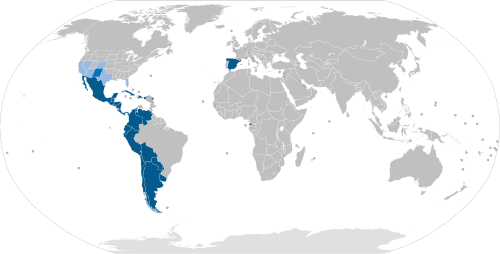
Key Facts
- Total Speakers: Approximately 574 million people (474.7 million native and 100 million second-language speakers as of 2022).
- Global Rank: Spanish is the second most natively spoken language and the fourth most spoken language overall globally.
- Primary Hubs: Mexico has the largest Spanish-speaking population, followed by the United States and Colombia.
- African Presence: Equatorial Guinea is the only African country where Spanish is an official language.
- Antarctic Outposts: The only civilian localities in Antarctica are primarily inhabited by native Spanish speakers.
The Geography of the Hispanosphere
The spread of the Spanish language was driven by migration and colonization between 1492 and 1898. This era created multiracial populations and established Spanish as a dominant tongue across several continents.
The Americas and the United States
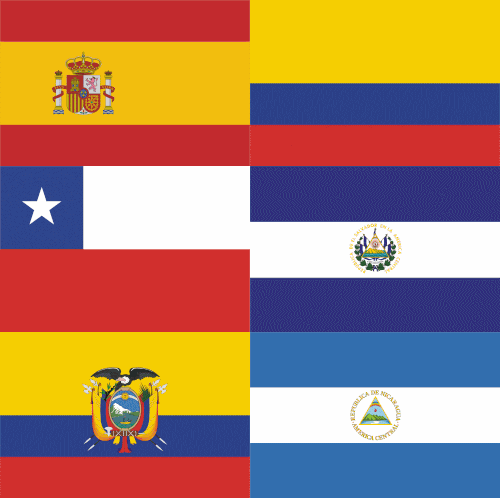
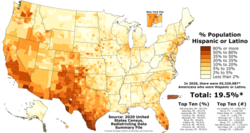
In the Americas, Spanish is the primary language for the majority of nations. In the United States, Spanish is the second most spoken language. While it has no official status nationwide, it is official in New Mexico.
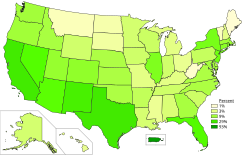
The Spanish presence in the U.S. predates English colonization. St. Augustine, Florida (1565) and Santa Fe, New Mexico, were established before Jamestown and Plymouth. By 1783, Spain claimed roughly half of the current continental United States. Today, Hispanics are a rapidly growing demographic; as of 2013, they accounted for 17.1% of the population, with projections suggesting they will make up 25% of the U.S. population by 2050.
Europe and Africa
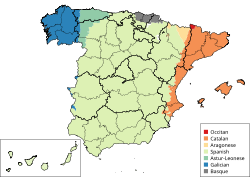
Spain remains the European heart of the language, though it is home to various regional languages.
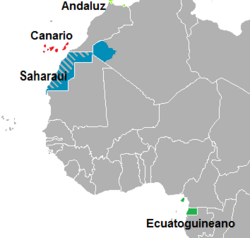
In Africa, Equatorial Guinea maintains Spanish as an official language. Additionally, about 1.7 million people in Morocco spoke Spanish as of 2018, though the language's popularity there has declined in favor of English and French.
Asia, Oceania, and Antarctica
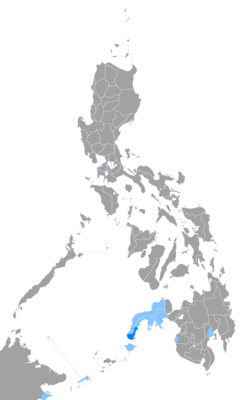
While the Philippines and Guam were former colonies, the linguistic legacy varies. In the Philippines, the Chabacano language remains a notable Spanish-based creole.
Easter Island (Rapa Nui), part of Chile, stands as the only island in Oceania where Spanish is an official language.
![Easter Island, part of Chile, is the only island in Oceania whose official language is Spanish.[27]](/images/55/37/5537e38542f014f6be8476709d0221236982272bb2c9aeecd6ab26314ae269fb.jpg)
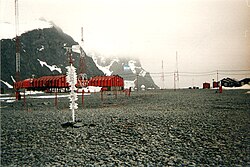
Even in Antarctica, Spanish is prominent. The Orcadas Base, an Argentine station, is the oldest operating Antarctic base (since 1907). Civilian populations also reside in the Argentine Fortín Sargento Cabral and the Chilean Villa Las Estrellas.

Linguistic and Cultural Diversity
Judeo-Spanish (Ladino)
Ladino is a dialect of Spanish historically spoken by Sephardic Jews in the Ottoman Empire, Morocco, and the Balkans. Recognized as a Spanish dialect by the Royal Spanish Academy in 2017, it is currently categorized as an endangered language, with approximately 51,000 native speakers as of 2018.
Demographics and Identity
Hispanic identity is independent of language proficiency. In the U.S., Hispanics can be of any race, including White, Amerindian, Black, Asian, or Pacific Islander. A significant portion of the population in Mexico, El Salvador, and Paraguay identifies as mestizo (a mixture of European and Indigenous ancestry).
Statistical Overview
The following table outlines the Spanish-speaking populations and land areas of key Hispanophone territories.
| Rank | Country/Territory | Spanish-Speaking Population | Area (km²) |
|---|---|---|---|
| 1 | Mexico | 130,118,356 | 1,964,375 |
| 2 | United States | 56,757,391 | 9,147,593 |
| 3 | Colombia | 51,609,474 | 1,141,748 |
| 4 | Spain | 47,615,034 | 505,944 |
| 5 | Argentina | 46,234,830 | 2,780,400 |
Frequently Asked Questions
What is the difference between Hispanic and Hispanophone?
Hispanophone specifically refers to those who speak the Spanish language. Hispanic is a broader term referring to people with ancestry or national origin from Spanish-speaking nations, regardless of whether they currently speak the language.
Is Castilian different from Spanish?
Castilian (Castellano) is the specific dialect from Castile that became the standard Spanish language. In many contexts, the terms are used interchangeably, though some use "Castilian" to refer to the language itself and "Spanish" to refer to the broader group of languages from Hispanic nations.
Which country has the most Spanish speakers?
Mexico has the largest Spanish-speaking population in the world, with over 130 million speakers.
Where is Spanish spoken in Africa?
Spanish is an official language in Equatorial Guinea. It is also spoken by a significant minority (approximately 1.7 million people) in Morocco.
What is Ladino?
Ladino, or Judeo-Spanish, is a dialect of Spanish developed by Sephardic Jews. It is currently considered an endangered language.