Hesperornis: The Toothed Diving Bird of the Cretaceous
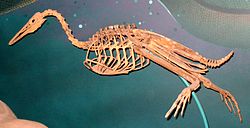
During the Late Cretaceous period, the oceans were home to a peculiar predator that defied the modern image of a bird. Hesperornis was a large, flightless marine bird that traded the sky for the sea, evolving into a highly specialized diver. Measuring between 1.5 and 2 meters (4.9–6.6 ft) in length and weighing approximately 10.6 kilograms (23 lb), this creature represents a fascinating chapter in avian evolution.
Unlike modern birds, Hesperornis possessed teeth and virtually no wings, relying instead on powerful hind legs to propel itself through the water. While early theories suggested it had lobed toes similar to modern grebes, recent morphometric studies indicate that webbed toes—common in loons and other aquatic birds—are equally likely.
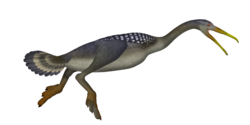
Key Facts
- Temporal Range: Late Cretaceous (Campanian), approximately 83.6 to 72 million years ago.
- Physical Traits: Flightless, wingless, and possessed teeth in its jaws.
- Locomotion: Powerful hind legs used for diving and swimming.
- Size: Up to 2 meters long and weighing around 10.6 kg.
- Distribution: Found in North America (Kansas, Montana, South Dakota, Alberta) and Russia.
Discovery and the Bone Wars
The story of Hesperornis is inextricably linked to the 19th-century rivalry known as the Bone Wars. The first specimen was discovered in 1871 by paleontologist Othniel Charles Marsh during an expedition to Kansas. Marsh initially found a large, wingless skeleton which he named Hesperornis regalis (the "regal western bird").
A subsequent find by Marsh's student, Thomas H. Russell, provided a nearly complete skeleton including the head. This discovery was revolutionary; the presence of teeth in the jaws of a bird provided critical evidence that broke down the traditional scientific distinction between reptiles and birds, highlighting a clear evolutionary link.
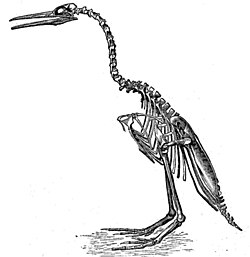
This period of discovery was marred by the hostility between Marsh and his rival, Edward Drinker Cope. After Cope accidentally received fossils intended for Marsh, including the toothed birds, the relationship dissolved into open conflict. Despite this, Marsh eventually acquired parts of 50 different Hesperornis specimens, allowing for a comprehensive study of the genus.
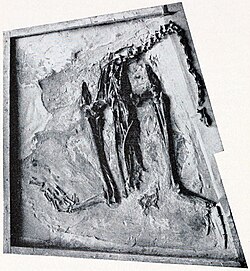
Species Diversity and Classification
The genus Hesperornis contains numerous species, though many are identified from limited skeletal remains. Classification is often based on the geographic location of the find, the age of the rock strata, or the size of the specimen.
North American Species
- H. regalis: The type species and best known, found in the Smoky Hill Chalk of Kansas. It is the only species with a nearly complete known skull.
- H. crassipes: Larger than H. regalis, distinguished by having five ribs instead of four and different bone sculpturing on the breastbone.
- H. gracilis: A smaller species known from the Niobrara chalk.
- H. altus: Found in Montana (approximately 78 million years ago), originally placed in the genus Coniornis.
- H. montana: A smaller species from Montana known from a single dorsal vertebra.
- H. bairdi, H. chowi, H. mengeli, and H. macdonaldi: Species identified from the Pierre Shale Formation in South Dakota and Alberta.
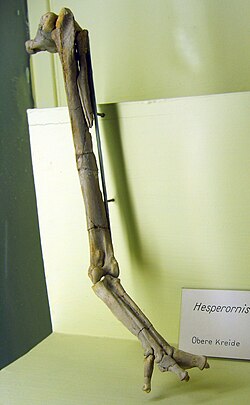
Global Distribution
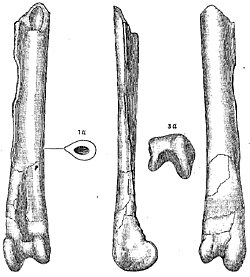
While primarily known from North America, Hesperornis rossicus was identified in 1993 from the early Campanian of Russia. At 1.4 meters long, it was among the largest hesperornithines and featured a highly flattened metatarsus (the bone between the ankle and toes).
Paleobiology and Survival
Hesperornis followed a growth pattern similar to modern birds, growing quickly and continuously until reaching adulthood. Its anatomy was perfectly tuned for a marine existence, though its specialized legs made it clumsy on land.
Evidence of the dangers it faced is preserved in the fossil record. A leg bone examined by researchers revealed bite marks from a young polycotylid plesiosaur. The presence of infection in the bone indicates that the Hesperornis actually survived the attack and escaped its predator.
Summary of Hesperornis Characteristics
| Feature | Description |
|---|---|
| Dietary Adaptation | Toothed jaws for gripping prey |
| Primary Locomotion | Hind-limb powered swimming |
| Flight Ability | Flightless (wingless) |
| Key Species | H. regalis, H. rossicus, H. crassipes |
| Geographic Range | North America and Russia |
Frequently Asked Questions
Did Hesperornis have teeth?
Yes, Hesperornis had jaws lined with teeth, a primitive trait that provided important evidence for the evolutionary transition from reptiles to birds.
Could Hesperornis fly?
No, Hesperornis was flightless. It had virtually no wings and was specialized entirely for diving and swimming in marine environments.
Where did Hesperornis live?
Most specimens have been found in North America, particularly in Kansas, Montana, and South Dakota, though one species (H. rossicus) was discovered in Russia.
How did Hesperornis swim?
It used powerful hind legs for propulsion. While it was once thought to have lobed toes like grebes, it is now considered equally likely that it had webbed toes.
What did Hesperornis eat?
While the source does not explicitly list prey, its toothed jaws and diving capabilities indicate it was a predator of marine animals.