Herod the Great: The Architect and Ruler of Judaea
Herod the Great remains one of the most complex and controversial figures of the ancient world. A master politician and prolific builder, he navigated the treacherous waters of Roman power to establish the Herodian dynasty, transforming the landscape of Judaea through ambitious architectural projects and a ruthless approach to governance.
Born around 72 BCE in Idumea, Herod rose from the status of a tetrarch—a governor of a fourth part of a region—to become the King of the Jews. His reign was characterized by a delicate balancing act: maintaining the favor of the Roman Empire while attempting to legitimize his rule over a Jewish population that often viewed him as an outsider.
The Rise to Power
Herod's ascent began in 41 BCE when Mark Antony appointed him and his brother Phasael as tetrarchs to support Hyrcanus II. However, the political climate was volatile. In 40 BCE, Antigonus, the nephew of Hyrcanus II, seized the Judean throne with Parthian assistance, forcing Herod to flee to Rome.
While in Rome, Herod successfully lobbied the Roman Senate, which unexpectedly named him King of the Jews. To solidify his claim and gain favor among the Jewish people, Herod married Mariamne I, the granddaughter of Hyrcanus II. This move required him to banish his first wife, Doris, and their son, Antipater.
With the support of the Roman governor Sosius, Herod captured Jerusalem in 37 or 36 BCE, executing Antigonus and ending the Hasmonean Dynasty. He then assumed the title of basileus (king), marking the official start of his sole rule over Judaea.
Navigating Roman Allegiances
As a vassal of the Roman Empire, Herod's primary duty was to serve Roman interests. However, his throne was frequently threatened. Internally, he faced opposition from the Hasmonean family; in 35 BCE, he ordered the assassination of Aristobulus III to prevent a potential coup backed by Cleopatra and Mark Antony.
Externally, Herod was caught in the power struggle between Mark Antony and Octavian (later known as Augustus). After Antony's defeat at the Battle of Actium in 31 BCE, Herod acted quickly to secure his position. At Rhodes, he convinced Octavian of his loyalty by demonstrating his ability to defend the frontier and keep Judaea open as a strategic link to the wealth of Egypt and Syria.
Architectural Legacy and the Second Temple
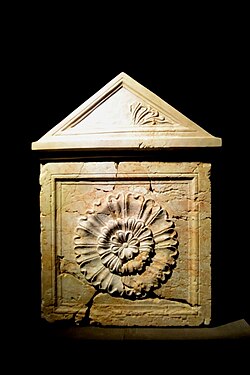
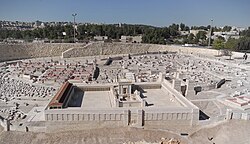
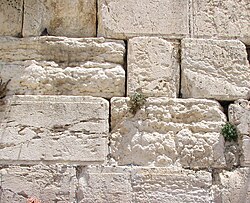
Herod is perhaps best remembered for his massive building programs. His most ambitious project was the expansion of the Second Temple in Jerusalem, beginning around 20–19 BCE. To ensure the project adhered to religious law, he employed 1,000 priests as masons and carpenters.
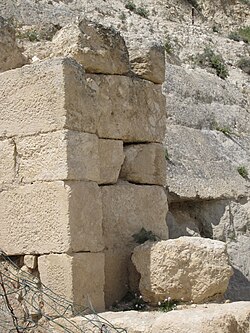
The expansion created a massive flat platform known as the Temple Mount. While the temple itself was destroyed in 70 CE, the retaining walls—including the famous Western Wall—still stand today as a testament to Herodian masonry.
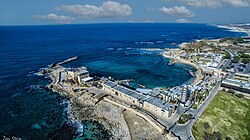
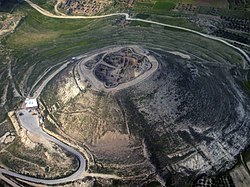
Beyond Jerusalem, Herod's influence extended to the coast and the desert. He constructed a magnificent harbor at Caesarea and built the Herodium, a fortress-palace that likely served as his final resting place.
Key Facts
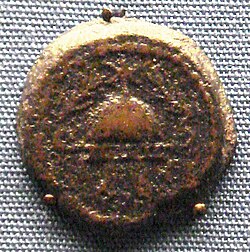
- Reign: Approximately 37/36 BCE to 4/1 BCE.
- Dynasty: Founded the Herodian dynasty, replacing the Hasmoneans.
- Major Works: Rebuilt the Second Temple and constructed the city of Caesarea and the Herodium fortress.
- Political Status: Served as a client king (vassal) to the Roman Empire under Mark Antony and Augustus.
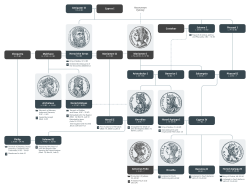
- Family: Had multiple wives, including Doris, Mariamne I, Mariamne II, Malthace, and Cleopatra of Jerusalem.
Chronology and Death
The exact date of Herod's death is a subject of scholarly debate. Most 20th-century historians, following Emil Schürer, place his death in 4 BCE. This is based on the reported reign lengths of his sons, Archelaus and Philip. However, other scholars, such as Steinmann and Young, argue for a date of 1 BCE, citing Sabbatical year records and lunar eclipse data mentioned by Josephus.
| Category | Details |
|---|---|
| Born | c. 72 BCE, Idumea |
| Died | 4 BCE or 1 BCE |
| Title | King of Judaea / Basileus |
| Preceding Dynasty | Hasmonean |
| Successors | Archelaus, Herod Antipas, Philip the Tetrarch |
| Primary Burial Site | Herodium (most likely) |
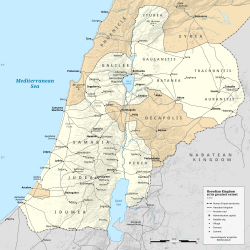
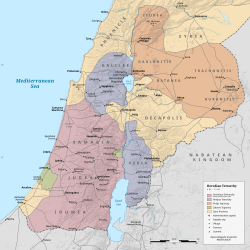
Following his death, the kingdom was divided among his sons: Archelaus became ethnarch of Judea, Samaria, and Idumea; Herod Antipas ruled Galilee and Perea; and Philip the Tetrarch governed territories including Batanea and Trachonitis.
Frequently Asked Questions
When did Herod the Great die?
There are two primary scholarly views: the traditional chronology places his death in 4 BCE, while more recent arguments suggest 1 BCE based on agricultural and astronomical records.
What was Herod's relationship with Rome?
Herod was a vassal king. He owed his throne to the Roman Senate and maintained his power by remaining loyal to Roman leaders, first Mark Antony and later Augustus.
What are the most significant buildings Herod constructed?
His most famous achievement was the massive expansion of the Second Temple in Jerusalem. He also built the port city of Caesarea and the Herodium fortress.
Who succeeded Herod the Great?
His kingdom was split between his sons: Archelaus, Herod Antipas, and Philip the Tetrarch, as decreed by Augustus.
Was Herod the Great Jewish?
Herod was born in Idumea to Antipater the Idumaean and Cypros. He practiced Second Temple Judaism and sought to legitimize his rule by marrying into the Hasmonean line.