Heraldic Supporters: The Figures That Guard the Shield
In the intricate world of heraldry, a coat of arms is more than just a shield. To create a full heraldic achievement—the complete display of all granted armorial bearings—various elements are added to provide context, status, and decoration. Among the most striking of these are supporters (also known as attendants): the figures or objects placed on either side of the shield, depicted as if they are holding it up.
While they may appear to be simple decorations, supporters carry a wide range of meanings, from royal favor and national identity to personal whimsy and historical legacy.
Key Facts
- Definition: Figures or objects that flank and support the central heraldic shield.
- Composition: Can be real or imaginary animals, humans, plants, or inanimate objects.
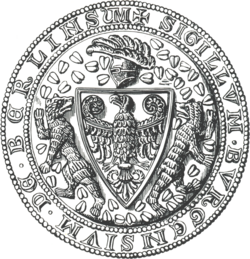
- Evolution: Became fashionable in the late 15th century, though early examples appear in medieval seals.
- Quantity: Usually two, but can range from a single supporter to as many as four (as seen in Iceland).
- Entitlement: In some countries, such as the UK, they are restricted to specific ranks or royal grants.
The Evolution and Nature of Supporters
Supporters were not part of early medieval heraldry, unlike the helmet or crest. They first gained popularity toward the end of the 15th century. Some historians suggest they originated from tournaments, where servants or pages dressed in fanciful costumes guarded the combatants' shields. However, evidence from 13th and 14th-century Scottish seals shows shields flanked by lizard-like creatures, suggesting an earlier development.
Types of Figures
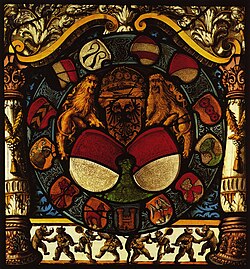
The variety of figures used as supporters is vast. Common choices include:
- Animals: Lions, unicorns, tigers, and even badgers. By default, animal supporters are depicted as rampant (standing on one hind leg with forepaws raised), unless the blazon (the formal written description of the arms) specifies otherwise.
- Humans: These can be specific named individuals, allegorical figures (such as Liberty or Justice), or professional representatives, like the fisherman and tin miner used by Cornwall County Council.
- Objects and Plants: Examples include the Pillars of Hercules for Spain, wheat sheaves (garbs) for nutritionist John Boyd-Orr, or missiles for the USS Donald Cook.
- Letters: The city of Valencia uses the letter 'L' to signify it is "doubly loyal."
Placement and Quantity
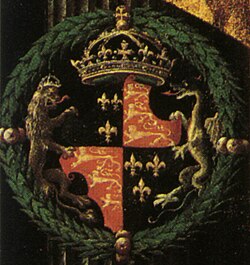
While the standard arrangement features one supporter on each side, variations exist. Some arms feature a single supporter placed behind the shield, such as the imperial eagle of the Holy Roman Empire or the eagle of Austria. In rare cases, the number of supporters increases; the Scottish chief Dundas of that Ilk used three, and the national arms of Iceland feature four, each representing a protector of a different intercardinal direction.
Regional Rules and Entitlements
The rules governing who may use supporters vary significantly by country. In some regions, they are a matter of personal choice, while in others, they are a strictly controlled honor.
United Kingdom
In the UK, supporters are typically a sign of special royal favor. Hereditary supporters are generally limited to hereditary peers, certain members of the Royal Family, and some Scottish clan chiefs. Non-hereditary supporters are granted to life peers, specific orders of chivalry (such as the Order of the Garter and the Order of the Thistle), and corporations with a royal charter.
Canada, Australia, and New Zealand
In these Commonwealth nations, supporters are often linked to high honors. In Canada, they are granted to Companions of the Order of Canada and certain high-ranking officials. In Australia, Knights or Dames of the Order of Australia may be granted them, though some armigers adopt them by personal choice. In New Zealand, they are granted to Principal Companions and Knights Grand Companion of the New Zealand Order of Merit.
France and Spain
These countries use specific terminology to categorize supporters. France distinguishes between Supports (animals), Tenants (humans or angels), and Soutiens (objects or trees). Spain similarly differentiates between soportes (beasts), tenantes (humans), and sosténes (other objects). In Spain, the use of supporters is often viewed as a matter of "capriciousness or fantasy," with the primary restriction being that female and ecclesiastical arms generally should not have them, unless they are angels.
Summary of Heraldic Supporters by Region
| Region | Primary Entitlement/Rule | Special Terminology |
|---|---|---|
| United Kingdom | Royal favor; limited to peers and specific orders | Supporters |
| France | Varies by figure type | Supports, Tenants, Soutiens |
| Spain | Generally unrestricted (except female/ecclesiastical) | Soportes, Tenantes, Sosténes |
| Canada | Granted to high orders and corporations | Supporters |
| Iceland | National arms feature four protectors | Supporters |
Frequently Asked Questions
What is the standard pose for animal supporters?
By default, animal supporters are depicted as close to rampant as possible, meaning they stand on their hind legs. This is assumed unless the blazon specifically describes a different posture, such as the "falling" whales found in the arms of Zaanstad.
Can inanimate objects be used as supporters?
Yes. While animals and humans are most common, inanimate objects are used in various arms, such as the Pillars of Hercules in the Spanish coat of arms or missiles in the arms of the USS Donald Cook.
Who is allowed to have supporters in the United Kingdom?
Supporters are typically granted by the sovereign. They are available to hereditary peers, certain Royal Family members, some Scottish clan chiefs, life peers, and members of high orders of chivalry like the Order of the Garter.
How many supporters can a coat of arms have?
Most have two, but it can vary. Some have a single supporter (like the eagle of Russia), while others have more. Iceland is a unique example of a nation with four supporters.
What is the difference between a tenant and a supporter in French heraldry?
In French heraldic tradition, the term "Support" is reserved for animals, while "Tenant" (meaning holder) is used specifically for human figures or angels.