Henri Poincaré: The Last Universalist of Mathematics and Physics
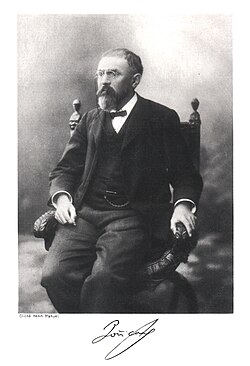
In the history of science, few figures possess the breadth of intellect associated with Henri Poincaré. Often described by mathematician E.T. Bell as "The Last Universalist," Poincaré was a French polymath whose contributions spanned nearly every major field of mathematics and theoretical physics. From the birth of topology to the early foundations of relativity and chaos theory, his work provided the scaffolding for much of 20th-century science.
Born in Nancy, France, Poincaré's journey took him through the prestigious École Polytechnique and École des Mines, eventually leading to a doctorate from the University of Paris in 1879. His intellectual curiosity was matched by a legendary memory, which contemporaries noted was even superior to that of Leonhard Euler.
Key Facts
- Primary Fields: Mathematics, Physics, and Philosophy.
- Major Invention: Virtually invented the field of algebraic topology.
- Key Concepts: Coined the term "Betti number" and developed the Poincaré conjecture.
- Physics Contributions: Early work on special relativity, gravitational waves, and dark matter.
- Legacy: Founded the qualitative theory of differential equations and laid the groundwork for chaos theory.
- Major Awards: RAS Gold Medal (1900), Sylvester Medal (1901), and the Bruce Medal (1911).
Foundations in Mathematics and Topology
Poincaré is perhaps most famous for his pioneering work in topology—the study of geometric properties and spatial relations that remain unaffected by the continuous change of shape or size. He introduced the fundamental group and developed the Poincaré duality, tools that remain essential for understanding the shape of manifolds.
One of his most enduring legacies is the Poincaré conjecture, a profound problem regarding the characterization of the 3-sphere. His work in this area transitioned mathematics from a focus on rigid measurements to a more fluid, qualitative understanding of space.

Algebra and Number Theory
Beyond topology, Poincaré made significant strides in algebraic geometry and number theory. He worked extensively with Fuchsian groups and automorphic forms, contributing to the theory of analytic functions of several complex variables and Diophantine equations.
Contributions to Physics and Astronomy
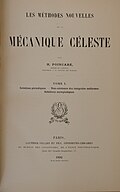
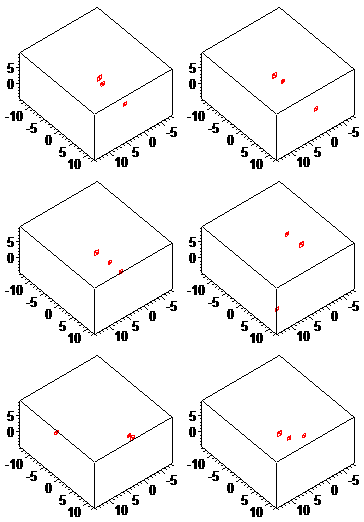
Poincaré's influence on physics was as profound as his mathematical work. He was deeply involved in the study of celestial mechanics, specifically the three-body problem. While attempting to solve the motion of three celestial bodies, he discovered that small changes in initial conditions could lead to vastly different outcomes—a discovery that served as the cornerstone for modern chaos theory.
Relativity and the Nature of Space
Poincaré played a critical role in the development of special relativity. He worked on the principle of relativity and Lorentz transformations, and he explored the mass-energy relation. His insights into the synchronization of clocks (local time) and his early mentions of gravitational waves place him alongside Albert Einstein as a primary architect of modern physics.
Philosophy and Epistemology
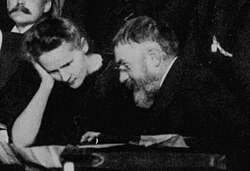
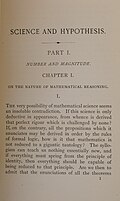
Poincaré was not merely a calculator but a philosopher of science. He championed conventionalism—the idea that the laws of science are not absolute truths but useful conventions. In his work Science and Hypothesis, he explored the nature of scientific discovery and the role of intuition in mathematical creation.
Summary of Scientific Contributions
| Field | Key Contribution / Theorem | Impact |
|---|---|---|
| Topology | Poincaré Conjecture / Fundamental Group | Founded algebraic topology |
| Dynamics | Three-body problem / Recurrence Theorem | Birth of Chaos Theory |
| Physics | Lorentz Transformations / Gravitational Waves | Foundations of Special Relativity |
| Analysis | Poincaré–Bendixson Theorem | Qualitative theory of differential equations |
| Philosophy | Conventionalism | Shifted views on scientific laws |
Legacy and Honors
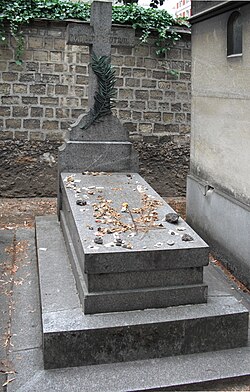
Poincaré passed away on July 17, 1912, at the age of 58. His influence persists through numerous institutions and awards, including the Institut Henri Poincaré in Paris and the Poincaré Prize. His name is immortalized not only in textbooks but also in the stars, with a lunar crater and an asteroid named in his honor.
Frequently Asked Questions
What is the Poincaré conjecture?
The Poincaré conjecture is a famous problem in topology regarding the characterization of the 3-sphere. It posits that every simply connected, closed 3-manifold is homeomorphic to the 3-sphere.
How did Poincaré contribute to chaos theory?
While studying the three-body problem in celestial mechanics, Poincaré discovered that certain dynamical systems are highly sensitive to initial conditions, meaning small differences can lead to wildly different results. This is the fundamental principle of chaos theory.
What was Poincaré's role in the theory of relativity?
Poincaré contributed significantly to the mathematical framework of special relativity, specifically regarding the principle of relativity and the Lorentz transformations, often working in parallel with Albert Einstein.
What is the Poincaré recurrence theorem?
The Poincaré recurrence theorem states that certain systems will, after a sufficiently long but finite time, return to a state very close to their initial configuration.
What is conventionalism in Poincaré's philosophy?
Conventionalism is the philosophical view that the fundamental laws of science and mathematics are not empirical facts or a priori truths, but rather convenient conventions chosen for their utility.